

You've just landed at Heathrow after a long flight. Your trolley is awkward, your bags are heavier than expected, and the signs seem to point in several directions at once. You still need to clear passport control, find the right baggage carousel, locate your onward transport, and perhaps reach a cruise port before check-in closes.
That's the situation an airport meet and greet service is designed to simplify. A driver tracks your flight, waits at an agreed terminal meeting point, helps with the luggage handoff, and takes you to a pre-booked vehicle. The important distinction is that a commercial meet and greet is private transport, while Heathrow's free special-assistance service is a separate accessibility pathway with its own booking process and responsibilities.
Table of Contents
- Landing at Heathrow and Meeting Your Ride
- What Meet and Greet at the Airport Really Means
- How Meet and Greets Compare to Other Airport Options
- Connecting from Heathrow to a UK Cruise Port
- How Meet and Greets Are Priced and What Affects the Quote
- Booking a Heathrow Meet and Greet Step by Step
- Common Misconceptions About Airport Meet and Greet
- Choosing the Right Service for Your Trip
Landing at Heathrow and Meeting Your Ride
The aircraft touches down, but your journey isn't finished. You follow the signs from the gate, join the queue for passport control, and try to keep track of family members, cabin bags, and the instructions your cruise line sent before departure. If you're travelling through Terminal 2 or Terminal 5, the terminal layout can feel especially large when you're tired and unfamiliar with Heathrow.
After immigration, you reach baggage reclaim. One suitcase appears, then another. A trolley gives you somewhere to stack everything, but it doesn't answer the next question: where exactly is the person collecting you?
Without a pre-arranged service, you might follow signs towards the taxi rank, search for a minicab pickup point, or message a relative who's waiting somewhere outside. A driver using an airport meet and greet service changes that first decision. Instead of searching for a vehicle, you leave the arrivals area and look for the agreed meeting point, usually with the driver holding a name board or following the provider's terminal instructions.
Practical rule: The booking confirmation should tell you the terminal, meeting location, passenger name on the board, and support contact before you board the aircraft.
The driver won't normally wait in an unrestricted kerbside lane. Heathrow uses designated areas for stopping, collecting, and meeting passengers, so the exact instructions matter. A service page that says “driver waits at arrivals” hasn't given you enough information.
If you want to understand the baggage stage in more detail, keep the airport's Heathrow baggage claim process in mind when planning your arrival. Your driver may monitor the flight, but you'll still need to clear formalities and collect your own bags unless a separate assistance or porter arrangement has been agreed.
What Meet and Greet at the Airport Really Means
Meet and greet airport service means a commercial provider organises the arrival handoff from terminal to vehicle. The process normally follows a clear sequence.
- Flight monitoring: You provide the flight number and arrival date. The provider uses that information to follow schedule changes and adjust the driver's dispatch time under its waiting policy.
- Terminal meeting: The driver goes to the agreed arrivals meeting point. The driver may hold a name board, or the confirmation may direct you to a specific desk, column, or greeting area.
- Luggage assistance: After you identify one another, the driver helps move bags towards the vehicle and loads them according to the vehicle's capacity. This is practical transport assistance, not automatically a full porter service.
- Destination transfer: You travel directly to the hotel, home, cruise terminal, railway station, or other address included in the booking.
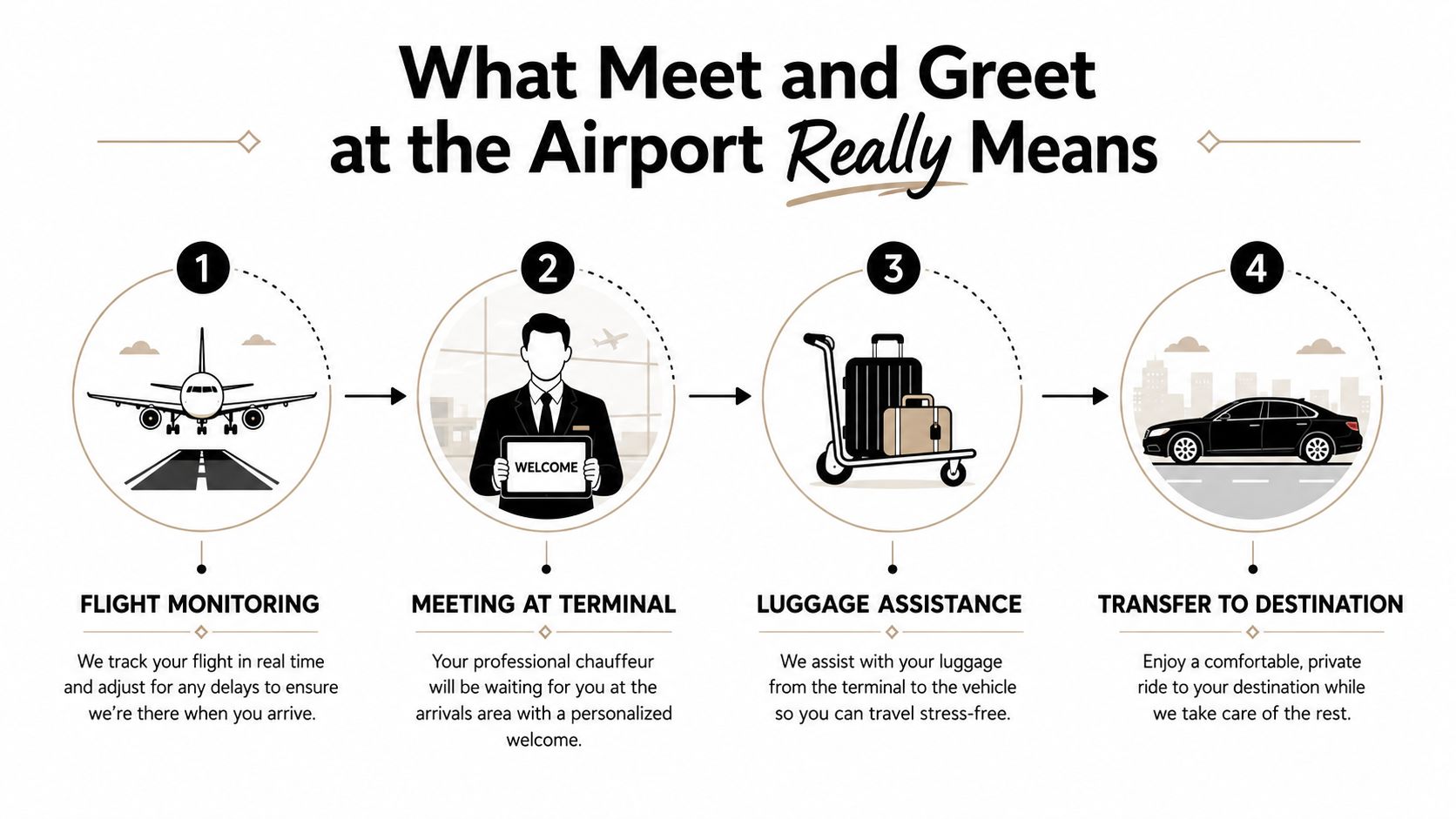
Who does what at the terminal
A family member meeting you may carry a sign and help with bags, but they'll usually need to arrange their own parking or use the airport's permitted meeting areas. A private driver has a transport booking, a vehicle allocation, and instructions for the onward address.
Heathrow's free special-assistance pathway is different. Heathrow says passengers who need accessibility support should request it through their airline at least 48 hours before travel, and its assistance team can help from disembarkation through passport control, baggage collection, and the arrivals hall. You can read the airport's official assistance and accessibility guidance before deciding which part of your journey needs support.
Commercial drivers generally meet the passenger after the airport's formal arrival processes, unless the provider has explicitly arranged a different service. They don't replace airline or airport assistance, and they don't automatically provide mobility support inside the aircraft or through immigration.
The boundary is simple. Airport assistance helps eligible passengers move through the airport. Meet and greet transport gets a booked passenger from an agreed terminal point to a vehicle and onward destination. Some travellers need one service, while others may need both, with a clear handoff between them.
How Meet and Greets Compare to Other Airport Options
The right choice depends on what you need help with. A private driver, Heathrow assistance, a friend, and a taxi can all collect someone, but they don't offer the same responsibilities.
| Option | Cost | Flight Tracking | Luggage Help | Booking Method |
|---|---|---|---|---|
| Private meet and greet | Pre-booked fare, normally quoted for the vehicle and journey | Usually included under the provider's policy | Driver assistance with loading is commonly included | Online booking with flight and destination details |
| Heathrow special assistance | Free airport service for passengers who need accessibility support | Coordinated through the airline and airport process | Assistance can cover airport stages, including baggage collection | Request through the airline, ideally at least 48 hours before travel |
| Friend or family meeter | Parking or access costs may apply | Usually depends on personal communication | Informal help from the person collecting you | Personal arrangement |
| Black cab or minicab | Black cabs use a meter, while minicab pricing depends on the operator | Not necessarily linked to your flight | Luggage help varies by driver | Taxi rank, phone booking, or app, depending on the service |
A private meet and greet airport booking suits travellers who want a named driver, a planned meeting point, and a direct transfer without relying on a taxi queue. It's also useful for passengers who've got a cruise port, hotel, or rail station as the next fixed destination.
Heathrow special assistance is the better route when the passenger needs help moving through the airport because of a disability or reduced mobility. It isn't a general chauffeur upgrade, and you shouldn't book it as a substitute for onward transport.
Free meeters face their own restrictions. They may need to use a designated area rather than walk through the terminal to collect you, and they'll still have to manage parking, terminal access, and the drive to your destination.
For a broader explanation of arranging a pre-booked airport transfer service, check the vehicle, waiting, and destination details rather than comparing only the headline fare.
Connecting from Heathrow to a UK Cruise Port
A Heathrow to cruise port transfer starts before you see the driver. Once your plane lands, you'll need to clear immigration if you've arrived internationally, collect every bag, and follow the signs to the correct arrivals hall. The driver's job begins with the agreed pickup process, but the clock is still shaped by your flight, the terminal, baggage delivery, and the cruise line's check-in instructions.
For a Southampton sailing, you may leave from Terminal 2, Terminal 3, Terminal 4, or Terminal 5 and then join the road network towards the south coast. Dover, Portsmouth, and Tilbury require different routes, so the destination must be written accurately in the booking. Southampton also has more than one cruise terminal area, making the berth or terminal name important for the final drop-off.
A useful working sequence looks like this:
- Collect everything first: Don't leave the arrivals hall until you've checked passports, medication, cabin bags, and cruise documents.
- Contact the driver as instructed: Some providers ask you to proceed to a named meeting point once baggage is collected.
- Load before setting off: Families and groups should allow time for cases, prams, mobility equipment, and hand luggage to fit safely.
- Confirm the terminal: Give the driver the cruise line, ship name, and terminal instructions if they're available.
The approximate driving windows supplied for these routes are one hour and 45 minutes to two hours and 15 minutes for Southampton, around two hours for Dover, one hour and 30 minutes to one hour and 45 minutes for Portsmouth, and one hour and 15 minutes to one hour and 30 minutes for Tilbury. These are planning windows, not guarantees, so you should add time for motorway disruption, baggage loading, and the cruise line's embarkation requirements.
| Cruise Port | Approx. Driving Time | Distance | Recommended Buffer |
|---|---|---|---|
| Southampton | 1 hour 45 minutes to 2 hours 15 minutes | Route and terminal dependent | Allow time for airport formalities, loading, and traffic |
| Dover | Around 2 hours | Route and terminal dependent | Allow extra time for motorway and port access delays |
| Portsmouth | 1 hour 30 minutes to 1 hour 45 minutes | Route and terminal dependent | Allow time for luggage and terminal navigation |
| Tilbury | 1 hour 15 minutes to 1 hour 30 minutes | Route and terminal dependent | Allow time for London-area traffic and port entry |
A pre-booked driver handles the vehicle allocation, luggage loading, and direct kerbside drop. A taxi queue can still get you there, but it may not give you the same fixed destination planning or cruise-specific communication. For more detail, see this guide to an airport-to-cruise-port transfer.
How Meet and Greets Are Priced and What Affects the Quote
A meet and greet quote reflects the work needed to deliver the journey, not just the distance between two postcodes. Providers usually build the fare around the vehicle class, airport access, waiting arrangements, passenger requirements, and final destination.
The vehicle needs to match both people and luggage. A saloon may suit a solo traveller with limited bags, while an MPV, executive vehicle, or minibus may be more appropriate for a family or group travelling to a cruise port. Choosing by passenger count alone can leave you without enough boot space.
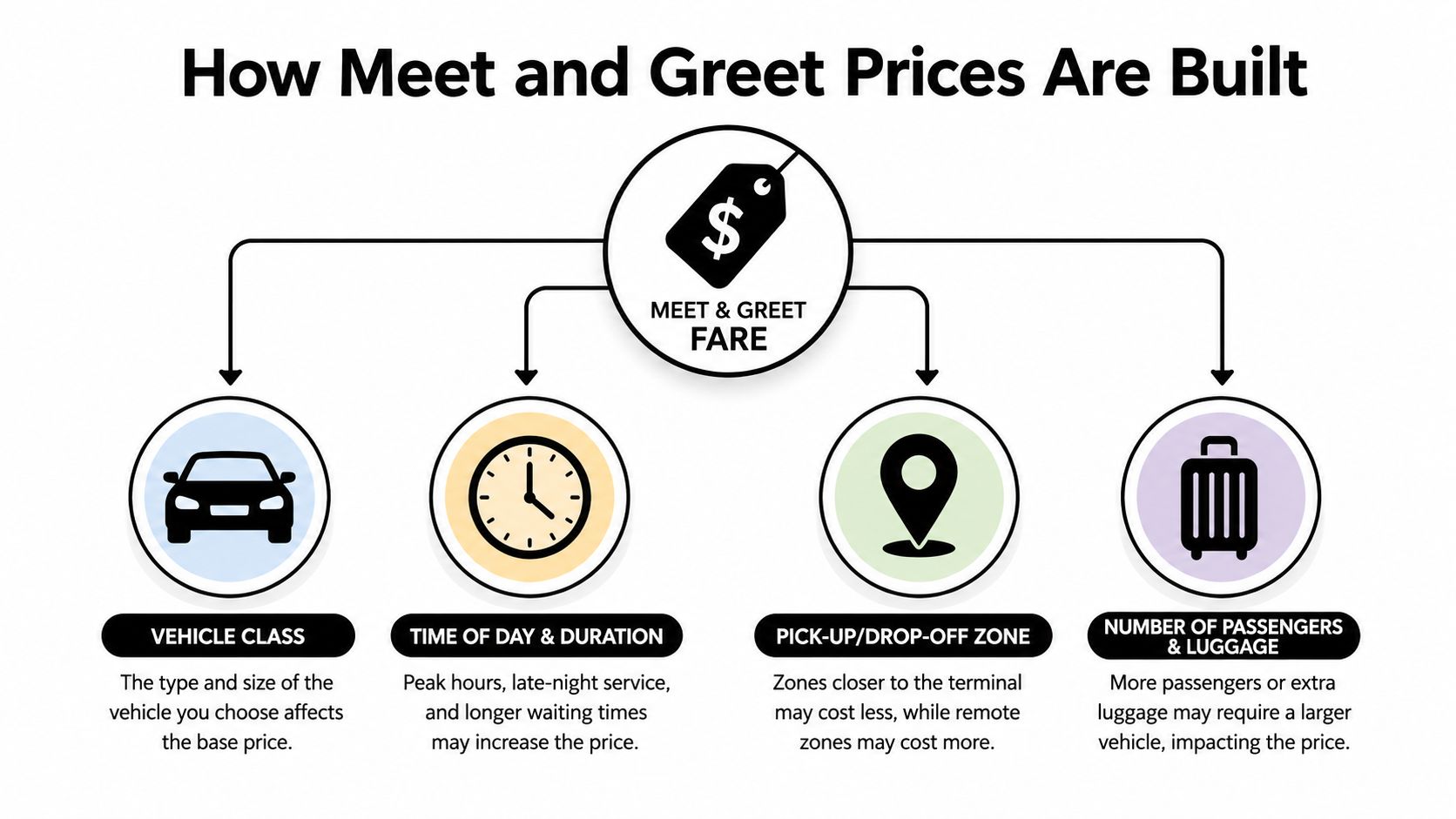
The operational parts of a fare
- Vehicle and luggage capacity: The model and size affect comfort, storage, and the number of cases that can be loaded safely.
- Flight monitoring and waiting: The provider may track your flight and include a stated waiting period. Read what happens after that period expires.
- Heathrow access and parking: Terminal collection can involve parking or access charges, depending on the meeting arrangement.
- Passenger requirements: Child seats, mobility equipment, oversized cases, or additional stops may change the quote.
- Drop-off geography: A cruise booking needs the correct port, ship, terminal, and sometimes berth information. “Southampton” alone may not be enough.
A metered black cab can change in price as traffic extends the journey. App-based services can also vary with availability and demand. A fixed quote offers a clearer total, provided the provider explains its cancellation rules, waiting limit, airport charges, and any extras.
Before paying: Compare written quotes on the same basis. Check whether flight delays within the stated policy are covered, whether parking is included, and whether child seats or excess luggage carry separate charges.
Booking a Heathrow Meet and Greet Step by Step
A professional booking should feel like an operations form, not a vague request for “a car from Heathrow”. Using EC Minibus as an example, the process should capture enough information for the provider to plan the handoff and onward journey.
Start with the journey details
Enter the flight number, arrival date, Heathrow terminal if known, passenger count, luggage details, and destination. If you're travelling to a cruise, add the port, cruise line, ship, and terminal information. The provider can't plan the final drop-off properly if the destination is incomplete.
Choose the vehicle after considering bags, not just seats. A group with several large cases may need more space than the passenger total suggests.
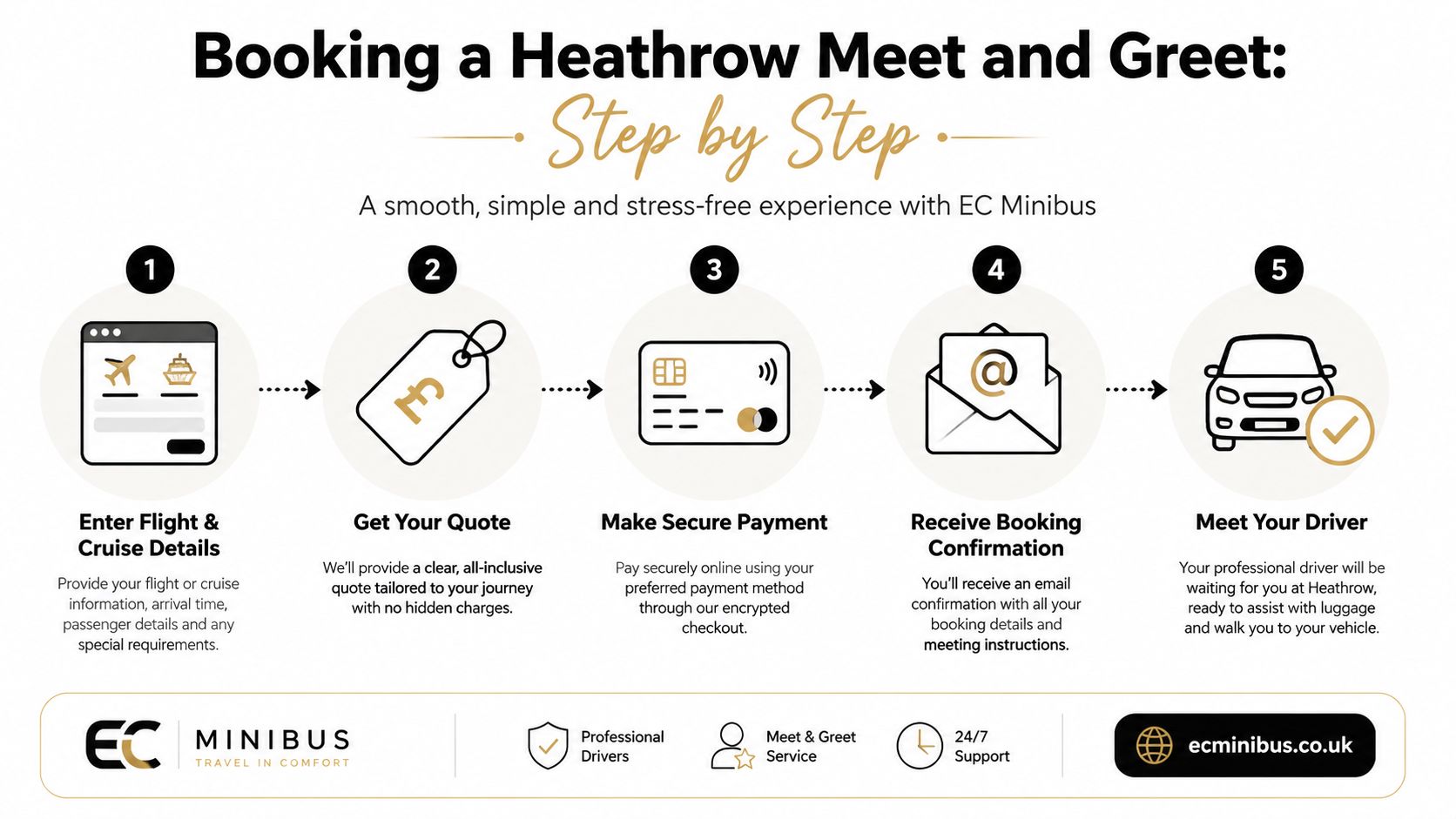
Add requirements before confirmation
Record child-seat needs, mobility considerations, extra waiting preferences, oversized luggage, and any special drop-off instruction during the booking. It's easier to solve these details before dispatch than at the arrivals door.
Ask for a fixed written quote and read the terms. Verify the cancellation window, delay tolerance, meeting point, support number, and the provider's licensing and insurance position for UK private hire work. The confirmation should identify the passenger, flight, destination, vehicle, and payment status.
After confirmation, the provider monitors the flight under its stated process and dispatches the driver. At arrivals, the driver meets you at the agreed point with the identification described in the booking, then helps with the luggage and takes you to the vehicle.
The video below gives a visual introduction to the booking flow.
Common Misconceptions About Airport Meet and Greet
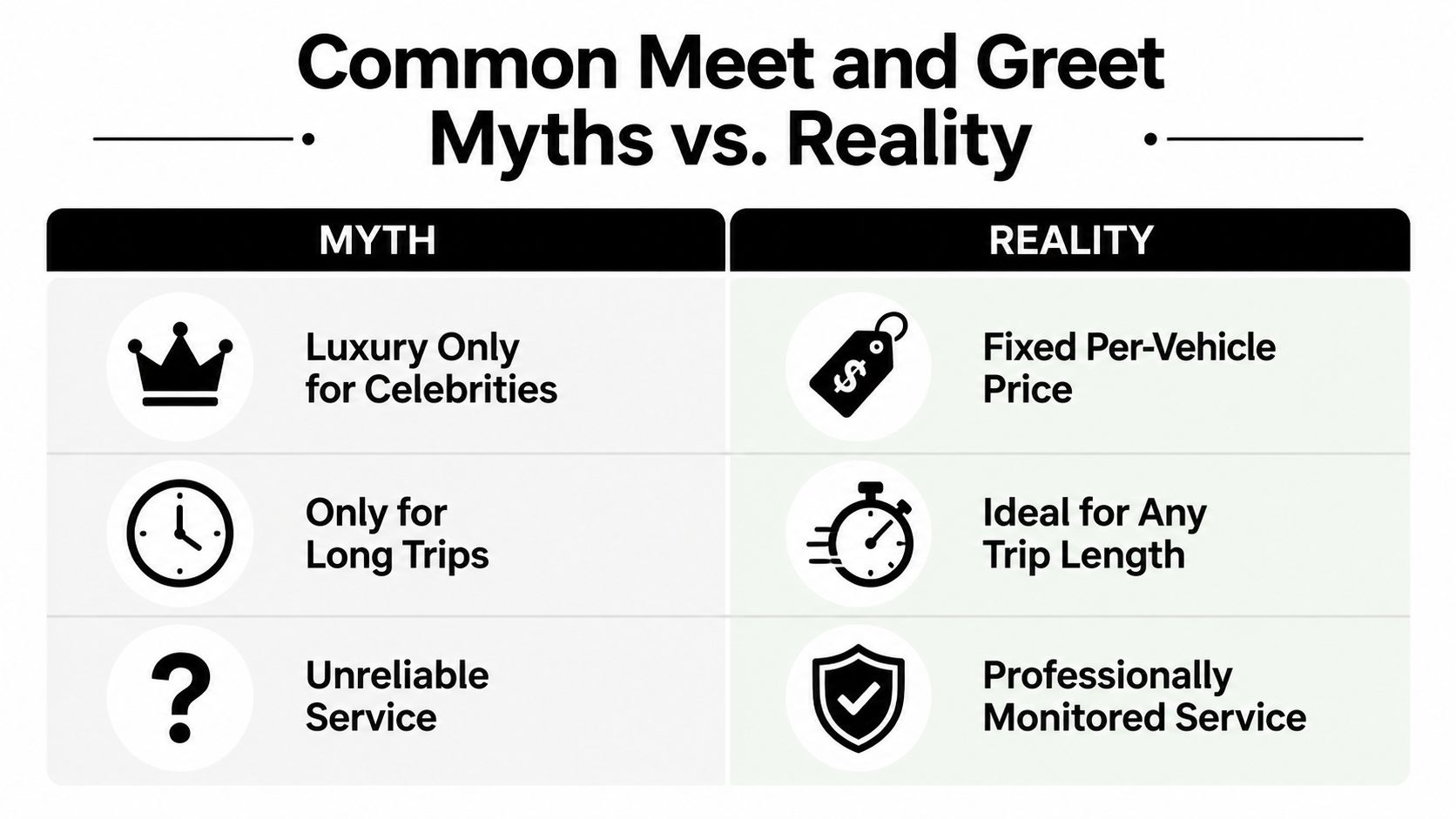
Myth one, it's only for celebrities
A private arrival service can sound like a luxury product, but the practical question is what the total journey requires. Families and small groups may compare one pre-booked vehicle with several separate fares, airport parking, or the effort of arranging a collection. The useful comparison is not “chauffeur versus cheap taxi”. It's planned door-to-door transport versus every cost and task involved in an unplanned pickup.
Ask whether the quote covers the vehicle, airport meeting arrangement, flight monitoring, luggage loading, and the destination you need.
Myth two, every provider works the same way
Operators differ in the details passengers only notice when something goes wrong. One may monitor flights closely, while another may rely on the scheduled landing time. One may have a clear backup process, while another may provide only a generic telephone number.
Check the provider's:
- Driver credentials: Confirm that the driver and operator meet the relevant UK private hire requirements.
- Vehicle information: Ask whether the vehicle suits your passenger and luggage combination.
- Delay policy: Read how early arrivals, delays, and diversions are handled.
- Meeting instructions: Look for a terminal-specific point rather than “arrivals”.
- Support process: Confirm what number to call if you can't see the driver.
Myth three, it's the same as Heathrow special assistance
It isn't. Heathrow's free assistance service exists to support passengers with accessibility needs through airport stages such as disembarkation, passport control, baggage collection, and the arrivals hall. A commercial meet and greet provider focuses on the booked transport handoff and onward journey.
Heathrow's service standards show how formal that assistance pathway is. The Civil Aviation Authority reported that at least 98% of arriving pre-notified disabled and less mobile passengers were assisted within 20 minutes from on-chocks in 2022 in its airport accessibility report. That service shouldn't be confused with a driver waiting at an arrivals meeting point.
Choosing the Right Service for Your Trip
A solo business traveller with a hotel near central London may prioritise a quick, clearly defined handoff. A family heading to Southampton may need a larger vehicle, child seats, room for cases, and a driver who understands that the destination is a cruise terminal rather than a general town address.
An overseas visitor may value something less glamorous but more practical: a clear name board, a known meeting point, and a direct transfer without needing to interpret UK motorway signs or negotiate a taxi journey after a long flight.
Use this checklist before confirming:
- Written fare: Make sure the total explains waiting, parking, and destination charges.
- Flight details: Confirm the correct flight number and arrival date are attached to the booking.
- Vehicle capacity: Match the vehicle to passengers, cases, buggies, and mobility equipment.
- Child-seat provision: Check that the required seat is available and recorded.
- Driver credentials: Confirm the operator's UK licensing and insurance arrangements.
- Cancellation terms: Read the deadline and the policy for delays, changes, or diversions.
- Meeting instructions: Save the terminal, arrivals point, name-board details, and support number.
Demand for airport assistance has become a substantial part of UK airport operations. The Civil Aviation Authority recorded 5.5 million assistance requests at UK airports in 2024, approximately 1.9% of passengers, compared with 1.35% in 2019 and 0.94% in 2010, as reported in its latest accessibility data. That makes accurate handoffs more important, particularly for older travellers, disabled passengers, families, and cruise passengers with fixed embarkation times.
Share your complete itinerary with the provider before payment. Include the Heathrow terminal, flight, baggage needs, cruise port, ship or terminal details, and any assistance already arranged through the airline. That preparation lets you choose a service based on the actual journey, not just the phrase “meet and greet”.
EC Minibus provides Heathrow meet and greet pickups, flight and cruise monitoring, luggage assistance, and fixed-price transfers to Southampton, Dover, Portsmouth, Tilbury, London hotels, and rail connections. Visit EC Minibus with your flight and onward travel details to request a planned airport-to-destination transfer.