

You've just landed at Heathrow, your bags are on the trolley, and the ship leaves Portsmouth later today. Now you need a straight answer, not brochure fluff, should you drive, book a private minibus, or trust the train with cruise luggage and a tight check-in window?
For Portsmouth Cruise Terminal, the right answer depends on how much friction you're willing to tolerate. If you want a defensible plan for door-to-door timing, parking, transfer costs, and embarkation-day flow, read this as a transfer planner's view, not a port marketing pitch.
Table of Contents
- Planning Your Trip to Portsmouth Cruise Terminal
- Where Portsmouth Cruise Terminal Sits in the UK Cruise Market
- Inside the Terminal and What to Expect on Embarkation Day
- Getting to Portsmouth Cruise Terminal from London and Heathrow
- Parking, Drop-Off, and Whether a Private Transfer Wins
- Accessibility, Nearby Hotels, and Timing for International Arrivals
- Booking a Transfer and Final Pre-Cruise Checklist
Planning Your Trip to Portsmouth Cruise Terminal
Start with the practical question. If your flight lands at Heathrow or Gatwick, you've got luggage, and the ship is closing check-in in a few hours, you're really choosing between motorway stress, railway compromise, or paying a driver to remove the uncertainty.
Portsmouth works well for organised travellers because the terminal is compact and easy to get around once you're there. The weak point is the approach, especially if you're arriving from London with bags, children, mobility needs, or a long-haul flight behind you.
What you need to decide first
The decision usually comes down to three things.
- Timing, because a delay on the road or at a station hits cruise passengers harder than hotel guests.
- Luggage handling, because cruise gear is heavier and less forgiving than a normal city break case.
- Tolerance for hassle, because parking, station changes, and curbside drop-offs all feel very different once you're tired.
If you're weighing port logistics across the UK, the broader cruise-port picture is useful too, and this guide from EC Minibus's UK cruise port overview helps compare the main departure points without turning your planning into guesswork.
The rule I'd use
If you're flying into London and cruising out of Portsmouth, book the transfer first, then build the rest of your day around it. That's the cleanest way to avoid a late check-in scramble, especially if your arrival time is already tight.
Practical rule: Treat Portsmouth as a transfer-first port, not a place to “figure out on the day”. Once the flight lands, every extra change adds risk.
You'll also want to think about whether you're arriving for a Brittany Ferries sailing or a turnaround cruise. The terminal handles both well, but the pressure points are different, and that changes how early you should turn up, how much luggage you should keep with you, and whether parking is worth the bother.
By the end of this guide, you should know exactly how to get from airport or city hotel to ship with a plan you can defend.
Where Portsmouth Cruise Terminal Sits in the UK Cruise Market
Portsmouth isn't a giant cruise factory, and that's exactly why people misjudge it. It sits in a different category from the busiest UK ports, with a more compact passenger flow and a stronger mix of ferry and boutique cruise movements than the mass-market rhythm many travellers assume.
The scale is real, though. BBC reporting on the port's 50-year history says Portsmouth International Port has grown from two berths in 1976 into a multi-use port handling around 1.6 million passengers a year, including 131,000 cruise passengers. That same reporting says the port is expected to host more than 70 cruise ships in 2026, with six first-time visitors, and that each cruise call can generate up to £1.5 million for the local economy. For context, the port also handles £7.5 billion worth of cargo annually and moves 2.9 million tonnes per year. BBC reporting on Portsmouth International Port's 50-year history
That matters because Portsmouth is busy enough to justify proper transfer planning, but still small enough that the passenger experience feels unlike Southampton. The terminal is geared to a more boutique cruise and ferry pattern, with movements that don't resemble the constant megaship churn at larger ports.
What that means for travellers
At Portsmouth, you're dealing with a port where cruise is important, but not the only thing happening. That affects queue behaviour, coach handling, and the way private transfers fit into the day. You won't get the same sprawling terminal footprint or the same scale of outbound crowds as a larger UK cruise hub.
| Metric | Portsmouth | Southampton |
|---|---|---|
| Cruise identity | Boutique, mixed-use, and ferry-linked | Larger mass-cruise hub |
| Passenger flow | More compact and less sprawling | Higher-volume and more complex |
| Transfer feel | Better suited to planned drop-off | More frequent but often busier |
The port's own 2024 stats show total passengers, including cruise, at 2,059,294 in 2024, up from 2,018,157 the prior year and 1,851,790 in an earlier year in the same series, which confirms that throughput is rising rather than flattening. The same stats book records cruise ship calls growing from 50 in 2019 to 83 in 2023, then 90 in 2024, with 94 cruise ship berthings booked for 2025. Portsmouth Port statistics book 2024
My view: Portsmouth is large enough to demand a proper transfer plan, but small enough that a smooth private arrival still feels noticeably easier than wrestling with rail connections or airport parking.
Inside the Terminal and What to Expect on Embarkation Day
The terminal experience at Portsmouth is straightforward if you arrive on time and keep your bags under control. It's also unforgiving if you arrive late, because the building is compact and the public space is limited.
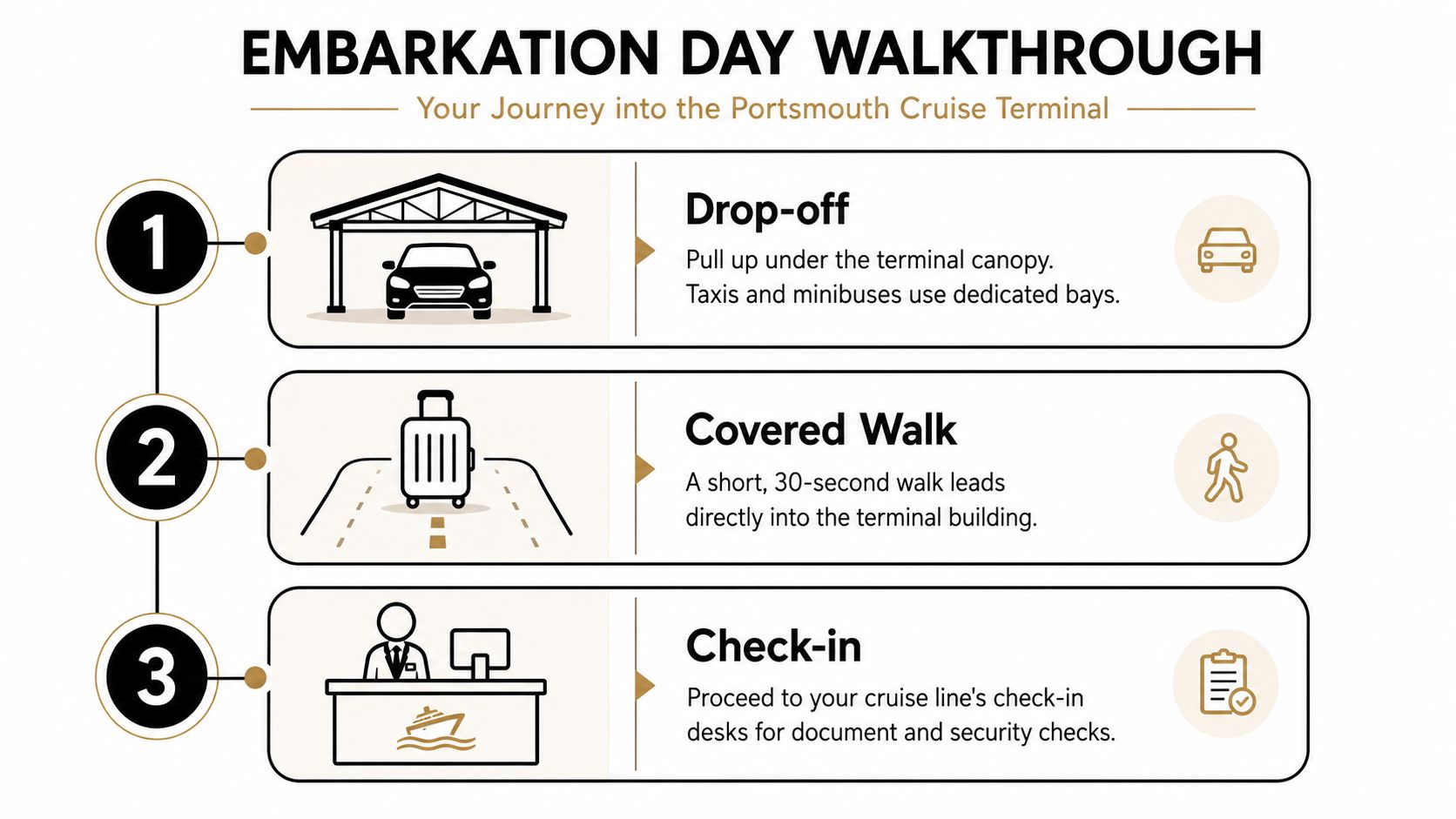
The sequence from curb to gangway
First, you pull up under the terminal canopy. Taxis and minibuses use the dedicated bays, so the handover is designed to be short rather than theatrical.
Then comes the short covered walk into the building. That matters more than most passengers realise, because a dry, direct walk is a lot kinder to rain-soaked bags, wheelchairs, and nervous first-timers than a long exposed trek across a car park.
After that, you go through check-in, security, and screening before moving on to boarding. The flow is brisk on many sailings because a large share of the departures are structured, repeatable ferry or cruise movements rather than chaotic one-off events.
How early you should arrive
For Brittany Ferries sailings, 90 minutes before departure is the sensible floor. For turnaround cruises with coach arrivals, two hours is the safer target. That extra time gives you room for document checks, luggage handling, and the kind of small delays that don't sound important until you're standing in line with a closing bag drop.
Hold luggage is collected curbside, so don't drag a full wardrobe into the terminal building. Keep one cabin-sized bag with your essentials, including medication, passports, chargers, and anything you'll want while the other bags are being processed.
The terminal's public area is not spacious. Seating is limited, and the whole place works best when travellers move through it in an orderly sequence. Families, older passengers, and anyone with mobility needs feel that constraint fastest, especially if they've been dropped off too early or too late.
Direct advice: Don't plan to “wait it out” inside the terminal. Portsmouth rewards passengers who arrive in the right window, not passengers who try to use the building as a lounge.
Getting to Portsmouth Cruise Terminal from London and Heathrow
If you're coming from London or Heathrow, the transport choice is brutally simple. The cheapest route isn't always the smartest one, and the fastest route isn't always the least stressful one.
Train, coach, or car, the real trade-offs
From central London, the rail option usually means London Waterloo to Portsmouth Harbour, which is around 1 hour 40 minutes, then a 5 to 10 minute taxi to the terminal. That's fine if you travel light, know the timetable, and don't mind rolling luggage through station platforms.
Coach travel is slower and less elegant. Direct coach and National Express-style options from Victoria Coach Station typically run at around 2.5 to 3 hours, and you may still need to change at Southampton or Portsmouth depending on the service pattern. That's tolerable for flexible travellers, but it's not the route I'd choose with cruise bags and a flight connection in the same day.
Heathrow is the key decision point for most international passengers. The airport is roughly 70 miles from Portsmouth, and there's no clean direct train that makes the journey painless with cases in tow. A taxi or private minibus is usually the sensible answer because two changes on the tube and rail network with cruise luggage are exactly the sort of “cheap” plan that becomes expensive in stress.
Practical rule: If the trip starts at Heathrow, assume public transport will feel harder than it looks on paper.
My recommendation for international travellers
For a same-day airport-to-ship transfer, private road transport is the cleanest choice. A car journey is usually 90 to 120 minutes door to door in normal conditions, while public transport can push beyond 3 hours once you add waiting time, changes, and the final station-to-terminal hop.
Typical private transfer pricing sits around £130 to £180 for a saloon car and £180 to £260 for a 5 to 8 seat minibus. That isn't cheap, but it's honest pricing for a direct, luggage-friendly transfer that doesn't force you to gamble on railway timing. EC Minibus's Heathrow transfer guidance for Portsmouth
| Mode | Door-to-Door Time | Typical Cost (2026) | Best For |
|---|---|---|---|
| Private car or minibus | 90 to 120 minutes | £130 to £260 | Heathrow arrivals, families, luggage-heavy travellers |
| Train plus taxi | About 1 hour 50 minutes plus connections | Variable | Light packers from central London |
| Coach | Around 2.5 to 3 hours | Variable | Flexible travellers without tight embarkation timing |
| Self-drive | Depends on traffic | Fuel plus parking | Confident UK drivers who don't mind the return hassle |
If you're already committed to driving, you need to be honest about the motorway routing and the stress of dropping a car into an unfamiliar port on departure day. For most overseas visitors, that's the point where self-drive stops looking economical.
Parking, Drop-Off, and Whether a Private Transfer Wins
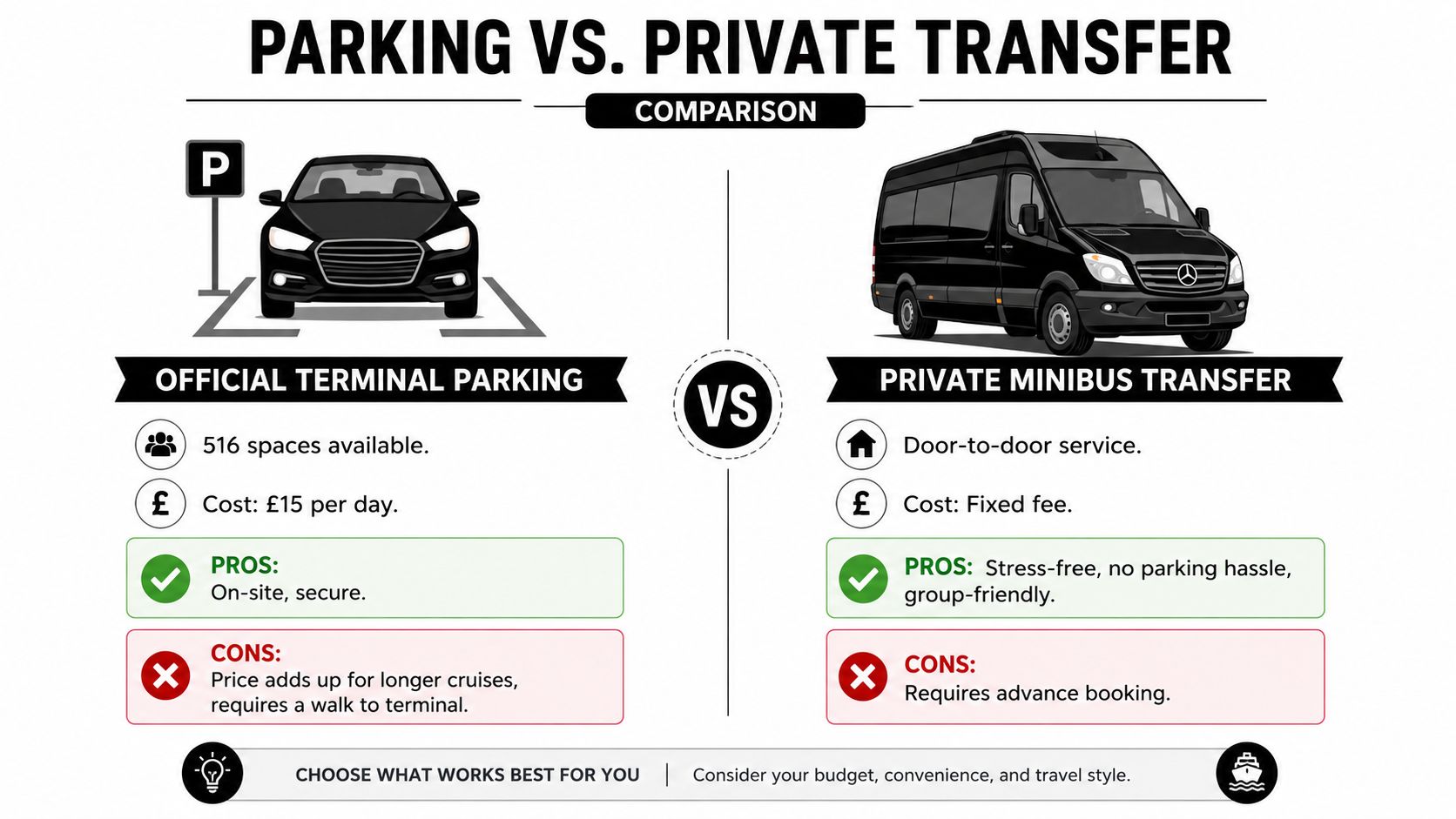
Portsmouth's parking setup is usable, but it's not the answer for everyone. The port says its multi-storey has 516 spaces, is open 24 hours, and charges up to £15 per day, with limited pre-embarkation parking and specific rules for late-night staging. That is what you have to plan around, not the ideal version you might wish existed.
The port also says the PortSolent cruise-and-stay car park is part of the parking offering, with a shuttle or taxi hop back to the terminal. That works if you're driving yourself and want to leave the car in one place, but it still adds a step at the start and finish of the journey.
When parking makes sense
Pre-booked parking is the straightforward choice for solo travellers or couples on shorter cruises who want to control their own arrival and don't mind the walk or shuttle. It can also make sense if you're already in the area and don't want to pay for a full private return transfer.
For 10 to 14 day cruises, parking at £15 per day quickly becomes a serious line item. At that point, the total lands roughly between £150 and £210 before you even factor in fuel, motorway charges in time rather than cash, and the mental cost of navigating the port on your own.
Drop-off is simpler. You can use the terminal gate, but the short-stay window is only 10 minutes and the charge is £5, so it's a brief unloading zone, not a place to linger.
Why a private transfer often wins
A return private minibus transfer from London or Heathrow is typically £180 to £260 for a group vehicle, and that price buys something parking can't, a door-to-door handoff both ways. No car to park, no shuttle to chase, no return taxi queue after the cruise.
That matters most for families of three or more, older travellers, and anyone landing at Heathrow with a long-haul body clock. It also matters for nervous overseas drivers who don't want to deal with UK road flow, wrong-side driving, and the pressure of a tight cruise check-in clock.
The verdict is blunt. Short cruise, solo or couple, and you're already local, parking is fine. Flying into Heathrow, travelling with family, or wanting a stress-free return, book the transfer.
Accessibility, Nearby Hotels, and Timing for International Arrivals
Portsmouth is a sensible port for travellers who need a manageable terminal, but only if you plan the arrival properly. Accessibility is decent, yet cruise day still rewards passengers who pre-book help and avoid turning up at the last minute.
Accessibility without guesswork
The terminal has step-free access, and assistance can be arranged through the cruise line at least 48 hours ahead. Wheelchairs and staff help are available on embarkation day, which is exactly what you want if a passenger has reduced mobility or just doesn't move fast after a long flight.
That support works best when it's requested early. If you leave it until the day, you're relying on goodwill rather than process, and that's a poor place to be when luggage is being moved and check-in desks are busy.
Hotels that make sense before departure
If you're staying overnight before the ship, keep it simple. Portsmouth Marriott is roughly 10 minutes by taxi from the terminal, which makes it a practical choice for an easy pre-cruise morning. Holiday Inn Portsmouth, near the Historic Dockyard, also works well if you want to stay central and keep the transfer short.
If you're driving in, budget hotels near the M27 at Fareham are the no-nonsense option. They suit passengers who want to avoid city-centre traffic and wake up close enough to make the final run without drama.
Timing advice for Heathrow and other arrivals
For Heathrow, I'd aim for a flight that lands before 11:00 if you want to do a same-day transfer to the ship with confidence. Build in 3 hours between landing and pickup if you're being realistic about immigration, bags, and the walk out of the terminal.
If you land after 14:00, or you're coming off a long-haul schedule and already know you'll be tired, book a pre-cruise hotel night instead. That's the cleanest way to avoid converting a holiday into an endurance test.
Gatwick can also work, and Southampton Airport is the smoother regional fallback for premium or charter flights, because it's only 25 minutes from the terminal. That's a very different equation from Heathrow, and you should plan accordingly.
Booking a Transfer and Final Pre-Cruise Checklist
The best transfer booking is the one that removes choices on the day. Don't leave it vague, don't assume the driver knows your cruise details, and don't expect luggage space to sort itself out after booking.
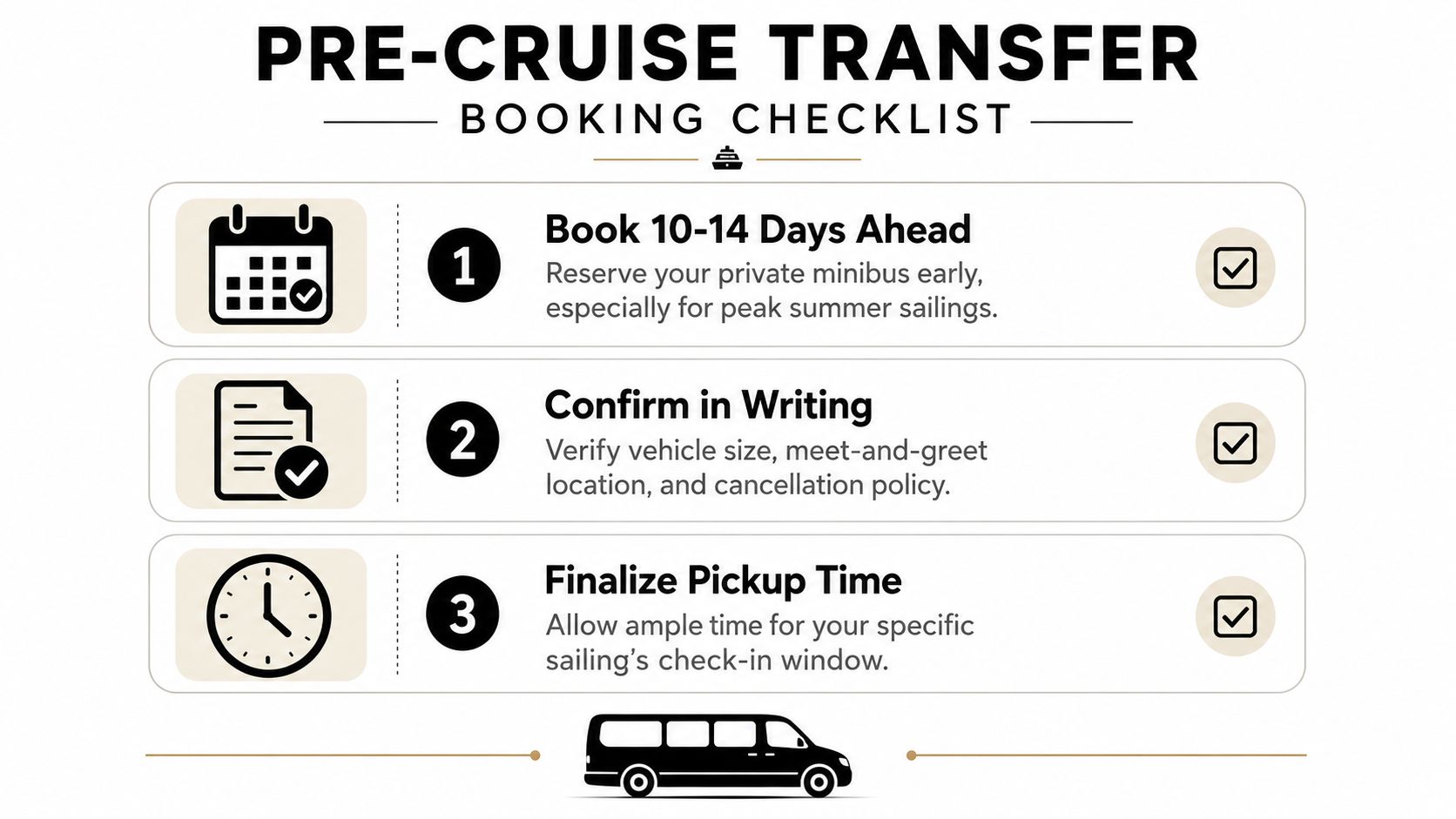
What to lock in when you book
For peak summer sailings, reserve a private minibus 10 to 14 days ahead. That gives you a better chance of getting the right vehicle size, especially if you're travelling with family baggage or cruise extras like mobility aids and carry-ons.
Put the following in writing before you pay:
- Vehicle size, because a saloon and a 7-seat vehicle are not the same answer when luggage is involved.
- Meet-and-greet point at Heathrow, so no one is searching the arrivals hall.
- Luggage allowance, because cruise packing is heavier than a normal city transfer.
- Portsmouth drop-off point at George Byng Way, so the driver doesn't improvise at the gate.
One sensible option among the transfer choices is EC Minibus's airport transfer service guidance, because it reflects the kind of written confirmation and fixed-pickup planning that matters on cruise day. Use it as a model for what a proper booking should spell out, whether you book there or elsewhere.
Bottom line: Cruise transfers fail when people assume details. Get the pickup time, luggage space, and drop-off point confirmed before you travel.
Final checklist before you leave
- Passport validity, especially if your itinerary touches Schengen destinations.
- E-visas or entry requirements, if your route needs them.
- Travel insurance, with cruise and missed-embarkation cover if you want proper protection.
- Embarkation slot time, so your transfer lines up with check-in.
- Medication supply, kept in your hand luggage.
- Mobile roaming, so you can contact the driver if plans change.
- Printed confirmations, because battery life and airport Wi-Fi aren't reliable enough to trust.
Quick answers to common worries
What about luggage limits on shared transfers? Ask before booking, because cruise bags eat space fast.
What if the flight lands late? A monitored private transfer is easier to recover than public transport.
Do taxis accept card payment? Some do, but you should not assume it.
How early should I arrive before sailing? Aim for the terminal window set by your operator, then add a buffer if you're carrying extra bags or arriving from Heathrow.
If you want a clean, door-to-door transfer to Portsmouth Cruise Terminal from Heathrow or central London, EC Minibus handles private cruise transfers with meet-and-greet, luggage help, and fixed pricing. Book early, confirm your pickup details in writing, and visit EC Minibus if you want the airport-to-terminal leg dealt with properly.