

You've landed at Heathrow with a wheelchair, hand luggage, four large cruise cases and a family trying to reach Southampton before embarkation closes. The flight was tiring, the terminal is unfamiliar, and every handoff now matters. A train, taxi or port shuttle may look manageable on paper, yet one inaccessible lift, narrow doorway or missing luggage space can disrupt the whole journey.
That's why choosing a wheelchair accessible minibus involves more than checking for a ramp. You need to understand the vehicle, the wheelchair position, companion seating, luggage capacity, driver assistance, airport meeting arrangements and what happens if a flight or ship runs late. This guide explains the practical questions to ask before booking transfers between Heathrow, Central London, Southampton, Dover, Portsmouth and Tilbury.
Table of Contents
- Why Accessible Transfers Feel Harder Than They Should
- What a Wheelchair Accessible Minibus Actually Is
- UK Accessibility Standards and the Minibus Exemption
- Seats, Wheelchairs and Cruise Luggage in One Vehicle
- Questions to Ask Before You Book an Accessible Minibus
- Timing Your Pickup at Heathrow and the Cruise Ports
- How EC Minibus Handles Accessible Transfers
- Your Accessible Journey from Booking to Arrival
Why Accessible Transfers Feel Harder Than They Should
The difficulty usually begins at the handoff, not at the vehicle door. A wheelchair user may board an accessible minibus without trouble, then face a long route through an airport terminal, an unclear meeting point, a luggage trolley that can't reach the vehicle or a cruise terminal where cars and coaches use different entrances.
The wider journey problem is well documented. Parliament has cited nearly 70% of disabled people and their companions encountering travel barriers frequently, including obstacles beyond boarding itself (UK Parliament transport accessibility report). That figure helps explain why a technically suitable vehicle can still produce an exhausting transfer.
The journey has several links
For a Heathrow to Southampton trip, the chain may include:
- Terminal arrival: Immigration, baggage reclaim and the route to the agreed meeting point.
- Vehicle handover: The driver must identify the correct passenger and position the minibus safely for boarding.
- Luggage loading: Cruise cases need space that doesn't obstruct a ramp, lift or wheelchair position.
- Road transfer: The passenger should remain safely secured, with companions seated comfortably.
- Port arrival: The driver must reach the correct terminal access point and help with the final handoff.
Public transport can work well for some journeys, but step-free access and staffing aren't consistent across every leg. Transport for All has highlighted that only around a quarter of UK railway stations are step-free and only 11% are staffed at all times (BBC reporting on accessible rail travel). A private door-to-door transfer can remove several uncertain connections, provided the operator confirms the details in advance.
Practical rule: Treat accessibility as a chain. If one handoff fails, the ramp in the vehicle can't solve the entire journey.
Before booking, write down the actual route from the aircraft or hotel entrance to the cruise terminal drop-off. Note the number of travellers, wheelchair type, luggage, flight details and any assistance required. That simple inventory gives the operator something useful to plan around, rather than leaving you with a generic promise that the vehicle is accessible.
What a Wheelchair Accessible Minibus Actually Is
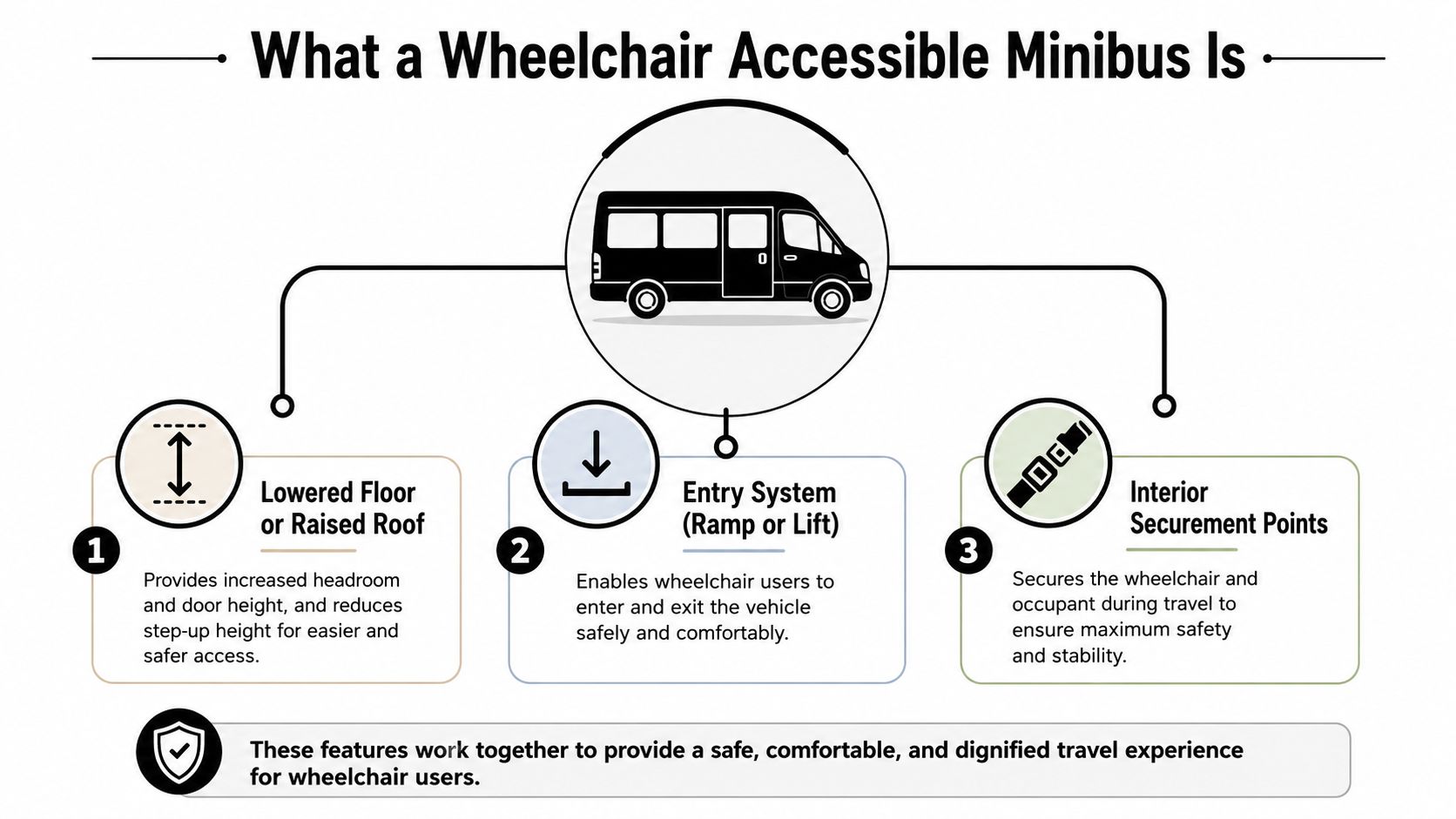
A wheelchair accessible minibus is a passenger vehicle modified so a wheelchair user can board, travel and leave without relying on ordinary steps. The conversion normally combines an altered interior height or floor, an entry system and securement points.
Think of the entry system as the vehicle's doorway. A ramp works like a shop's front entrance, creating a sloped route into the cabin. A passenger lift works more like a service lift, raising the wheelchair vertically when a ramp would be too steep or difficult to use. The right option depends on the wheelchair, the passenger's preference, the available kerb space and the operator's layout.
Start with the boarding method
Rear-entry ramps provide a straight loading path and can be practical where the vehicle can stop behind the passenger. Side-entry ramps may make kerbside boarding easier, but the driver needs enough lateral space to deploy them. Electric lifts can help with heavier powered chairs, though the operator should confirm the lift's usable dimensions and weight capacity rather than assuming every lift is identical.
The interior matters just as much. Some layouts place the wheelchair facing forwards, while others use a different orientation. Forward-facing travel generally requires the wheelchair restraint to be correctly attached before the vehicle moves. GOV.UK guidance describes a suitable wheelchair space for a reference wheelchair, boarding equipment and, where the position faces forward, a restraint system that must be fitted correctly (GOV.UK manufacturer and operator guidance).
Understand securement and seating
A typical arrangement uses four-point webbing straps attached to the wheelchair, together with an occupant seatbelt. The passenger may be able to remain in their wheelchair for the journey, or may need to transfer to a standard minibus seat. That isn't a minor detail, especially for someone who can't transfer safely or who relies on a powered chair.
Ask the operator to describe the setup in ordinary language:
- How does the wheelchair enter? Ramp, lift, side or rear access.
- Where does it travel? Forward-facing, rear-facing or another approved position.
- How is it held? Straps, docking system or another securement method.
- Where do companions sit? Beside the passenger, ahead of them or in another row.
- Can the passenger remain in the wheelchair? Confirm this before payment.
A vehicle isn't suitable merely because its doors are wide enough. The usable space must allow boarding, positioning, restraint and comfortable travel without blocking companions or luggage.
UK Accessibility Standards and the Minibus Exemption
A transfer can meet a ramp requirement and still fail at the terminal. UK accessibility rules use the word “bus” for vehicles with different obligations, so passengers arranging Heathrow or cruise-port journeys must check which rules apply to the minibus they are booking.
The disabled-access framework for buses and coaches covers wheelchair space, seating orientation and safety provisions. It does not apply in the same way to minibuses or buses and coaches carrying 22 or fewer passengers, as explained in the official buses and coaches accessibility guidance.
Many private accessible minibuses sit in the 8 to 16 seat category. That means a booking may not be governed by every public-service bus requirement. The useful checks are the vehicle's licensing position, the quality of its conversion, the operator's procedures and the details recorded in your confirmation.
A mainstream market with different obligations
England's regulated bus network provides useful context. Department for Transport statistics recorded 99.5% of buses with accessibility certification as of 31 March 2024, while 52.8% provided audio-visual information and 98% of operators were required to provide disability awareness training (Department for Transport accessibility statistics).
Those figures describe local bus and coach services, not every private minibus. They show the standard of accessible transport passengers increasingly encounter, while private operators may follow a different set of duties. The same statistics recorded 930,000 concessionary disabled bus passes, an annual increase of 5%, indicating substantial demand across the public network.
Accessible information rules are being phased in between 2024 and 2031 for local bus and coach services in England, Scotland and Wales. Vehicles first used on or after 1 October 2019 must comply from 1 October 2024, according to the official guidance. A private operator may not fall under every part of that framework, so ask how it will provide boarding instructions, meeting-point details and assistance if a flight is delayed.
The exemption does not remove the need for care. It makes the operator's own standards more important to verify.
For practical checks, use this accessibility compliance guide. Request evidence you can act on, including vehicle photographs, confirmed dimensions, securement details and a written plan for handoffs between the terminal, vehicle and cruise-port entrance.
Seats, Wheelchairs and Cruise Luggage in One Vehicle
The phrase “room for everyone” doesn't tell you enough. A wheelchair position occupies floor area and may replace one or more ordinary seats, while cruise luggage can fill the storage area quickly. The correct vehicle depends on the passenger layout, the wheelchair's size and the amount of luggage travelling with the group.
Start with four details:
- Passenger count: Include the wheelchair user, companions and anyone joining at a hotel or station.
- Wheelchair information: Provide width, length, height, weight and whether it folds.
- Luggage volume: List large cases, cabin bags, medical equipment and mobility aids separately.
- Loading plan: Ask where each item will go once the wheelchair space is occupied.
A practical Heathrow example
Consider a family of four travelling from Heathrow to Southampton. One traveller uses a wheelchair, and the group has four large cruise cases plus hand luggage. The operator needs to confirm four passenger seats or an appropriate combination of wheelchair and companion positions, then check whether the wheelchair remains in the cabin during travel.
The luggage must not sit on a ramp, block the lift platform, narrow the manoeuvring route or interfere with the wheelchair restraints. A rear luggage pod or a vehicle with dedicated storage may be more suitable than a compact conversion, even if both vehicles are described online as accessible.
Use this table when you speak to the operator:
| Traveller Profile | Must Confirm at Booking |
|---|---|
| Wheelchair user travelling in the chair | Chair dimensions, weight, boarding method, restraint position and whether the chair can remain occupied |
| Wheelchair user transferring to a seat | Transfer requirements, chair storage and accessible boarding assistance |
| Family or group with companions | Number of usable seats after the wheelchair position is installed |
| Cruise passengers with large cases | Storage capacity, loading order and whether luggage is kept separate from the passenger area |
| Powered wheelchair or mobility scooter | Battery information, total weight, turning clearance and lift or ramp compatibility |
| Passenger carrying medical or mobility equipment | Safe storage, access during the journey and any advance notice required |
Don't rely on the number of seats printed in a vehicle listing. A minibus can have a stated passenger capacity that changes once a wheelchair bay, lift equipment or removable seats are in use.
Send a photograph of the wheelchair if the operator requests one, but don't treat a photograph as a substitute for measurements. Width at the widest point, including hand rims or controls, can determine whether the chair will pass through the entry system.
Good capacity planning counts floor space, not just heads and seats.
Ask for the luggage arrangement in writing. A clear answer might explain which cases go in the rear compartment and which items stay inside. “There should be plenty of room” is not a plan.
Questions to Ask Before You Book an Accessible Minibus
A reliable booking conversation produces specific answers. An uncertain one relies on phrases such as “probably suitable”, “we usually manage” or “the driver will see what he can do”. Accessibility needs shouldn't be left to improvisation at the kerb.
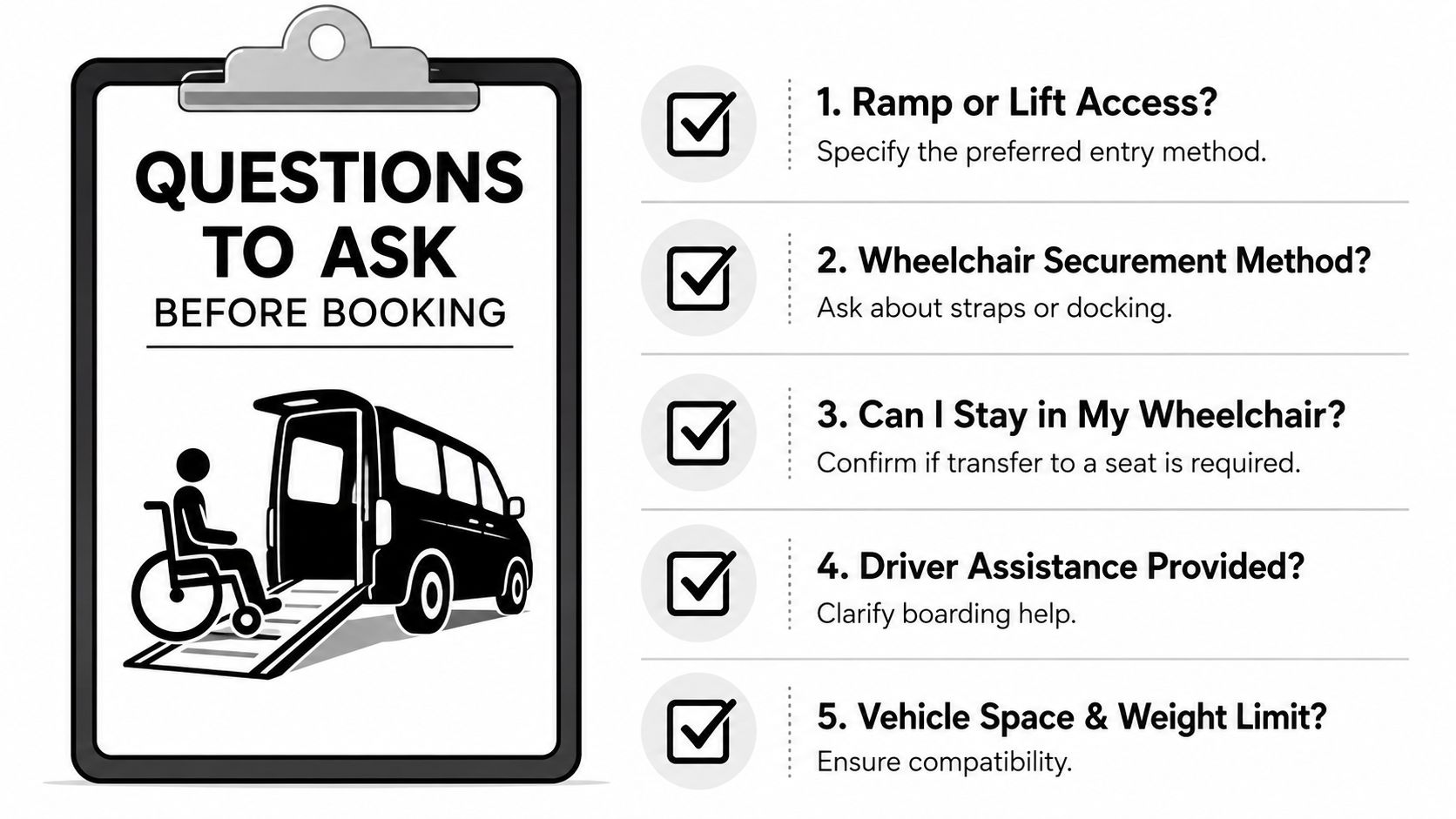
Use this phone checklist
- Is access by ramp or lift? Ask whether the entry is at the rear or side, and whether the vehicle can deploy it safely at the planned pickup point.
- How is the wheelchair secured? Request a plain description of the straps, docking arrangement and passenger seatbelt.
- Can I remain in my wheelchair? If a transfer is required, explain any limitations and ask where the wheelchair will travel.
- Will the driver assist? Confirm help with positioning, boarding, unloading and luggage. Also ask what the driver can't do, since safe boundaries matter.
- What are the space and weight limits? Give exact wheelchair measurements and the weight of the passenger, chair and any attached equipment.
Then ask questions that cover the journey rather than the conversion alone:
- Vehicle evidence: Can the operator send current photographs showing the entry, wheelchair bay, companion seats and luggage area?
- Booking continuity: Is the accessible vehicle guaranteed, or might the booking be subcontracted?
- Change handling: What happens if the flight time, hotel pickup or cruise schedule changes?
- Pricing: Does the quoted total include assistance, luggage handling and any accessibility-related charge?
- Meeting point: Where will the driver wait, and how will you identify one another inside Heathrow?
- Port access: Which Southampton, Dover, Portsmouth or Tilbury terminal entrance will the vehicle use?
A good answer connects your information to a decision. For example, the operator might say that your powered chair fits the lift, the wheelchair bay replaces a particular seat, four cases require a larger luggage area and the driver will meet you at a named terminal point. A vague answer leaves the key risk unresolved.
Check the written confirmation
After the call, make sure the confirmation records the wheelchair type, dimensions, passenger count, luggage, flight or cruise details and assistance request. If the email only says “accessible vehicle” without the configuration you discussed, ask for an amended confirmation.
Accessible travel guidance increasingly expects more responsive assistance, but availability still depends on the operator, vehicle and route. Written details protect both sides by giving the dispatch team and driver the same instructions.
Timing Your Pickup at Heathrow and the Cruise Ports
Airport and cruise transfers need different timing strategies. A Heathrow arrival has uncertainty after touchdown, including immigration, baggage reclaim, toilet stops and the route to the meeting point. A cruise departure has a fixed operational deadline, and a late road journey can affect check-in even when the ship itself is still in port.
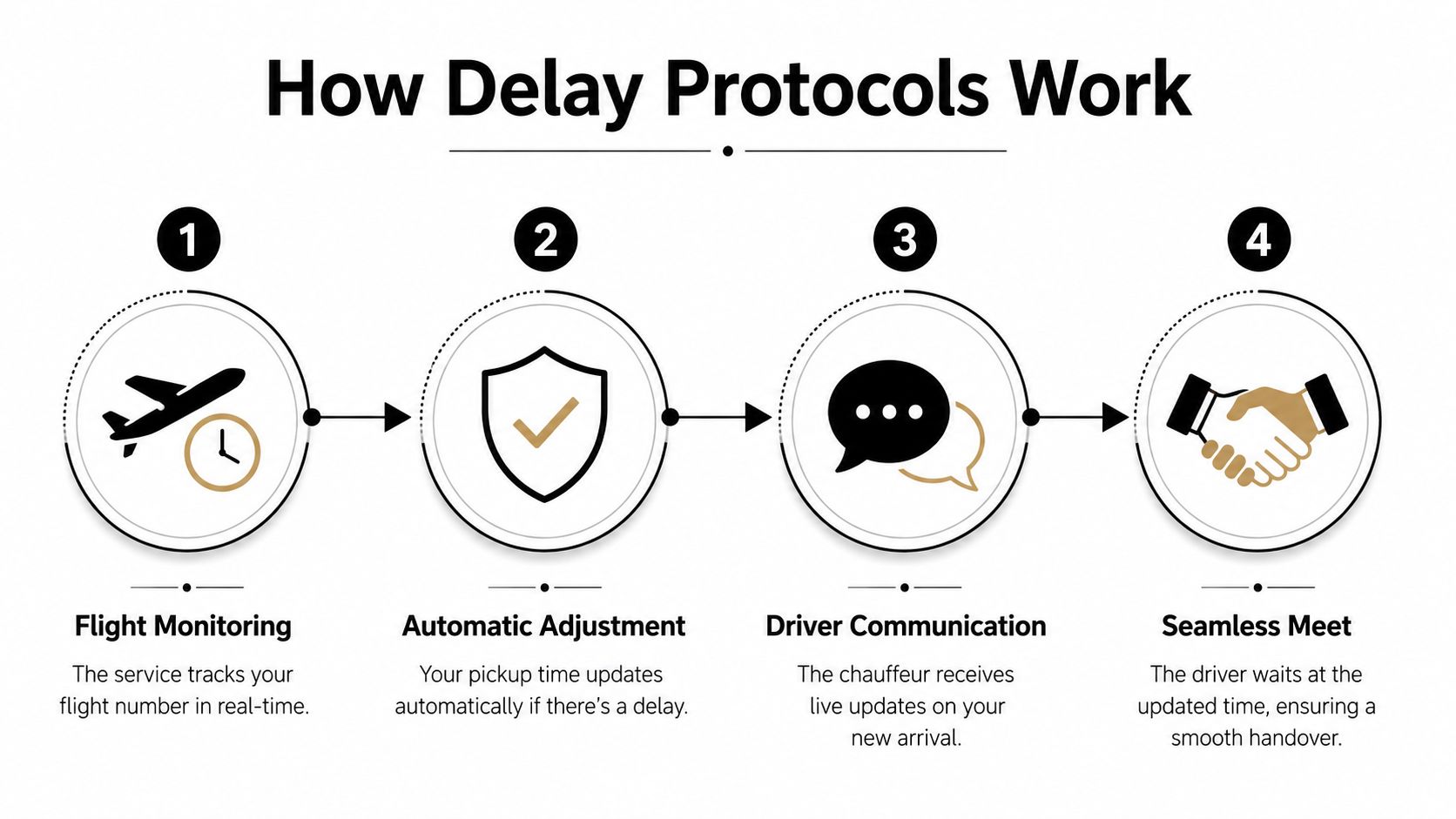
For an arriving flight, provide the airline, flight number, arrival date and terminal. A service that monitors the flight can see a delay before the passenger reaches the terminal, but monitoring doesn't remove every uncertainty. The driver still needs a clear meeting instruction, and the passenger needs a way to contact the operator if bags are delayed or assistance takes longer than expected.
Build the buffer around the real handoff
For Heathrow, don't set the pickup for the moment the aircraft is scheduled to land. Allow time for the passenger to leave the aircraft, complete border formalities, collect luggage and reach the agreed point. A wheelchair user may also need assistance from airport staff, and that assistance can affect the time required.
For a cruise port, work backwards from the terminal's requested arrival or check-in window. Southampton, Dover, Portsmouth and Tilbury have different road approaches, terminal layouts and vehicle access arrangements. Ask whether the driver will drop passengers at the terminal entrance, luggage area or another designated point, and whether the group needs help moving from the vehicle to port staff.
A delayed flight can often be managed. A missed cruise check-in window is much harder to recover from.
A door-to-door service can offer more control than a fragmented journey. A train connection may depend on a lift, a staffed station or a working platform route. A taxi may not accept the wheelchair configuration. A port shuttle may require a separate boarding process. Each additional leg adds another handoff to verify.
Watch this short explanation of how an airport chauffeur service can handle flight changes, then ask the operator which parts of that process apply to your booking.
For practical booking guidance on a private airport journey, see this door-to-door airport transfer service information. The essential questions remain the same: who monitors the timing, who communicates changes and who completes the final handoff at the terminal?
How EC Minibus Handles Accessible Transfers
EC Minibus provides private transfers between Heathrow, Central London and UK cruise ports, but its published vehicle information says that its vehicles aren't wheelchair accessible. The company can transport foldable wheelchairs and walkers when passengers note them at booking, so passengers who need to remain in a wheelchair during travel should confirm suitability before reserving.
That distinction is important. A service can provide meet and greet, luggage assistance and careful timing without being the right vehicle for a non-folding wheelchair or a passenger who can't transfer. The evaluation should begin with the accessibility checklist, not with the route alone.
Use the service details as booking questions
EC Minibus says it has operated since 2006, with licensed and insured drivers, Heathrow meet and greet, flight and cruise monitoring, professional luggage assistance and fixed pricing without hidden fees. Its routes include Heathrow, Central London hotels, Southampton Cruise Terminal, Dover, Portsmouth, Tilbury and St Pancras International.
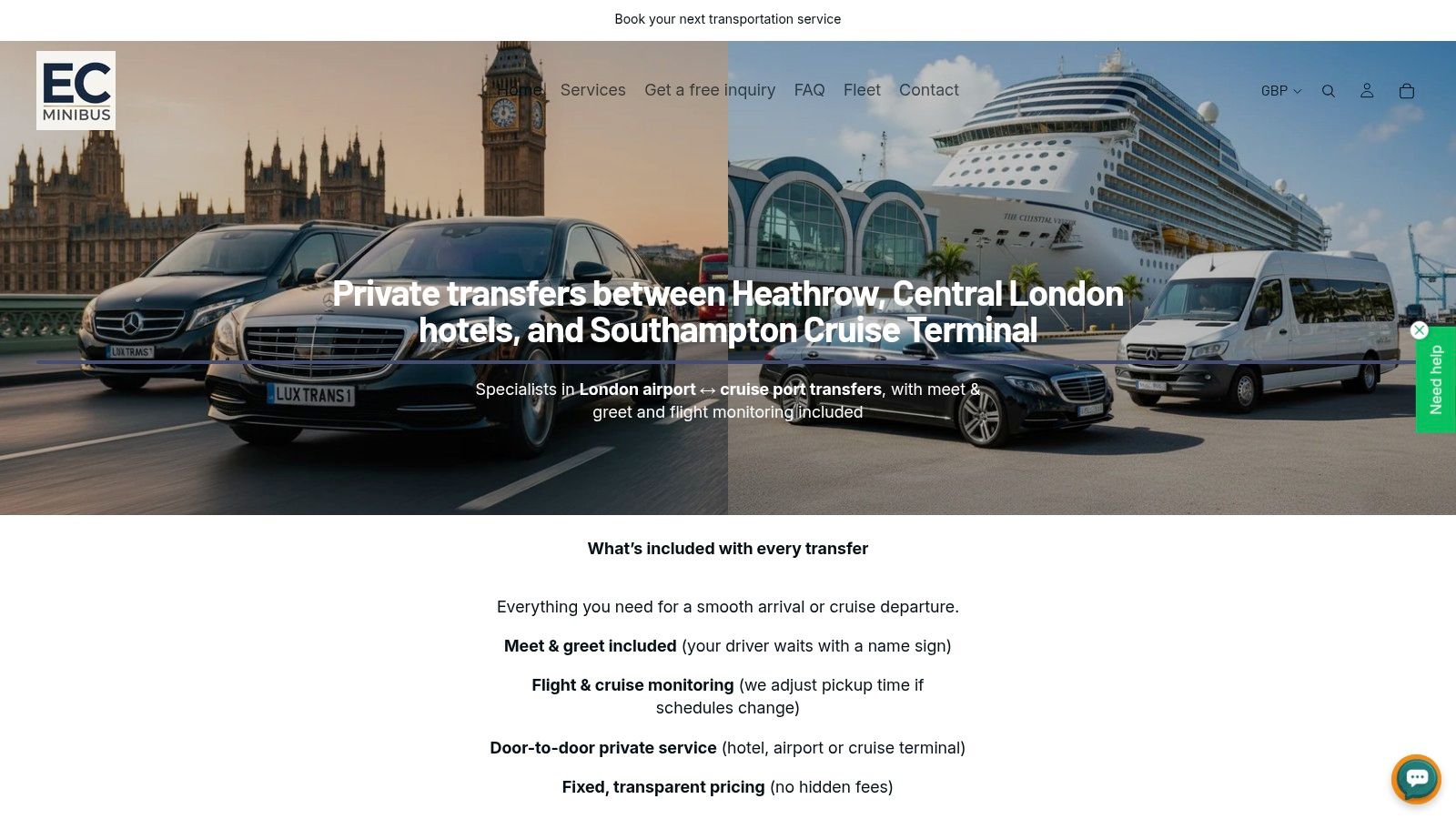
For a traveller with a foldable wheelchair, those features may help simplify the wider journey. Ask where the folded chair will be stored, whether it affects luggage capacity and whether the passenger transfers into a standard seat. For a traveller remaining in a powered or rigid wheelchair, request a clear confirmation that the vehicle has the required ramp or lift, wheelchair bay and restraint system. If it doesn't, arrange a specialist accessible vehicle instead.
The online booking process includes secure booking, instant confirmation, live chat and support. Use those channels to record the complete transfer profile, including flight or cruise details, passenger assistance, luggage and the precise vehicle requirement. The company's concierge assistance information may also be relevant when a group needs help coordinating the airport or hotel handoff.
EC Minibus is therefore a useful example of why operators must be assessed against the passenger's actual mobility profile. Its monitoring and transfer support may suit some travellers, while its non-wheelchair-accessible vehicle policy makes advance verification essential.
Your Accessible Journey from Booking to Arrival
A reliable transfer starts before payment. Record the passenger's chair measurements, weight where relevant, folding method, preferred boarding method, companions, luggage volume and whether the passenger remains seated in the chair. “Wheelchair passenger” alone does not give a driver enough information.
Use this checklist:
- Confirm the vehicle configuration. Ask about the entry method, wheelchair position, restraints, companion seats and current photographs if needed.
- Check total capacity. Include passengers, the chair, cruise cases, cabin bags, medical items and other mobility aids.
- Document each handoff. Record the Heathrow terminal meeting point, driver identification, luggage collection, cruise terminal entrance and assistance arrangements.
- Agree the delay plan. Provide flight and cruise details. Ask who monitors changes and how updates reach the driver.
- Secure the price in writing. Confirm inclusions, cancellation terms and accessibility conditions before travel.
A ramp alone does not make a journey accessible. The vehicle must connect with airport staff, luggage collection, companion seating, road timing and port procedures. The handoff works like a relay: if one person lacks the right information, the next stage can fail. Accessible transport guidance also stresses the need for clear information and suitable transport arrangements (government accessible transport guidance).
Clear answers and a written record turn the transfer into a managed process. Vague replies are a reason to keep asking questions or choose a provider with the correct vehicle and documented procedures. Your family should focus on the flight, hotel or cruise, not whether the next doorway will work.
EC Minibus offers private Heathrow, London and cruise-port transfers with meet and greet, flight and cruise monitoring, luggage assistance and fixed pricing. Foldable wheelchair and walker transport must be recorded during booking. Visit EC Minibus to check your route, explain mobility and luggage requirements, and confirm whether the available vehicle matches the journey.