

You're arranging a Heathrow pickup for a cruise from Southampton. The flight is booked, the ship is waiting, and the transfer looks like the simple part. Then the practical questions begin. Can the vehicle take a wheelchair without folding it? Will the driver know how to secure it safely? Can a companion sit close by? What happens if the flight is delayed or the accessible vehicle becomes unavailable?
These questions are the everyday meaning of accessibility compliance. For a traveller, it can determine whether a journey feels calm and organised or uncertain from the moment of booking. For an operator, it means turning legal responsibilities into reliable vehicles, booking procedures, trained staff, and clear communication.
Table of Contents
- A Traveller Scenario That Shows Why This Matters
- What Accessibility Compliance Means
- The Four Practical Pillars Operators Must Deliver
- Where Private Transfers Sit in UK Rules
- How EC Minibus Approaches Accessibility in Practice
- Monitoring, Feedback, and Continuous Improvement
- What Passengers Should Ask and Expect When Booking
A Traveller Scenario That Shows Why This Matters
A wheelchair-using passenger is travelling from Heathrow to Southampton ahead of a cruise. They've provided the flight number and asked for a private transfer, but “accessible vehicle” can mean different things to different providers. One operator may offer a vehicle with a ramp but expect the passenger to transfer into a seat. Another may have space for the wheelchair but no suitable securement system. A third may be able to provide the right vehicle only if the request is confirmed early.
The passenger needs clear answers before paying. Is the ramp suitable for the chair's size and weight? Can the chair remain occupied during travel? Where will the chair be secured, and where will luggage go? If a companion is travelling, can they sit nearby rather than several rows away? These aren't unusual demands. They're details that define whether the booked service matches the passenger's actual mobility needs.
The airport adds another layer. A delayed flight can change the collection time, while a busy kerbside area can make it difficult to identify the correct vehicle. The driver needs accurate information, a workable meeting point, and enough time for safe boarding. Rushing a passenger up a ramp or discovering that the vehicle can't accommodate essential mobility equipment turns a routine transfer into a preventable problem.
Practical rule: A booking is only accessible if the promised arrangement survives real travel conditions, including delays, luggage, boarding time, and vehicle changes.
The same principle applies beyond cruise transfers. A scheduled public service may have duties shaped by vehicle type, route, and public availability. A pre-booked private transfer may sit under a different part of the regulatory framework. Yet the passenger still needs a service that doesn't create avoidable barriers. The rules, the operator's process, and the traveller's expectations must work together.
What Accessibility Compliance Means
Accessibility compliance follows the same logic as a public building. A ramp, handrail, clear entrance, and readable signs are part of making the space usable. Transport should work by the same principle. Disabled passengers need to access the service, understand the arrangements, use the vehicle safely, and raise a concern when something goes wrong.
In UK law, the Equality Act 2010 is central. It protects disabled people from less favourable treatment and can require service providers to make reasonable adjustments. “Anticipatory” duties may sound technical, but the underlying rule is clear. An operator should not wait until a passenger meets a barrier before considering accessibility. The business should assess foreseeable needs when it designs vehicles, booking channels, staff procedures, and passenger information.
The UK's public-sector digital rules offer a useful example of how this responsibility works. The government guidance on equality and accessibility regulations explains that public-sector digital activity must comply with the Public Sector Bodies (Websites and Mobile Applications) Accessibility Regulations 2018 and the Equality Act 2010. Those regulations came into force on 23 September 2018, with phased deadlines for new websites, other websites, and mobile apps.
Legal baseline and better practice
Transport operators may need to consider several layers of obligation. The Public Service Vehicle Accessibility Regulations, commonly called PSVAR, set accessibility requirements for certain regulated public service vehicles. The Equality Act still matters when a service treats disabled passengers, even if a particular vehicle or pre-booked private transfer falls outside a specific PSVAR requirement.
Accessibility also covers the information surrounding a journey. Public-sector rules require digital services to be perceivable, operable, understandable, and resilient, alongside an accessibility statement. The UK government accessibility requirements for websites and apps describes this as ongoing work involving testing, documentation, exemptions, and remediation.
A private operator can provide more than the legal minimum. Clearer booking questions, more generous boarding time, practical contingency planning, and direct communication can make the promised service easier to use. A technically compliant arrangement may still create difficulty if a passenger cannot understand what has been agreed or what to do when circumstances change.
The Four Practical Pillars Operators Must Deliver
Accessibility compliance works as a connected system. A suitable vehicle will not help if the booking team records the wrong information, and a careful process will fail if the driver cannot apply it. For a private transfer, the passenger's experience depends on four linked parts: the vehicle, the booking process, staff capability, and reliable information at the point of travel.
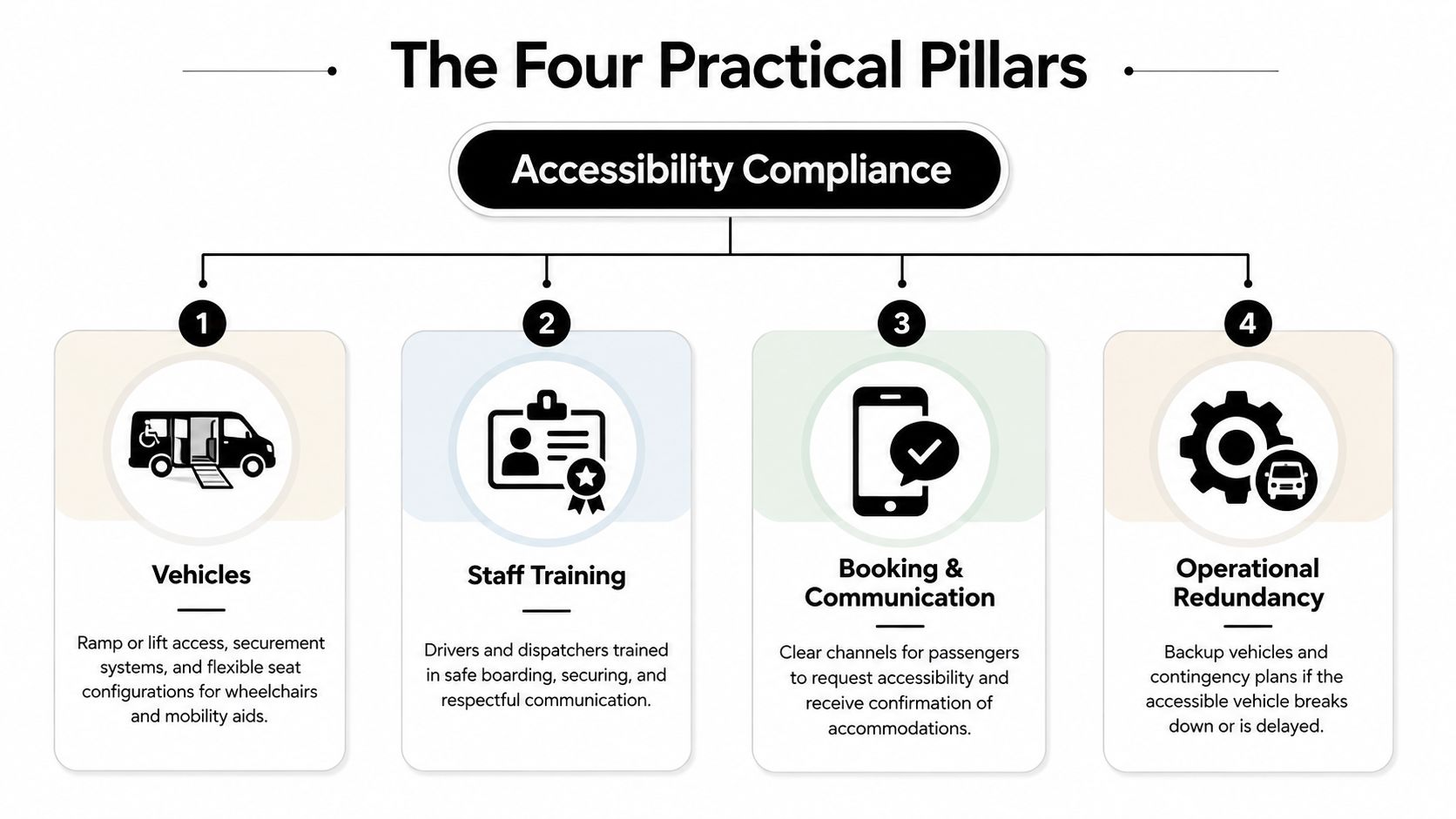
Vehicles
The vehicle must match the passenger's actual needs, rather than rely on a general label such as “wheelchair accessible”. Before accepting the booking, the operator should establish what the passenger needs to board, whether they will remain in their wheelchair, and what mobility equipment will travel with them.
The check should cover usable space, the entry route, seat layout, luggage capacity, and whether the vehicle is configured for the planned journey. A folded wheelchair may require a different arrangement from a powered chair. Someone who can transfer to a seat may need a different setup from someone who must remain in their chair. Mobility equipment should also be accounted for so it is not left behind or placed where it affects safe travel.
Booking and communication
The booking channel should give passengers a clear way to describe their requirements. A phone call may suit one traveller, while a web form may capture equipment details more accurately. Staff should ask specific questions, repeat the agreed arrangements, and provide written confirmation.
That confirmation should state the relevant vehicle features, collection details, assistance arrangements, and the procedure for delays or changes. “Accessible” can mean different things to different people. The passenger should know whether it refers to step-free boarding, wheelchair travel, luggage assistance, or another agreed adjustment.
A good booking record acts like a handover note. It keeps the passenger's request from being lost between the adviser, dispatcher, and driver.
Staff training
Drivers and dispatchers need role-specific knowledge of the operator's vehicles, booking records, and escalation procedures. Training should cover respectful communication, privacy, the limits of physical assistance, and how to respond when the agreed arrangement cannot be provided.
A journey briefing should give the driver the information needed to deliver the booking without exposing unnecessary personal details. Operators can use professional driver training resources to support a structured programme, then adapt that learning to their own vehicles and procedures. Refresher sessions and reviews of real incidents help turn written policies into consistent practice.
Signage and operational resilience
A passenger meeting a vehicle at a busy airport needs to recognise it and contact the driver. Clear registration details, a legible description, an agreed meeting point, and accessible contact methods reduce uncertainty. For scheduled services, readable timetables and audible or visible announcements may also be required for passengers to identify the correct service.
The operator also needs a workable contingency plan. If a vehicle becomes unavailable, dispatchers must know which alternative can meet the recorded requirements. A replacement that looks similar but lacks enough space or the agreed accessibility features is not a suitable replacement. The four pillars hold together only when the operator checks the complete journey before departure.
Where Private Transfers Sit in UK Rules
Transport accessibility rules aren't a simple choice between “PSVAR applies” and “nothing applies”. The exact position depends on the service. Relevant questions include the vehicle's size and seating capacity, whether the journey is pre-booked or open to the public, and whether the operator runs a fixed route or timetable.
PSVAR mainly concerns regulated public service vehicles. A scheduled service open to passengers generally raises different questions from a private airport-to-cruise transfer booked for a named customer. Some smaller vehicles or services operating solely as pre-booked private hire may fall outside particular PSVAR requirements. That exemption changes the direct application of one regulation. It doesn't give an operator permission to disregard a disabled passenger's needs.
The Equality Act 2010 remains an important reference point for private services. An operator should consider reasonable adjustments and avoid policies that place disabled passengers at a particular disadvantage without adequate justification. For example, a blanket rule refusing all wheelchair users, or a booking process that makes accessibility requests impossible to communicate, may create serious legal and practical risk even if the service isn't a scheduled bus operation.
| Service Type | Main Rules That Apply | Typical Exemptions | What Operators Must Still Do |
|---|---|---|---|
| Regulated public service vehicle | PSVAR requirements may apply alongside Equality Act duties | The exact application depends on vehicle and service characteristics | Provide accessible operation, information, assistance, and safe procedures |
| Fixed-route or scheduled service | Public service obligations are more likely to be relevant | Specific vehicle categories or circumstances may be treated differently | Make the service usable and communicate arrangements clearly |
| Pre-booked private transfer | Equality Act duties remain relevant to treatment and adjustments | Some PSVAR requirements may not apply to a purely private-hire model | Ask about needs, provide suitable arrangements, and avoid unjustified refusal |
| Smaller private vehicle | The vehicle may fall outside parts of the public-service accessibility regime | Seating capacity and service model can affect coverage | Avoid discriminatory practices and respond reasonably to accessibility requests |
Operators should examine the full service model rather than relying on a vehicle label. The legal requirements for minibus operators can help identify the wider compliance questions, but a specific case may require professional legal advice. The safest operational approach is to treat accessibility as a service responsibility first and an exemption question second.
How EC Minibus Approaches Accessibility in Practice
A strong operator treats accessibility as one continuous experience, from the first enquiry to the final drop-off. The passenger shouldn't have to repeat the same information to a booking adviser, dispatcher, and driver, nor should the driver discover critical requirements only when the vehicle reaches the airport.
At enquiry stage, the operator should record the details that affect the journey. These may include the type of mobility aid, whether the passenger remains seated in a wheelchair, the assistance required for boarding, the amount of luggage, and any onward flight or cruise timing. The booking team can then match the request to a suitable vehicle rather than accepting a vague description and hoping the arrangement works.
Written confirmation gives both sides something concrete to check. It should state the agreed vehicle arrangement, ramp or lift availability where relevant, collection point, timing buffer, and contact process for changes. For a Heathrow pickup, the passenger also needs practical meeting instructions, because an accessible vehicle is less useful if the traveller can't identify it at the kerb.
Vehicle and driver preparation
Practical vehicle details matter. Low-step access can help passengers who don't use a wheelchair but have difficulty climbing. Wheelchair tie-downs and passenger restraints support safe travel. Seatbelt extensions may be necessary for some passengers, while sufficient luggage space prevents mobility aids from being squeezed into an unsafe position.
The driver should know how to assist without taking control away from the passenger. Training can cover ramp use, safe wheelchair securement, mobility equipment, respectful language, and what to do if boarding takes longer than expected. The driver also needs a clear escalation route if the planned vehicle becomes unavailable.
Live adjustments are part of the service. A dispatcher may need to reassign a more suitable vehicle, give the driver a step-free drop-off point, or allow extra collection time for slower boarding. If a flight changes, the operator should update the plan rather than treating the original booking time as immovable.
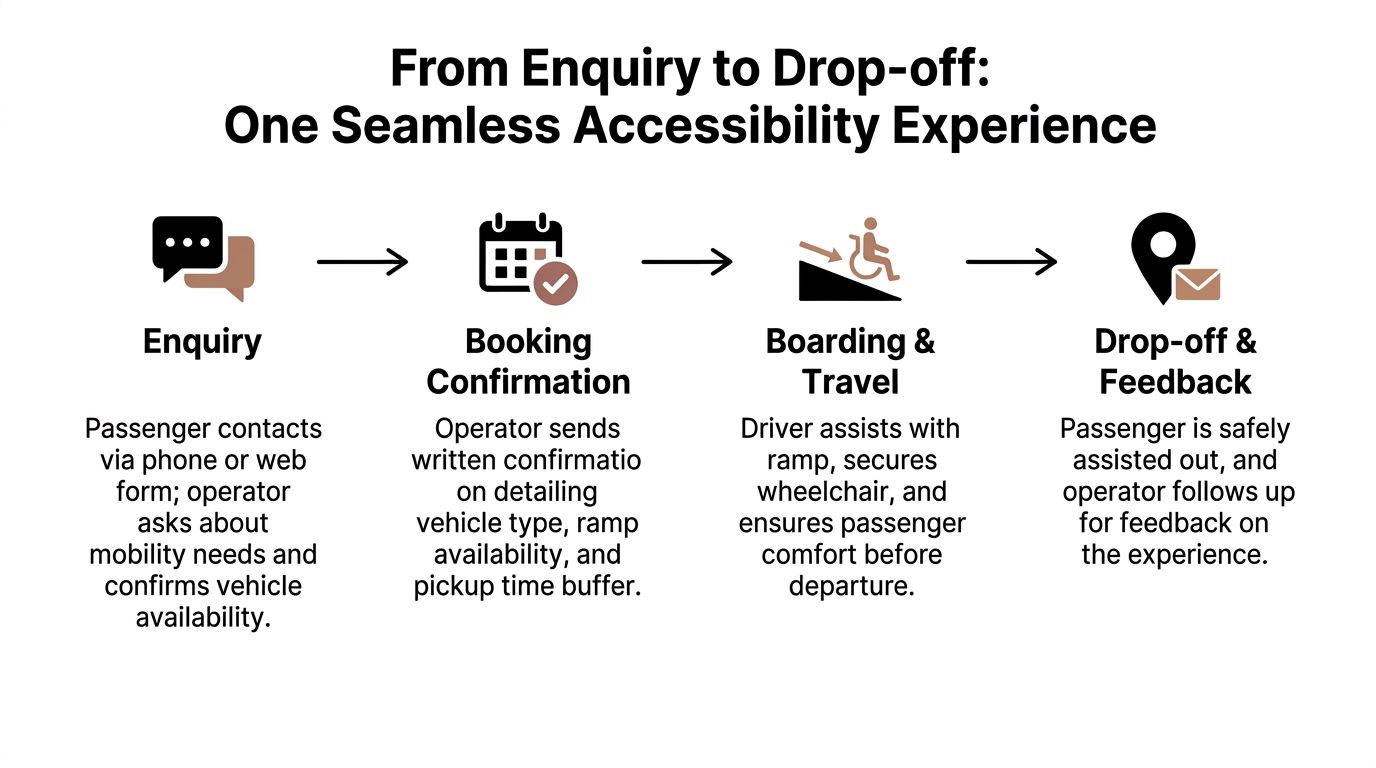
The process becomes dependable when each handover is recorded and checked. The enquiry informs the booking, the booking informs the driver, and the driver's experience informs future improvements.
Monitoring, Feedback, and Continuous Improvement
An operator can't prove that accessibility works by inspecting a vehicle once. It needs a feedback loop that compares what the passenger requested with what the service delivered. The review should cover whether the agreed vehicle arrived, whether assistance was available at the expected time, whether boarding and securement were handled safely, and whether the communication was clear.
Complaints belong inside that same process. A useful system logs the concern, acknowledges it within the operator's stated timeframe, checks booking and dispatch records, and speaks with the relevant staff. The outcome should lead to a practical response, such as retraining, a fleet review, a booking-form change, or a clearer airport meeting instruction.
A complaint is not only evidence of failure. It's information about where the service design needs to become stronger.
Government monitoring shows why verification matters. During the 2022 to 2024 monitoring cycle, public-sector bodies had 29,787 accessibility issues identified and fixed 16,482, with 55.3% remediated during the monitoring period, according to the government monitoring report. The figures concern public digital services rather than private transport, but they illustrate a wider lesson. Organisations need to identify problems, repair them, and check that the repair worked.
Feedback should influence vehicle replacement decisions, refresher sessions, dispatch instructions, and booking-system updates. Transparency helps passengers see that their experience affects future operations rather than disappearing into an inbox.
What Passengers Should Ask and Expect When Booking
Accessibility questions are routine booking information, not an inconvenience. A passenger who asks for precise details is helping the operator assign the right vehicle and staff. The answers should be specific enough for the traveller to make an informed decision.
Ask:
- Vehicle type and dimensions: Does the vehicle have a dedicated wheelchair space, and will it accommodate the mobility aid?
- Ramp or lift availability: Is boarding step-free, and is the equipment suitable for the passenger's chair?
- Securement system: Can the wheelchair be secured safely, and will the passenger have an appropriate restraint?
- Boarding assistance: Will the driver assist with boarding and leaving the vehicle, and what kind of help can they provide?
- Companion seating: Can a companion sit nearby, and is there enough room for the travelling group?
- Written confirmation: Will the operator confirm the accessibility arrangements, collection point, and contingency process in writing?
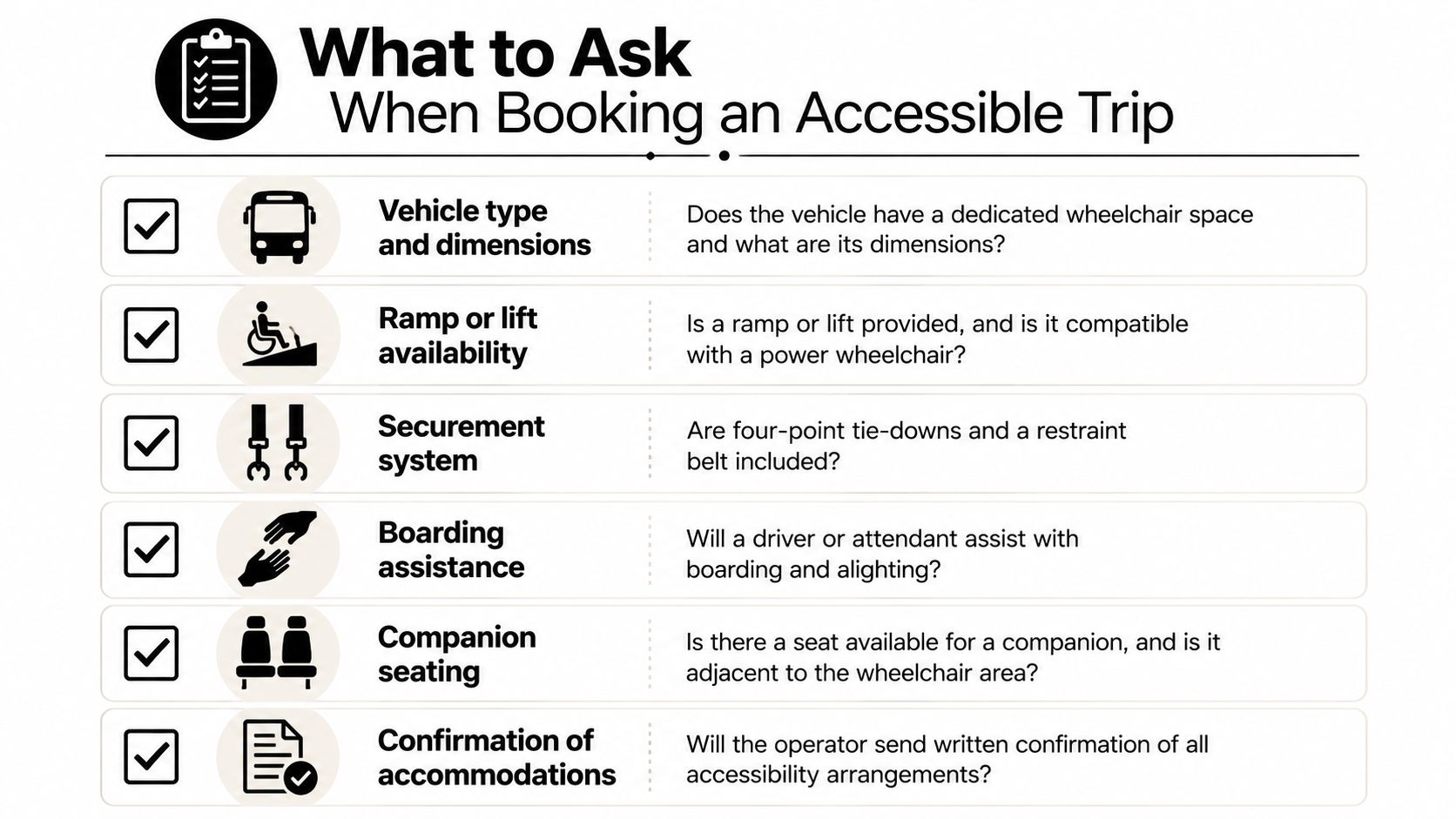
A good response won't rely on “yes, it's accessible” without explanation. It will clarify what the vehicle can do, what the driver will provide, and what information the passenger must share. If the operator can't meet a request, it should say so promptly and explain whether another arrangement is available.
Passengers should raise any mismatch before travel, keep written confirmations, and use the operator's formal complaint route if the agreed service isn't delivered. For cruise travellers comparing airport connections, practical planning information about England's cruise ports can also help identify transfer requirements early.
For accessible airport, hotel, and cruise-port transfers, EC Minibus offers pre-booked journeys with clear arrangements, professional drivers, and support for mobility and luggage needs. Contact the team before travelling to discuss your requirements and confirm the right vehicle for your Heathrow, Southampton, Dover, Portsmouth, or Tilbury transfer.