

You've landed at Heathrow with cases, a fixed sailing date and a ship that won't wait for a late transfer. The nearest-looking port on a map may not be the easiest one to reach, especially when you add terminal location, rail connections, parking, luggage handling, mobility needs and your post-cruise hotel plans.
Choosing among England cruise ports is therefore a transport decision as much as a cruise decision. Southampton offers the greatest scale, Dover provides a direct continental gateway, Portsmouth suits selected South Coast itineraries, and Tilbury connects cruise travel with London. Smaller and less familiar ports also form part of the wider UK network, but the most reliable planning starts with the terminals and routes that have verified operational information.
The guide below follows the complete port-day journey, from selecting the right gateway and travelling from Heathrow or London to managing luggage, accessibility, embarkation timing, disembarkation and onward hotels. It also explains how travel agents and transfer providers can build dependable arrangements around the four principal England ports covered in the supplied information.
Table of Contents
- 1. Southampton Cruise Terminal, the UK's Premier Cruise Port
- 2. Dover Cruise Port, the Gateway to Continental Europe
- 3. Portsmouth Cruise Terminal, a South Coast Maritime Hub
- 4. Tilbury Cruise Terminal, London's River Gateway
- 5. Pre-Cruise Heathrow to Port Ground Transfer Planning
- 6. Post-Cruise Port to Hotel Transfer Services
- 7. Cruise Passenger Demographics, Understanding 45+ American and Canadian Travellers
- 8. Travel Agent Partnerships, B2B Ground Transfer Integration
- 9. Multi-Port Regional Transfer Strategies, Maximising Geographic Coverage
- 10. Premium Customer Experience Excellence, Service Differentiation in Transfers
- England Cruise Ports & Transfers, 10-Point Comparison
- Turn Port Choice Into a Stress-Free Cruise Day
1. Southampton Cruise Terminal, the UK's Premier Cruise Port
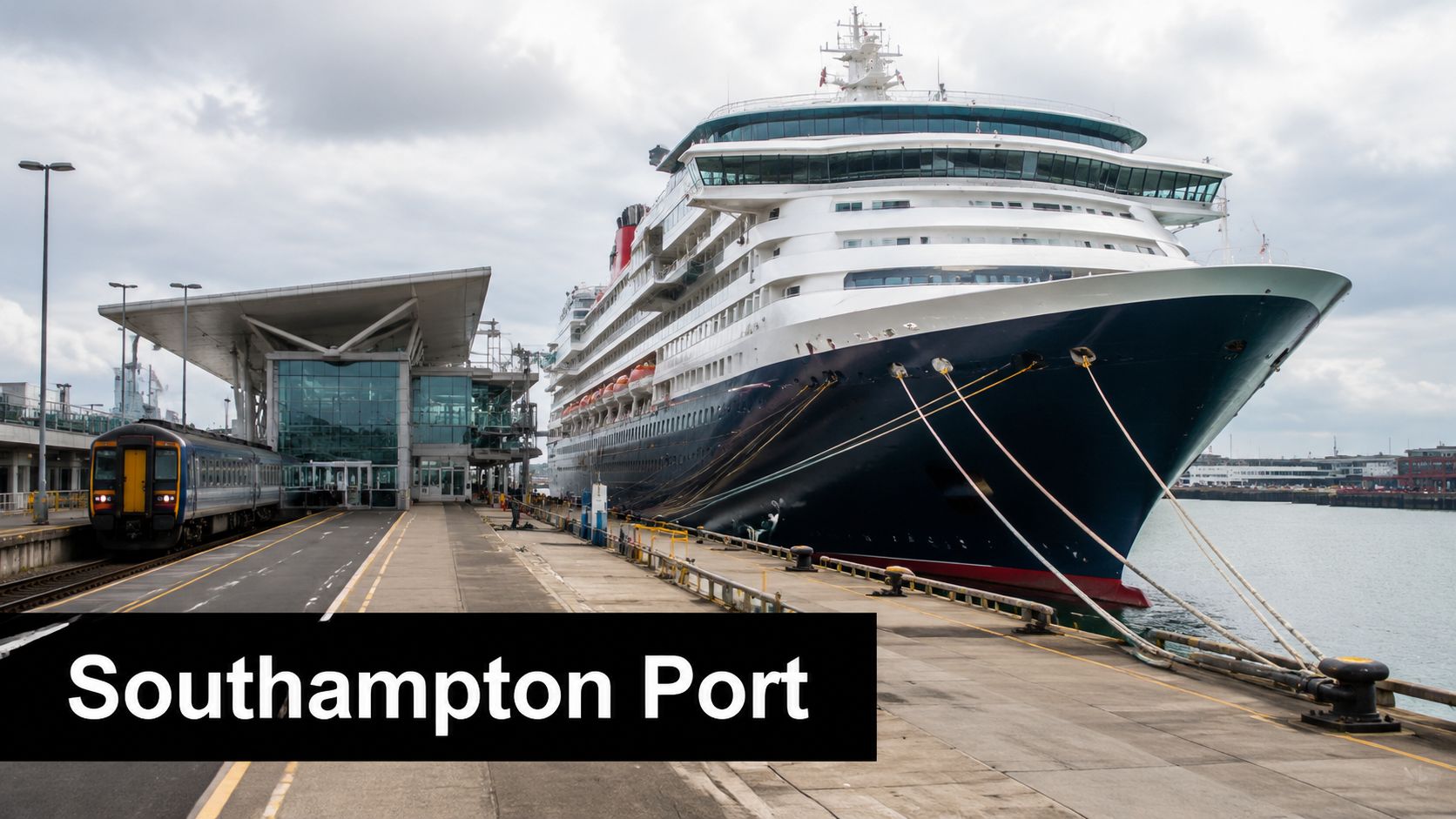
Southampton is the practical starting point for many travellers comparing England cruise ports. Associated British Ports describes it as the UK's dominant cruise port and leading turnaround hub, with around 3 million cruise passengers passing through five dedicated cruise terminals annually. Industry coverage also records 3 million cruise guests in 2024, compared with 2.6 million in 2023, while cruise activity contributed more than £1 billion to the local economy in 2024. These figures are reported by Associated British Ports and industry coverage of Southampton's cruise activity.
That scale brings choice, but it also creates pressure on peak sailing days. Southampton has five cruise terminals, including the Horizon Cruise Terminal, and the port's operational information identifies a shore power facility for cruise ships, a useful benchmark for modern terminal planning. The Southampton VTS port information is the right place to confirm the current terminal before arranging a vehicle.
Match the transfer to the terminal
Southampton Central provides the main rail connection, but a train journey still leaves you with the final leg, luggage and the exact terminal entrance. A private, door-to-port transfer can be more convenient for families, passengers with reduced mobility or anyone arriving from Heathrow with multiple cases. Read the practical terminal guidance in this Queen Elizabeth Cruise Terminal Southampton guide before confirming the pickup and drop-off details.
Practical rule: Confirm the terminal name on your cruise documents before booking transport. “Southampton cruise port” is not a precise enough drop-off instruction.
Allow generous time for check-in, security and luggage acceptance. Don't assume the largest port will offer the simplest last-minute solution. During busy periods, pre-arranged transport removes the need to search for parking or negotiate an unfamiliar terminal layout after a long flight.
2. Dover Cruise Port, the Gateway to Continental Europe
Dover suits itineraries crossing the Channel. The port lies 34 kilometres, or 21 miles, from the French coast, making it the nearest English port to France and a major short-sea gateway. In 2019, Dover handled 130 cruise ship calls and more than 200,000 cruise passengers, ranking second among UK cruise ports after Southampton, according to the Port of Dover overview.
Cruise ships share the port with a much larger passenger and freight operation. Arrival roads, parking areas and terminal approaches can therefore feel less straightforward than those at a purpose-built cruise facility. The White Cliffs provide an immediate landmark, while exposed coastal conditions make weather and traffic worth checking before travel.
Build in flexibility around the Channel
Dover works well for itineraries visiting France, Belgium or the Netherlands, and for passengers staying in Kent or travelling from London. Passengers flying into Heathrow may find another port more convenient, as Dover sits on the opposite side of the country. A private transfer avoids changing trains with luggage and gives the driver a clear destination, provided the booking includes the ship's exact terminal instructions.
Use the Dover Cruise Terminal guidance when preparing the journey. Share your flight number, luggage quantity and sailing details, then confirm how EC Minibus or another provider handles flight delays and late arrivals. A weather check also helps, since coastal conditions can affect road and port operations.
Choose reliability over a tight schedule
Plan to reach the terminal well before the cruise line's stated check-in deadline. While parking looks cheaper upfront, it adds walking, shuttle changes and uncertainty for passengers who need assistance, so a door-to-door vehicle is usually the safer choice. This approach is particularly useful when luggage is heavy, mobility is limited or a Heathrow arrival leaves little margin for disruption.
3. Portsmouth Cruise Terminal, a South Coast Maritime Hub
Portsmouth suits travellers whose ship is scheduled to use its international port and who want time on the South Coast before boarding. The historic maritime city offers access to the waterfront, the Isle of Wight and nearby New Forest attractions, making an overnight stay practical for some itineraries. Its cruise facilities support selected departures, turnaround calls and seasonal sailings, so the ship and sailing date should determine the transfer plan.
Southampton handles a broader concentration of cruise activity. Before booking a transfer, confirm whether your ship is calling at Portsmouth International Port, since port-name searches can match the wrong terminal. Check the cruise line's arrival instructions and use the terminal details in every booking.
Make the overnight stay work for you
A Portsmouth hotel night can reduce the pressure of travelling from Heathrow on embarkation day. A stay near the historic area may also leave time for sightseeing, but check luggage storage, step-free access and whether taxis or private vehicles can reach the entrance. Large cases, walking difficulties and mobility aids can make the final short journey the most tiring part of the day.
For Heathrow connections, the Portsmouth to Heathrow transfer information offers a useful starting point for both the outward and return journeys. EC Minibus can help plan Heathrow, London and port transfers when the booking includes the ship's exact terminal, pickup address and sailing details. State the number of bags and whether the vehicle must accommodate a wheelchair or other mobility equipment.
A clear luggage plan matters as much as the route.
Leave the car question until last
Portsmouth's urban setting can make parking less straightforward than a suburban hotel car park. A pre-booked private transfer works well when passengers have fixed check-in times, several bags, or a group travelling together. It keeps the party together and removes the need for one person to handle luggage while another searches for a space.
Allow enough time for check-in and security, including extra margin for passengers who need assistance. A relaxed pre-cruise night delivers its value when the final transfer is arranged with the same care as the hotel booking.
4. Tilbury Cruise Terminal, London's River Gateway
Tilbury gives London-bound travellers another route to a cruise departure. Set on the Thames Estuary, it provides deep-water berths and access to the capital while remaining separate from central London. A hotel in Westminster, Kensington or near St Pancras may suit sightseeing, yet reaching Tilbury still requires a well-timed road or rail connection.
Tilbury suits passengers combining a cruise with a London stay before or after sailing. It can also work for UK-based itineraries and selected international calls. Check the cruise line's sailing information carefully, since the riverside location makes ship movements and port access relevant to the day's plan.
Treat London and Tilbury as separate locations
A short hotel-to-terminal distance on a map doesn't guarantee a simple transfer, because underground changes, stairs and large cases can make the journey uncomfortable. A private vehicle gives the group a direct connection and avoids changing services, although the booking must include the hotel's exact entrance and postcode.
Allow extra flexibility for a Tilbury transfer. Tidal conditions may affect ship movements, while traffic and station changes can extend the journey beyond the map estimate. Check the cruise line's embarkation instructions and confirm whether the terminal has changed for the sailing.
Plan the return journey before boarding
Tilbury works well when a London hotel follows disembarkation. Give the transfer provider the full hotel address, preferred arrival time and any onward rail or flight connection. A flexible booking gives more room for queues, luggage collection and immigration procedures that follow disembarkation.
EC Minibus can help coordinate London and Tilbury transfers when the booking includes the ship's exact terminal, pickup address and sailing details. State the number of bags and whether the vehicle must accommodate a wheelchair or other mobility equipment. These details affect vehicle choice, loading time and the comfort of the final journey.
5. Pre-Cruise Heathrow to Port Ground Transfer Planning
A Heathrow arrival can become stressful when the cruise departure time leaves little room for baggage delivery, border formalities, a crowded arrivals hall or delayed passengers. Allow extra time between landing and departure, because each stage can affect the planned pickup. Give the transfer provider the flight number, arrival date, passenger count, luggage quantity and confirmed terminal so it can choose a suitable vehicle and monitor the journey.
EC Minibus handles transfers from Heathrow or Central London to Southampton, Dover, Portsmouth and Tilbury. Its supplied service information describes meet and greet at Heathrow, flight and cruise monitoring, licensed and insured drivers, modern vehicles, luggage assistance and fixed pricing without hidden fees. Confirm these arrangements when booking rather than assuming they come with every airport taxi service.
Give the driver useful information
A complete booking record helps the provider plan the vehicle, meeting point and timing. Include:
- Flight details: Share the flight number so the provider can monitor arrival changes.
- Luggage requirements: State the number and type of cases, including oversized bags or mobility equipment.
- Terminal confirmation: Enter the ship, cruise line and terminal information exactly as shown in your documents.
- Meeting instructions: Confirm where the driver will wait and how you'll identify the service in arrivals.
- Contingency contact: Keep the provider's support details available if baggage or immigration takes longer than expected.
A transfer is only as accurate as the information attached to it. The ship name, terminal and luggage profile should be part of the booking record.
Allow a practical journey buffer
A flight-tracking driver can respond to an early or late landing, while baggage collection, immigration and traffic still require extra allowance. No service can eliminate every delay after touchdown, so build a practical buffer into your planned arrival time. Book the transfer early, allow time before embarkation and avoid placing a non-refundable, tightly timed rail connection immediately after landing.
Check the cruise line's embarkation instructions before finalising the pickup. The confirmed terminal and a realistic departure time matter as much as the airport arrival itself, particularly when the journey includes luggage or mobility equipment.
6. Post-Cruise Port to Hotel Transfer Services
Disembarkation is often slower and less predictable than passengers expect. The ship may reach port at the published time, but passengers still need to wait for clearance, collect cases, pass through the terminal and locate their onward vehicle. A post-cruise transfer should therefore be arranged around a realistic collection window, not the instant the ship reaches the berth.
The most useful arrangement links the outbound and return journeys. Passengers travelling from Southampton, Dover, Portsmouth or Tilbury to a London hotel can ask the same provider to keep both bookings together, which reduces the risk of entering the wrong terminal or hotel details later. EC Minibus provides port transfers to London hotels and Heathrow, with luggage assistance and monitored cruise journeys included in its stated service offering.
Make the hotel booking part of the transport plan
Give the provider the hotel's complete address and postcode. London hotels can have similarly named entrances or multiple access points, while some central streets restrict vehicle access. Tell the driver whether you need reception drop-off, luggage storage or a specific arrival window for check-in.
A flexible collection time is usually more useful than an aggressively early appointment. If the cruise line offers a disembarkation group or luggage tag system, use that information when choosing the pickup window. Passengers with reduced mobility should also request appropriate assistance from the cruise line before arrival, because vehicle access and terminal support are separate arrangements.
Keep an onward flight buffer
Travellers connecting to Heathrow should avoid treating the port-to-airport leg as a guaranteed fixed-duration journey. Road congestion, terminal queues and disembarkation delays can affect the schedule. If the flight is important, provide the flight details to the transfer company and explain that the booking is cruise-related, rather than requesting a generic airport ride.
7. Cruise Passenger Demographics, Understanding 45+ American and Canadian Travellers
A North American passenger may reach an English cruise port after a long-haul flight, with several cases, prescription medication, mobility aids and a fixed hotel-to-ship schedule. The transfer should therefore receive the same planning attention as the cruise itself. Comfort, clear instructions and dependable timing shape the first part of the holiday.
Passengers aged 45 and over commonly look for comfortable seating, clear communication and a driver familiar with cruise schedules. The practical standard is simple: confirm the booking, explain the meeting point, assist with luggage and provide updates if a flight or road journey changes. These details carry more value than promotional wording.
Build the booking around comfort
Check luggage capacity before payment. Cases should fit in the vehicle's storage area rather than passenger footwells. Ask about step height, seating position, wheelchair storage and kerbside assistance. Families and small groups should also confirm that every passenger and case can travel in one vehicle.
The following details make comparisons easier:
- Meet and greet: A named meeting point reduces uncertainty after immigration.
- Luggage assistance: Confirm what the driver can do at collection and drop-off.
- Vehicle information: Ask whether the booking uses a minibus, executive car or another vehicle type.
- Communication access: Wi-Fi or charging may help with onward arrangements, but verify what the booked vehicle includes.
- Professional support: A responsive contact channel helps when flights, baggage collection or cruise timings change.
EC Minibus handles transfers linking Heathrow, London and cruise ports, with luggage assistance and monitored cruise journeys included in its stated service offering. Travellers should still confirm the vehicle and assistance requirements for their own booking.
Use reviews alongside operational checks
Reviews on platforms such as Trustpilot and Tripadvisor can help assess punctuality, communication and driver conduct. Before paying, ask about insurance, licensing, terminal knowledge and cancellation terms, particularly when arranging transport from overseas.
Passengers connecting through Heathrow should share flight details and explain that the booking is cruise-related. A port transfer can be affected by road congestion, terminal queues and disembarkation delays, so an onward flight needs a suitable buffer rather than a narrowly timed collection.
A clear confirmation email with local meeting instructions is more useful on arrival day than a long promotional description. The strongest booking removes avoidable decisions when passengers are tired, carrying luggage and working to a cruise timetable.
8. Travel Agent Partnerships, B2B Ground Transfer Integration
A client arriving at Heathrow, staying in London, boarding at Southampton and continuing to a hotel has several handovers to manage. Treating transport as a late add-on leaves the agent with less control over terminal information, luggage arrangements and disruption planning. Build the ground journey into the cruise package from the first quote.
EC Minibus handles routes linking Heathrow, Central London, Southampton, Dover, Portsmouth, Tilbury and St Pancras International. That coverage can help agents keep one transfer plan when a traveller uses different gateways for arrival, embarkation and onward travel. The practical benefit depends on confirming each vehicle, terminal and timing rather than assuming one standard arrangement fits every itinerary.
A partnership should be judged by its working process, not only by its public fare. Before committing, agree how the provider will receive and update flight, ship, hotel, terminal, luggage and accessibility details. Confirm group capacity, wholesale terms, commission arrangements, payment responsibilities and cancellation rules directly.
Agents should also establish who handles changes. A useful arrangement allows the agent to amend booking information, coordinate several vehicles when required and reach a named contact if a connection is missed or a terminal changes. The traveller should receive clear meeting and collection instructions as well, so essential information does not remain inside the agency's booking system.
Build the handovers into the package
The strongest itinerary links airport arrival, pre-cruise accommodation, port transfer and post-cruise hotel travel. Each stage can then be checked for collection points, luggage volume, mobility needs and realistic timing. One record of those details reduces the risk of a vehicle arriving without the space or access support the passenger requires.
Agents should present the service accurately. A transfer does not remove road congestion, flight disruption or terminal queues. It can provide a documented plan, visible support and an agreed fallback process, giving the traveller clearer decisions throughout the port day.
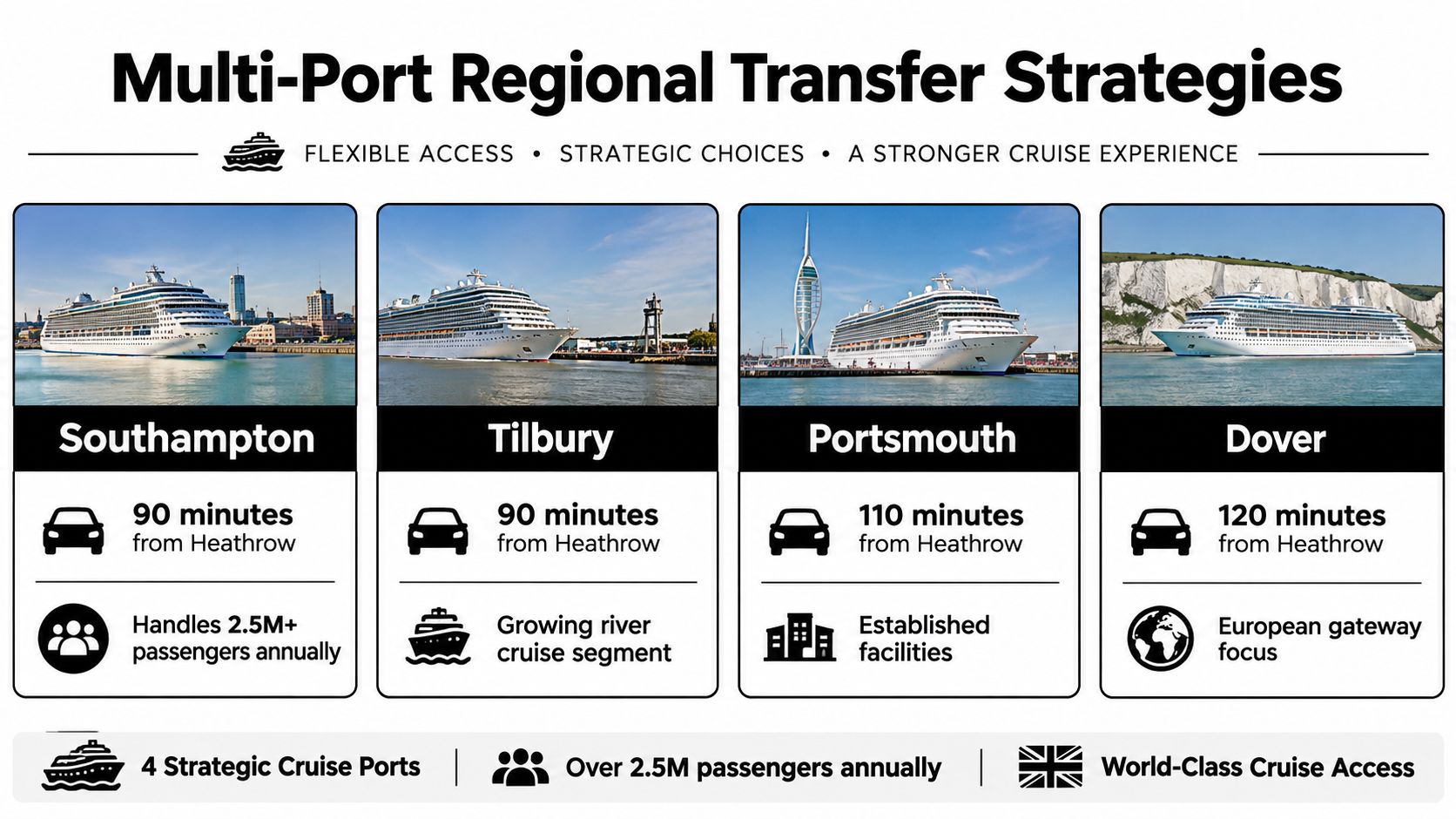
9. Multi-Port Regional Transfer Strategies, Maximising Geographic Coverage
England's cruise network is more concentrated than many destination guides imply. Government sea-passenger statistics report that about 3.1 million cruise passengers travelled through UK ports in 2025, with 2.6 million, or 86%, passing through Southampton. The same source records 102,000 through Dover, 61,000 through Portsmouth and 131,000 through London, while other ports accounted for 57,000. These figures are available in the UK Government's 2025 international sea passenger statistics.
That concentration changes the planning task. Southampton offers scale and frequent operational experience, but peak demand can make vehicle availability and terminal approaches more pressured. Secondary ports may provide a better geographical fit for a particular itinerary, yet they require passengers and agents to verify local access rather than assuming the same transfer pattern works everywhere.
Use one regional provider carefully
EC Minibus lists Southampton, Dover, Portsmouth and Tilbury among its cruise-port routes. That can be useful for travel agents coordinating clients on different itineraries or for passengers arriving through Heathrow and departing from a port that isn't Southampton. The provider still needs the exact sailing information, because a regional service is only dependable when the final terminal and access instructions are correct.
Map the handovers, not just the roads
A professional plan should account for airport arrivals, hotel pickups, rail connections, parking alternatives, luggage volume and peak sailing periods. It should also maintain consistent standards across routes, including vehicle condition, driver communication and assistance for passengers with accessibility needs.
Planning principle: Geographic coverage helps only when every route has the same attention to terminal detail, capacity and contingency handling.
The less obvious port may reduce a passenger's road journey from a regional hotel, but it may not offer the same frequency of transfers or onward transport. Compare the complete door-to-door journey before choosing on distance alone.
10. Premium Customer Experience Excellence, Service Differentiation in Transfers
A premium cruise transfer is measured by how few problems the passenger faces during a tiring travel day. The driver should arrive with accurate passenger and luggage details, confirm the destination, manage the handover calmly and communicate promptly if circumstances change.
This matters on England cruise ports routes, where a Heathrow arrival may continue to a South Coast terminal, a London hotel may connect with Tilbury, or disembarkation may be followed by an international flight. The provider must understand the full sequence, including the terminal, luggage and onward connection, rather than treating each journey as an isolated booking.
Details that shape the passenger's experience
The practical standard is visible in small decisions:
- Clear confirmation: The passenger receives the meeting point, vehicle details and contact process before travel.
- Prepared vehicles: Cases fit safely, seats remain comfortable and the interior is clean.
- Informed drivers: The driver knows whether the collection is from a hotel, rail station or cruise terminal.
- Proactive monitoring: Flight and cruise information helps the provider respond to schedule changes.
- Human support: Travellers can reach someone when baggage delays, traffic or port procedures alter the plan.
A good transfer also makes accessibility and luggage requirements part of the booking conversation. Confirming case volume, mobility needs and the amount of assistance required helps the operator assign a suitable vehicle and allow enough loading time.

Premium service should solve practical risks
Reliability protects the cruise booking, even when a luxury vehicle is not required. Check verified reviews, licensing and insurance details, then confirm what the quoted price includes. Fixed pricing, meet and greet, luggage assistance and responsive support may offer more value than decorative extras.
EC Minibus describes its vehicles as modern and comfortable and its drivers as licensed and insured. Assess those details against the booking itself, including group size, luggage volume, accessibility requirements and the timing of embarkation or the onward flight.
England Cruise Ports & Transfers, 10-Point Comparison
| Item | Implementation Complexity 🔄 | Resource Requirements ⚡ | Expected Outcomes ⭐ / 📊 | Ideal Use Cases 💡 | Key Advantages 📊 |
|---|---|---|---|---|---|
| Southampton Cruise Terminal - UK's Premier Cruise Port | Moderate, established multi-terminal ops; peak-season logistics 🔄 | High, staffing, terminal services, rail/road interface ⚡ | High throughput (2.5M+/yr); wide itinerary range ⭐⭐⭐ 📊 | Major turnarounds; London-origin passengers; large-ship deployments 💡 | Closest major port to London; direct rail; multi-ship capacity 📊 |
| Dover Cruise Port - Gateway to Continental Europe | Low–Moderate, modern single-terminal flow; weather-dependant 🔄 | Moderate, berth management, limited adjacent amenities ⚡ | Moderate throughput (~200k/yr); efficient short crossings ⭐⭐ 📊 | Short European itineraries; quick continental hops 💡 | Proximity to continent; modern 2016 terminal; short sea times 📊 |
| Portsmouth Cruise Terminal - South Coast Maritime Hub | Moderate, capable terminal with smaller volume than Southampton 🔄 | Moderate, rail links, parking, local logistics ⚡ | Growing throughput; good regional connectivity ⭐⭐ 📊 | Regional departures; Isle of Wight/New Forest access; turnaround cruises 💡 | Historic port atmosphere; strong rail link to London (1.5h) 📊 |
| Tilbury Cruise Terminal - London's River Gateway | Low–Moderate, deep-water, year-round ops but tidal constraints 🔄 | Moderate, London access, fewer shore amenities outside terminal ⚡ | Convenient London access; rising river-cruise use ⭐⭐ 📊 | Passengers visiting central London; river/urban itineraries 💡 | Closest to Central London (30–45 min); direct train access 📊 |
| Pre-Cruise Heathrow→Port Ground Transfer Planning | Moderate, requires flight monitoring, scheduling systems 🔄 | High, vehicles, trained drivers, real-time ops and comms ⚡ | High reliability; reduced missed sailings; better on-time performance ⭐⭐⭐ 📊 | International arrivals; time-sensitive departures; group transfers 💡 | Meet-and-greet, flight tracking, door‑to‑door reliability 📊 |
| Post-Cruise Port→Hotel Transfer Services | Low, standard pickup logistics with flexible timing 🔄 | Moderate, luggage-capable vehicles and flexible staffing ⚡ | Improved passenger experience; seamless onward travel ⭐⭐ 📊 | Disembarkation to hotels/airports; post-cruise extensions 💡 | Luggage assistance, flexible scheduling, continuity of service 📊 |
| Cruise Passenger Demographics (45+ North Americans) | Low, market segmentation and tailored offers 🔄 | Moderate, higher‑comfort vehicles, trained staff, agent channels ⚡ | Higher spend per passenger; loyalty and repeat bookings ⭐⭐⭐ 📊 | Premium transfers; agent-sold packages; personalized service offers 💡 | Willingness to pay for comfort/reliability; strong agent relationships 📊 |
| Travel Agent Partnerships - B2B Integration | Moderate, contract, system and payment integration required 🔄 | Moderate, wholesale pricing, dedicated agent support teams ⚡ | Increased bookings and stable B2B revenue; higher volumes ⭐⭐ 📊 | Package bundling; group bookings; wholesale distribution channels 💡 | Access to agent networks; recurring volume; reduced direct sales cost 📊 |
| Multi-Port Regional Transfer Strategies | High, complex routing, dispatch and contingency planning 🔄 | High, scalable fleet, real-time fleet mgmt and cross-port coordination ⚡ | Broader market reach; reduced seasonality risk; optimized utilization ⭐⭐⭐ 📊 | Operators serving multiple ports; travel agents offering flexible itineraries 💡 | Comprehensive coverage across Southampton/Dover/Portsmouth/Tilbury; resilience 📊 |
| Premium Customer Experience Excellence | Moderate, process, training and QA systems to maintain standards 🔄 | High, investment in training, vehicles, 24/7 support and tech ⚡ | Strong NPS, high repeat bookings, premium pricing potential ⭐⭐⭐⭐ 📊 | Luxury transfers; high-value clientele; branding/differentiation strategies 💡 | Verified reviews, preferred-vendor status, customer loyalty and premium margins 📊 |
Turn Port Choice Into a Stress-Free Cruise Day
A smooth cruise transfer starts before the flight. First, confirm the ship's exact terminal, not just the port city. Southampton has five cruise terminals, while Dover, Portsmouth and Tilbury each require their own terminal and access instructions. Check the cruise line's embarkation deadline, luggage rules and mobility arrangements, then save the terminal details with your booking confirmation.
Next, compare the complete journey from your actual starting point. Rail can work well for passengers travelling light and staying near a suitable station. Parking may suit those driving from home, but it adds vehicle access, walking and luggage decisions. A private transfer is often the most direct option for Heathrow arrivals, families, older travellers, small groups and passengers carrying several cases.
Southampton remains the dominant UK turnaround hub. Associated British Ports reports 45,600 jobs supported and £2.5 billion contributed to the national economy annually through the wider Southampton operation, as detailed on its official Southampton port information. That scale explains why the port can offer extensive cruise infrastructure, but it also means passengers should avoid leaving terminal decisions until arrival day.
Dover deserves a different approach. Its proximity to continental Europe makes it a natural gateway for Channel-focused itineraries, while its wider passenger role creates busy transport flows around the port. Portsmouth can be a good fit when the itinerary and hotel plan align with the South Coast, and Tilbury works well for travellers combining a cruise with Central London. None of these ports should be judged by distance alone. Consider the terminal, the road journey, the available rail connection, parking, luggage handling, accessibility and the next stage after disembarkation.
For Heathrow arrivals, provide the flight number so the transfer company can monitor changes. State how many cases you have and whether anyone needs extra assistance or a low-step vehicle. Ask for meet and greet in the arrivals hall, confirm the vehicle capacity and ensure the driver has the terminal name. Flight monitoring helps with landing changes, while cruise monitoring can support adjustments around port schedules, but you should still allow a practical buffer before embarkation.
The return journey deserves equal attention. Disembarkation may involve clearance, luggage collection and terminal queues before you reach the vehicle. Arrange your port-to-hotel or port-to-Heathrow transfer early, provide the hotel postcode and avoid placing a flight or train connection immediately after the ship's nominal arrival. If you're staying in London, make sure the driver can access the hotel entrance and knows whether luggage storage or reception drop-off is required.
EC Minibus is one relevant option for private journeys between Heathrow, Central London hotels, Southampton, Dover, Portsmouth, Tilbury and St Pancras International. Its supplied service details include meet and greet, flight and cruise monitoring, luggage assistance, modern vehicles, licensed and insured drivers, secure online booking and fixed transparent pricing. Confirm that the selected vehicle and route suit your group before paying.
The right England cruise port is the one that fits the entire day, from airport arrivals and hotel departure to terminal check-in and the journey after the ship. Plan each handover, share accurate information and leave room for real-world delays. That approach turns a complicated port day into a sequence you can follow with confidence.
If you're arranging a Heathrow, Central London, Southampton, Dover, Portsmouth or Tilbury cruise transfer, visit EC Minibus to review private door-to-door options with meet and greet, flight and cruise monitoring, luggage assistance and fixed transparent pricing. Enter your flight, terminal, hotel and luggage details when booking so the journey can be planned around your actual cruise day.