

Your flight has landed at Heathrow, but the terminal feels strangely empty. It's 1:40 AM after a delayed journey from Dubai, your family's phones are nearly dead, airport Wi-Fi keeps dropping, and the transfer you booked hasn't appeared. The booking confirmation says “24/7 support”, yet the phone line sends you to voicemail.
That situation exposes the difference between a provider that advertises 24 hour customer care and one that can manage a problem at three in the morning. Airport arrivals, hotel transfers and cruise connections don't follow office hours. A reliable operator needs people, systems and authority working when passengers need them most.
Table of Contents
- What 24 Hour Customer Care Really Means for Travellers
- Why Round-the-Clock Support Matters for UK Transfers
- Essential Features of Reliable 24 Hour Transfer Support
- How to Choose a Transfer Provider with Genuine 24/7 Care
- How EC Minibus Delivers 24 Hour Customer Care in Practice
-
Frequently Asked Questions About Out-of-Hours Transfer Support
- What happens if my flight diverts to another airport overnight?
- Does 24-hour support include bank holidays and public holidays?
- Can passengers with mobility needs get help at unsocial hours?
- Does round-the-clock care mean a vehicle can arrive immediately?
- Does 24/7 support always cost more?
- What should I do if no one responds?
- Final Thoughts on Booking Transfers with 24 Hour Support
What 24 Hour Customer Care Really Means for Travellers

The family at Heathrow doesn't need a chatbot to explain where Terminal 5's taxi rank is. They need someone to confirm whether the driver is still waiting, check the delayed flight, contact the vehicle and give clear instructions in a place they may never have visited before.
That's the baseline. Genuine 24 hour customer care means live human assistance at any time, with access to the operational information needed to solve the problem. It isn't an automated voicemail greeting, a chatbot that can only answer routine questions, or an “emergency number” that forwards calls to an unrelated call centre.
Availability is not the same as capability
A marketing claim says a company is available around the clock. Operational capability means the night team can take action. The dispatcher must be able to contact the driver, amend the collection plan, update the passenger and escalate a serious issue without waiting for the daytime office to open.
For a transfer provider, that normally includes:
- Live human response: A passenger can reach a person rather than leave a message and hope for a callback.
- Flight and cruise monitoring: The team sees schedule changes and understands how they affect collection times.
- Driver coordination: Dispatchers can confirm the vehicle's position and communicate directly with the assigned driver.
- Escalation procedures: Complex situations move quickly from the dispatcher to someone with authority to make an operational decision.
- Practical instructions: The passenger receives usable directions, not a generic reassurance.
A provider that can only record your complaint at 3 AM isn't delivering 24 hour care. It's offering delayed customer service.
Practical rule: Ask who answers outside office hours, what they can change, and whether they can contact your driver immediately.
Travellers should also check the provider's last-minute transfer availability before assuming a late change can be handled. The answer should describe a working process, not repeat the words “24/7”.
Why Round-the-Clock Support Matters for UK Transfers
A delayed flight reaches Heathrow after midnight. The passenger still has to cross a terminal, clear immigration, collect luggage and find an unfamiliar meeting point. If the transfer provider answers only during office hours, the booking offers little protection when the journey becomes difficult. Cruise passengers face tighter timing, because a late airport collection can threaten the connection to Southampton, Dover, Portsmouth or Tilbury.
The wider customer-service record shows why travellers should question every “24/7” promise. In a major UK eGain study, only 36% of companies responded to customer emails within 24 hours, while 44% ignored email customer service and 80% failed to answer questions within that window. Among companies that did respond, just 20% supplied an acceptable answer. The result was worse than the earlier 2004 study, when 48% responded within 24 hours, according to YouGov's analysis of British customer-service preferences.
Those figures cover customer service generally, but the risk is sharper in transport. A traveller waiting outside a terminal, dealing with a missed connection or managing a last-minute change across time zones cannot treat a slow reply as a minor inconvenience. The provider must respond while the problem is active, not after the passenger has found an expensive alternative.
The operational pressure is already visible
The 2023 UK Contact Centre Decision-Makers' Guide recorded an average inbound call cost of £6.55, call abandonment of 9.1%, and an average speed to answer of 120 seconds. It also found that 93% of UK contact centres expected at least some remote working. These figures appear in the UK contact-centre benchmark summary.
That pressure affects transport operators during disruption. A provider without a properly staffed night operation may leave passengers waiting while the daytime team catches up. The consequences include uncertainty around luggage, costly replacement travel and a real possibility of missing a fixed cruise departure.
Channel choice does not solve the problem by itself. UK live-chat benchmarks report an average wait of 2 minutes 40 seconds, with 21% of chats unanswered, while the fastest channels respond in seconds, as documented by SuperOffice's live-chat support benchmark. A chat icon proves little if nobody monitors it overnight or has authority to resolve an active transfer problem.
| Support Feature | Traveller Expectation | Typical Provider Reality |
|---|---|---|
| Late-night phone support | A live person who can act | Voicemail or a generic call centre |
| Flight disruption handling | Collection adjusted automatically | Passenger must chase the provider |
| Driver contact | Immediate confirmation of vehicle status | Office has no direct operational visibility |
| Cruise connection support | Clear coordination around port deadlines | Advice limited to the original booking |
| Live chat | Fast response from a trained adviser | Unanswered messages after office hours |
| Escalation | Access to an operations decision-maker | Issue waits until the next working day |
Reliable support belongs inside the transport operation. Travellers should ask who monitors each channel, what the night team can change and how quickly it can involve the driver or an operations decision-maker. Treat those answers as booking requirements, not optional extras discovered after a disruption.
Essential Features of Reliable 24 Hour Transfer Support
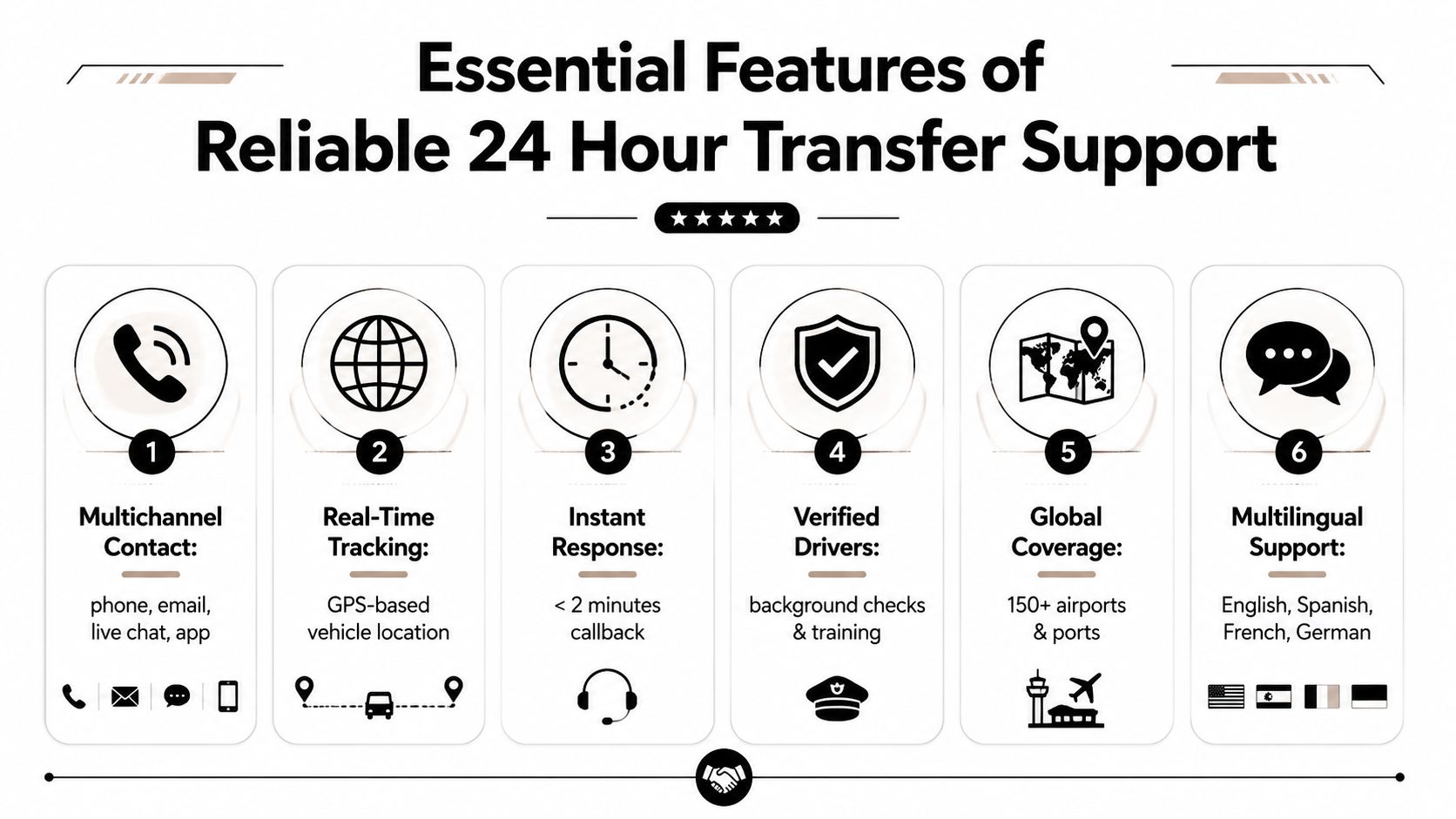
Use this checklist before paying for a transfer. If a provider can't answer these questions clearly, assume the support promise is weaker than the advertising suggests.
Start with contact methods that work abroad
A live phone line remains important, but it shouldn't be the only route. International passengers may not have a UK SIM card, may have limited roaming or may be unable to make a traditional voice call. A dependable provider should offer a practical mix of phone, WhatsApp, SMS, email and live chat, with clear expectations for urgent and non-urgent messages.
Ask whether the phone number reaches the operating team directly. Confirm whether WhatsApp messages are monitored overnight. A booking confirmation should identify the correct contact route, not leave the passenger searching through an old email thread.
Check what happens when the itinerary changes
Flight monitoring is useful only when it changes the operation. The team should track the relevant arrival, recognise a delay and adjust the collection plan so the driver isn't sent away before the passenger has cleared customs.
The same principle applies to cruise movements and rail connections. Ask:
- Delay management: Does the provider adjust the pickup time when the flight changes?
- Outbound updates: Will the team contact you, or must you report every disruption yourself?
- Terminal changes: Can the dispatcher revise the meeting point during the night?
- Driver visibility: Can the team confirm where the vehicle is and whether it remains assigned?
- Escalation: Who takes control if the original plan can't work?
A mobile transfer tracking system can help, but technology doesn't replace a person who can make a decision. GPS information is valuable only when dispatchers use it to coordinate the passenger and driver.
Demand accessibility, not just an open phone line
Inclusive support must cover passengers who can't rely on ordinary voice calls. UK communications guidance describes around-the-clock alternatives including Relay UK, emergency SMS and 999 BSL services, as explained by EE's communication support guidance. Transfer providers should tell passengers whether their own night operation can work with Relay UK, SMS or text-based channels.
The wider contact-centre picture also points towards multi-channel service. UK survey data reports that 96% of centres support live voice, 93.6% support email and 60% support web chat, while 25.3% planned automated voice expansion and 32.3% planned more web chat. For an international traveller, that means accessibility and language support should be checked before booking, especially when travelling with older passengers, hearing or speech barriers, reduced mobility or limited English.
Finally, insist on a written confirmation containing the pickup details, vehicle information, meeting instructions and direct support contact. Clear records reduce confusion when the passenger is tired, the terminal is busy or the original itinerary has changed.
How to Choose a Transfer Provider with Genuine 24/7 Care
The quickest test is to ask operational questions before booking. Don't ask, “Do you offer 24/7 support?” Every provider with a booking page can answer yes. Ask, “Who answers at 3 AM if my flight diverts?” and “Can that person contact my driver and change the collection?”
A credible answer names the process. It may identify a night dispatcher, explain the escalation route and confirm which channels are monitored. A weak answer relies on broad language such as “someone will get back to you” or “emergencies are handled where possible”.
Questions worth asking
- Who answers out-of-hours calls? Get a clear description of the team, not just a phone number.
- How are flight delays monitored? Confirm whether tracking is automatic and whether the collection time changes as a result.
- What happens after a diversion? Ask whether the provider can reprice, reroute or arrange a replacement vehicle.
- How are terminal changes handled? A night dispatcher should be able to issue new meeting instructions.
- Which channels are active overnight? Check phone, SMS, WhatsApp, email and live chat separately.
- What accessibility support is available? Ask specifically about text communication, Relay UK and mobility requirements.
- Where are the escalation boundaries? Find out who takes over when the dispatcher can't solve the issue.
Read reviews with a narrow focus. Look for comments about late arrivals, delayed flights, cruise-port collections, missed connections and contact attempts outside normal working hours. A review that praises a comfortable vehicle says little about overnight support. A review describing how the operator handled a changed arrival time tells you much more.
| Red Flags | Green Flags |
|---|---|
| Automated phone line after midnight | Named night dispatch or a clearly described live team |
| “Emergency support” with no response commitment | Defined response and escalation process |
| No flight or cruise monitoring | Active monitoring linked to pickup planning |
| Passenger must find the driver alone | Meet-and-greet instructions and direct coordination |
| Only one contact method | Phone plus text-based and digital channels |
| Vague diversion policy | Written instructions for rerouting and disruption |
| Reviews mention unanswered calls | Reviews describe successful out-of-hours resolutions |
A provider's night-time process matters more than its daytime branding.
Don't wait until arrival day to discover whether the emergency number reaches an actual operator. Verification takes a few questions before booking and can prevent a much harder conversation beside an empty terminal.
How EC Minibus Delivers 24 Hour Customer Care in Practice
Consider a cruise passenger whose connecting coach is cancelled after arriving at Southampton Port late at night. The passenger still needs to reach a London hotel, has luggage in the terminal and doesn't know whether the original booking can be salvaged.
A functioning support operation treats the message as a live logistics problem. The dispatcher confirms the passenger's location, checks the booking, identifies the available vehicle, updates the passenger by SMS and coordinates the collection point with the terminal contact. The driver receives the revised instructions instead of following an obsolete schedule.
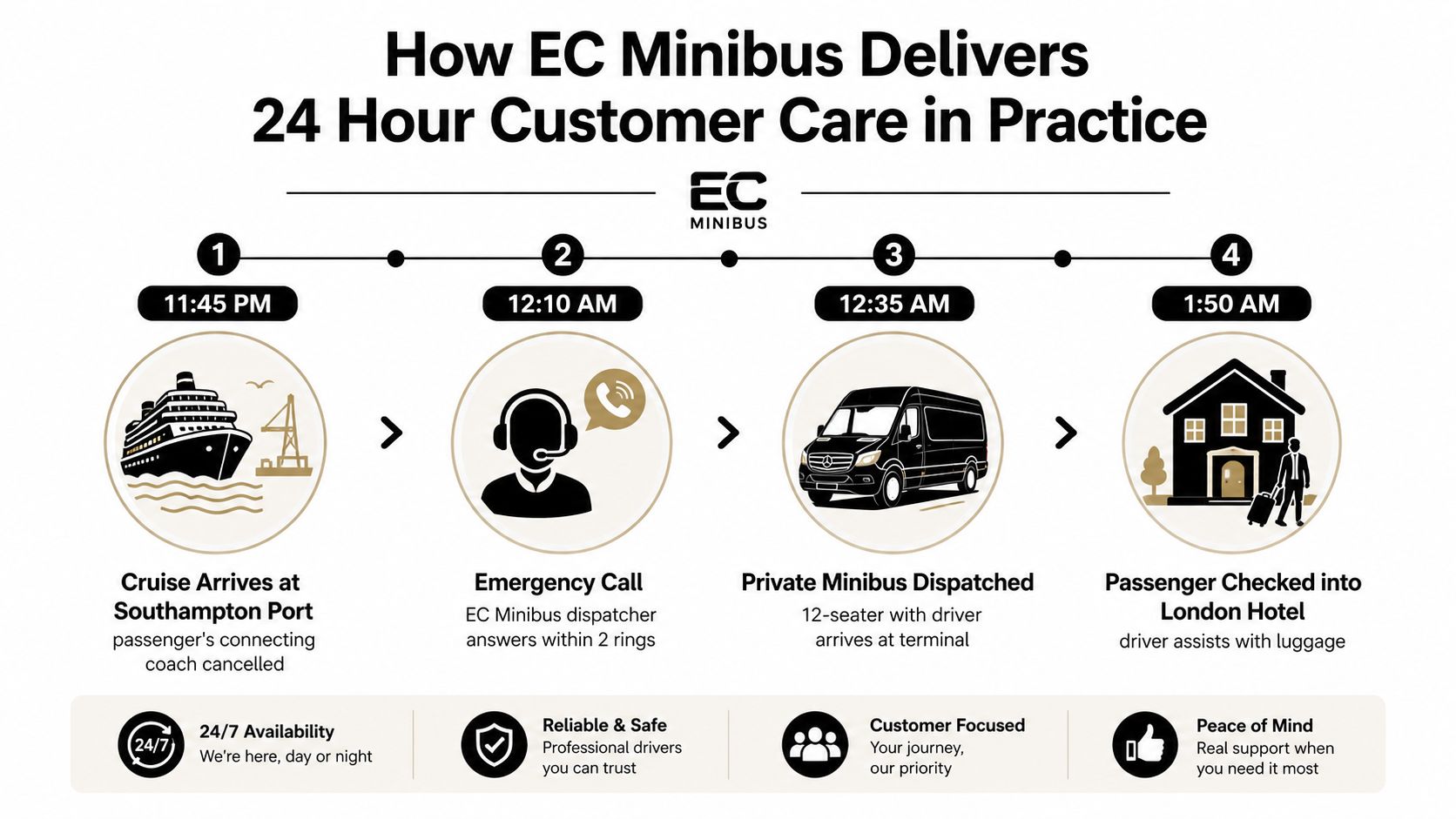
The mechanics matter more than the slogan. A night dispatcher needs visibility of the fleet, a direct line to the driver and permission to make practical changes. The passenger needs one accountable contact, updated instructions and honest information about what can happen next.
For an accessibility requirement, the same process should begin before the vehicle moves. The team confirms the passenger's needs, checks the vehicle and driver arrangement, and records any assistance required at the port or hotel. For a diversion or missed connection, the dispatcher should establish the new location first, then decide whether the original vehicle can reach it or whether a replacement plan is necessary.
EC Minibus describes direct customer assistance, live website chat for questions and booking confirmation details that include contact information and a UK toll-free number. Its transfer information also refers to flight and cruise monitoring, which is the kind of operational detail travellers should look for when comparing providers. Passengers arranging extra help can review the provider's concierge assistance information before travelling.
The useful lesson isn't that one operator can eliminate every disruption. No provider can control customs queues, diversions or cancelled coaches. The standard is whether the team responds, communicates and takes responsibility for the next workable step.
The following video provides another way to understand the service flow and the role of human coordination during an urgent transfer issue.
Frequently Asked Questions About Out-of-Hours Transfer Support
What happens if my flight diverts to another airport overnight?
Contact the provider as soon as you know the diversion airport and your new arrival details. A genuine support team should assess vehicle availability, distance, timing and the effect on any following cruise or hotel connection. Don't assume the original pickup will transfer automatically to a different airport.
Does 24-hour support include bank holidays and public holidays?
Ask before booking. “24/7” should mean every day, but some providers use the phrase for extended weekday hours and operate a separate holiday schedule. Request the holiday policy in writing if your itinerary falls over a weekend or public holiday.
Can passengers with mobility needs get help at unsocial hours?
They should be able to request assistance before travel and reach a team member if the plan changes overnight. Confirm vehicle suitability, luggage requirements, boarding support and text-based communication in advance. Don't rely on a general promise that “special requests” are handled.
Does round-the-clock care mean a vehicle can arrive immediately?
No. Customer-care availability and vehicle dispatch time are different promises. A dispatcher may answer promptly but still need time to locate a suitable vehicle, reach the passenger and comply with the revised route. Ask what the provider can commit to in the specific area and circumstances.
Does 24/7 support always cost more?
Not necessarily. Some providers include it within the transfer service, while others attach an after-hours fee or offer limited emergency coverage. Compare the full booking terms rather than assuming a low headline fare includes live overnight assistance.
What should I do if no one responds?
Keep screenshots of messages, note call times and use every listed channel. If you're in immediate danger, contact the appropriate emergency service. For a transport failure, keep receipts for necessary alternatives and report the issue formally once you're safe, using the booking terms to request an explanation or refund.
Final Thoughts on Booking Transfers with 24 Hour Support
A transfer provider proves its value when the original plan fails. A delayed flight, extended customs queue, terminal change or cancelled connection can quickly become a high-pressure problem for international passengers unfamiliar with UK transport.
Treat 24 hour customer care as an operational requirement, not a decorative booking feature. Demand working contact channels, direct driver coordination, accessible communication and a clear disruption policy. Flight or cruise monitoring helps, but confirm who answers overnight and what that person can arrange.
The headline fare reveals little about support at 3 AM. Read the booking terms, check reviews and ask direct questions about response times and escalation. Providers with a clear night process have planned for disruption. Vague “24/7” wording leaves you to find the service gap during the worst part of the journey.
Use the same test before a Heathrow arrival or UK cruise transfer. Check response channels, delay procedures and accessibility arrangements, then assess EC Minibus against those standards. Its stated service includes private transfers between Heathrow, London hotels and UK cruise ports, booking support, flight and cruise monitoring, and direct contact details in the booking confirmation. Arrange your journey only after out-of-hours support expectations are clear.