

A passenger has just asked whether your Heathrow to Southampton transfer is carbon-offset. A cruise agent has emailed asking for an ESG statement before they'll place the next group booking. Your drivers are doing the job properly, the cars are clean, the pricing is fixed, and yet you can feel the awkward pause when someone asks what your business stands for beyond getting people from A to B.
That's where corporate social responsibility stops being a boardroom phrase and starts becoming a practical business issue for a private transfer operator. In the UK, CSR is now tied to reporting, trust, and customer choice, not just charity and good intentions. For a small fleet business, the question is simple: what do you do that a passenger, agent, or reviewer can see, believe, and reward?
Table of Contents
- What CSR Means for a Private Transfer Operator Today
- The Four Pillars of CSR and How They Apply to Transport
- The Business Case for CSR in UK Passenger Transport
- Highest-Impact CSR Initiatives for a Private Transfer Operator
- A 30-60-90 Day Implementation Roadmap for Small Operators
- How Governance Turns CSR Activity into Auditable Evidence
- Communicating CSR to Passengers, Agents, and Drivers
- Your CSR Action Checklist for the Next 30 Days
What CSR Means for a Private Transfer Operator Today
A driver drops a family at Southampton. The lead passenger checks the vehicle, then asks the question that used to be unusual, whether the journey is being handled responsibly. For a private transfer business, corporate social responsibility is the answer to that question, backed by evidence, not polished copy. It covers emissions, labour practices, accessibility, and honesty about what the operator does.
CSR has moved from charity to operating standard
For a small transfer company, CSR is no longer a matter of writing cheques to a local cause and calling it leadership. In the UK, it is increasingly tied to reporting, governance, and the evidence buyers expect to see. Quoted companies have had to disclose annual greenhouse-gas emissions under the Companies Act 2006 reporting regulations, and the Financial Conduct Authority introduced climate-related disclosure rules for premium-listed companies in 2021, aligned to the TCFD framework procurementtactics.com.
That pressure does not stop at large listed firms. If you run 12 vehicles, large buyers, lenders, and travel intermediaries still expect clear standards, clear records, and a straight answer when they ask how the operation is run. A small fleet that cannot explain its approach looks behind the curve fast.
Practical rule: if a passenger, agent, or corporate buyer asks about your CSR and you can only answer with “we care”, you do not have a CSR position yet.
In transport, CSR is operational
A retailer can support a cause and stop there. A transfer operator cannot. The service is the journey itself, so CSR shows up in route planning, idling policy, vehicle choice, driver treatment, supplier selection, and accessibility.
That makes CSR part of everyday operations, not a side project for the website footer. It is the discipline of running the business so that what you promise in public matches what happens on the road. In transport, CSR means doing the work in a way that is safer, cleaner, fairer, and easier to verify.
The Four Pillars of CSR and How They Apply to Transport
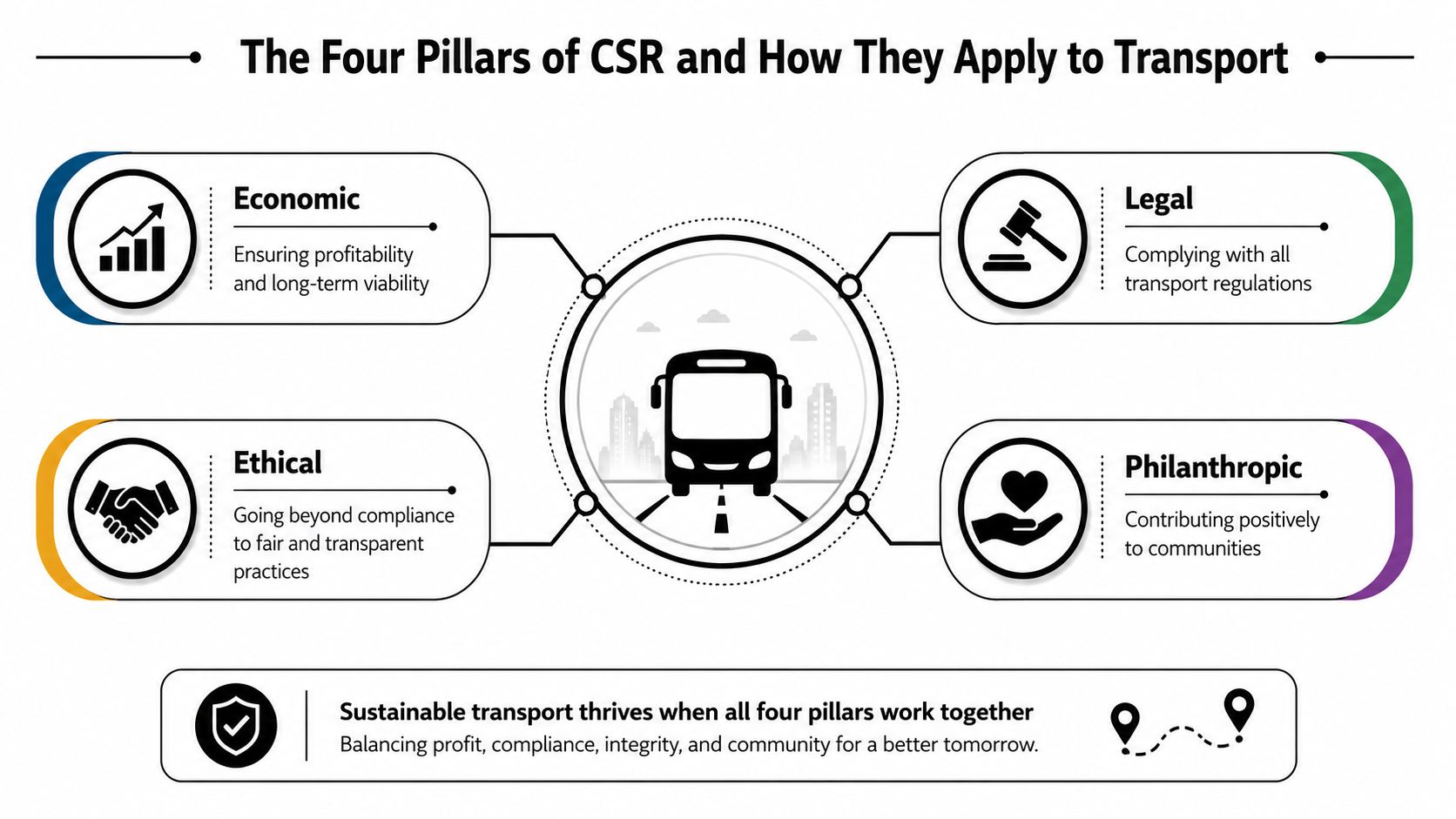
The four classic pillars still work, but only if you stop treating them like a classroom diagram. For a transfer operator, each pillar maps to a business decision you make every week, often before the first pickup. A small London fleet with 12 vehicles does not need theatre. It needs standards that hold up when a cruise line buyer, an airport passenger, or a Trustpilot reviewer asks simple questions.
Economic responsibility is about staying viable without cutting corners
Economic responsibility means the business needs to remain profitable, but not by underpaying drivers, hiding fees, or chasing the cheapest supplier at all costs. For a transfer company, that means fair pricing, transparent quotes, proper maintenance budgets, and paying people on time. If the operation is not financially stable, none of the other CSR claims will last. Cheap decisions tend to come back as breakdowns, complaints, and repeat booking losses.
Legal responsibility sets the minimum standard
Legal responsibility covers licensing, insurance, transport compliance, and the climate disclosure pressure already shaping UK oversight. In practical terms, it also means keeping evidence ready when a corporate buyer asks for documentation, and being able to show the right records without a scramble. A company that is only barely compliant is not doing CSR, it is just waiting for the next audit to expose the gaps.
Ethical responsibility is where reputation is won or lost
Ethical responsibility goes beyond the minimum. It means passengers are safe, drivers are treated properly, suppliers are screened, and claims about sustainability are accurate. It also means you do not dress up a small gesture as a transformation. Greenwashing is a trust killer because people in travel compare notes quickly, and once credibility slips, the booking conversation gets harder.
Philanthropic responsibility is the visible layer, not the whole job
Philanthropy is the outward-facing piece, community support, local partnerships, and practical help around ports and airports. Done well, it strengthens local relationships and gives the business a visible local presence. Done badly, it looks like a photo opportunity, especially if the everyday operation tells a different story.
A useful way to think about the four pillars is this:
- Economic: keep the fleet profitable and dependable.
- Legal: stay compliant and document it properly.
- Ethical: treat people fairly and speak candidly.
- Philanthropic: give back where the business operates.
The Business Case for CSR in UK Passenger Transport
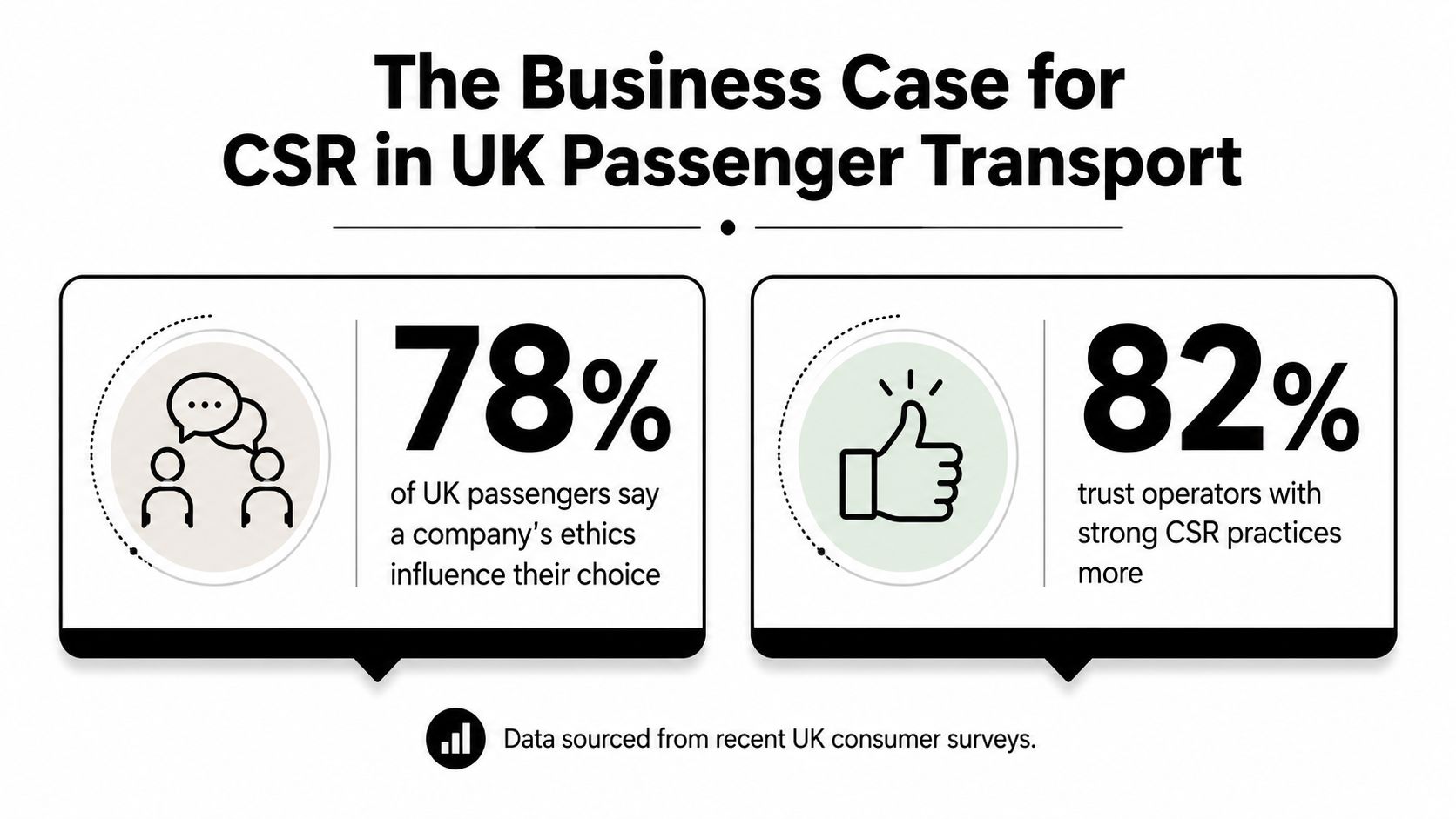
UK consumers are already telling operators what matters. The 2024 Edelman Trust Barometer found that 69% of UK respondents trust businesses, 76% expect CEOs to take the lead on societal issues, and 69% buy brands based on their beliefs and values groundswell.io. That is not abstract sentiment. It is booking behaviour, review behaviour, and contract behaviour.
Trust affects quote comparison
A passenger comparing two similar prices is rarely comparing only price. They're comparing reliability, tone, and credibility. If your website says you care about sustainability, but your booking confirmations, vehicle policy, and review responses say nothing concrete, the passenger will assume the claim is cosmetic. On Trustpilot, that doubt becomes visible very quickly.
Agents and corporate buyers want evidence
Travel agents and corporate accounts don't want a speech. They want to know whether your business is stable, compliant, and easy to work with. CSR helps when it is documented because it gives them something to put in front of their own stakeholders. It also reduces the chance that your business is excluded because another operator can show a cleaner, clearer policy pack.
Hard truth: if your CSR is only discussed on your homepage, it's marketing. If it appears in your operating documents, it becomes part of the buying case.
Get the risk side right too
A weak CSR claim can backfire faster than no claim at all. Transport is full of public feedback loops, review platforms, agent networks, and group-booking WhatsApp chains. If you overstate what your fleet or suppliers are doing, someone will challenge it. That challenge may come from a passenger, a buyer, or a driver who knows the actual situation on the ground.
The business case is straightforward. CSR helps when it supports trust, repeat bookings, and partner confidence. It fails when it becomes a slogan with no operating proof.
Highest-Impact CSR Initiatives for a Private Transfer Operator
A small operator does not need a glossy sustainability programme with six committees and no results. It needs a short list of actions that affect vehicles, people, and booking confidence. The five below are the ones worth doing first.
Fleet emissions reduction
Start with the fleet because that's where most passengers will expect to see action. Vehicle choice, route optimisation, and an anti-idling policy are more credible than a vague promise to “go green”. Track grams of CO2 per passenger-kilometre as your core KPI, even if your first version is rough. Measure it monthly so you can see whether newer vehicles, smarter routing, or fewer empty miles are making a difference.
Carbon offsetting for unavoidable journeys
Offsetting only makes sense for journeys you can't remove. That includes the trips that are structurally unavoidable because the customer wants the service, the route, and the timing. The KPI here is percentage of offset bookings. Keep it simple, transparent, and optional unless a contract requires otherwise.
Ethical procurement
Your CSR story is weaker than you think if your supplier base is messy. Build a checklist for fuel, cleaning, parts, and subcontracted services, then ask whether the supplier can meet your standards on labour, quality, and transparency. A useful KPI is the percentage of suppliers reviewed against your checklist. That's boring work, but it's the kind that stops future problems.
Community partnerships
Ports and airports sit inside communities, not outside them. Supporting a local cause near Southampton, Dover, Portsmouth, or Tilbury gives your business a local footprint that people can understand. The KPI is community-hours logged per quarter or the number of local partnership activities completed. Keep the activity tied to the geography you serve.
Accessible services
Accessibility is CSR, and it's also service quality. If a passenger with reduced mobility can't book confidently, your business has a basic operating problem. Track the percentage of accessible-vehicle bookings fulfilled and the number of access-related complaints. Honesty matters most here, because overpromising on accessibility creates immediate harm.
Here's the simple version.
| Initiative | Primary KPI | Measurement Cadence |
|---|---|---|
| Fleet emissions reduction | Grams of CO2 per passenger-kilometre | Monthly |
| Carbon offsetting | Percentage of offset bookings | Monthly |
| Ethical procurement | Percentage of suppliers reviewed | Quarterly |
| Community partnerships | Community-hours logged per quarter | Quarterly |
| Accessible services | Percentage of accessible-vehicle bookings fulfilled | Monthly |
For operational tracking, a basic mobile app tracking setup can help consolidate journeys, driver notes, and customer requests in one place without forcing you into an enterprise system.
A 30-60-90 Day Implementation Roadmap for Small Operators
A small transfer company does not need a grand launch. It needs a clean sequence. The first 90 days should build enough structure that your CSR activity is real, visible, and repeatable.
Days 1 to 30, get the basics on paper
Start with the items that cost little and create immediate clarity. Publish a one-page CSR statement, switch the depot to a greener energy tariff if that's available, draft an ethical supplier checklist, and decide whether offsetting is optional, bundled, or reserved for specific products. Assign one owner, even if that owner is the managing director.
Rule of thumb: if nobody owns the task, it will drift into a drawer and stay there.
Days 31 to 60, establish your baseline
Now measure what you do. Pull together your current fleet emissions data, note accessibility requirements from recent bookings, and identify one community partner per major port area. At the same time, create a first CSR register so your activity has a home rather than living in email threads.
Days 61 to 90, embed the routine
Brief drivers on the wording you want them to use, and the wording you don't. Start a monthly KPI review, even if the first report is short and imperfect. Publish the first quarterly CSR update on your website so corporate buyers can see that you're not just promising, you're reporting.
For the longer horizon, think in two layers:
- By 6 months: standardise the supplier review process, add accessibility checks into booking handling, and tighten the evidence trail for each KPI.
- By 12 months: review which initiatives are producing trust, booking confidence, or operational savings, then drop the weak ones and double down on the useful ones.
If you need better training for the people delivering the service, professional driver training content can support a more consistent passenger experience without turning every briefing into a lecture.
How Governance Turns CSR Activity into Auditable Evidence
Doing good is not the same as proving it. That distinction matters because a passenger, a review site, or a corporate buyer will only trust what you can show. Governance is the mechanism that turns decent intentions into auditable evidence.
Build one register, not scattered notes
Start with a simple CSR register that lists the initiative, the owner, the KPI, the reporting date, and the evidence stored. Keep it in one place. If your proof lives in a mix of spreadsheets, inboxes, and memory, it will fail the first time someone asks for it properly.
Use a recurring review cadence
The point of recurring measurement is to spot whether the activity is linked to the outcome you care about. The UNESCO CSR guidance frames this well, define a narrow set of material focus areas, select KPIs that map to them, and review them on a regular cadence to reduce greenwashing risk and strengthen trust unesco.org. That approach fits a small operator too. A monthly dashboard, a quarterly director review, and an annual public statement are enough to start.
Governance protects the claim
If a buyer challenges your CSR statement, good governance gives you a calm answer. If a reviewer questions your environmental language, your register and KPI trail show whether the claim is proportionate. That is the difference between a company that looks serious and one that looks improvised.
A clean governance habit also forces better internal discipline. Once the owner knows the KPI will be reviewed, the work stops being optional. That's how CSR shifts from a poster on the wall to a management system.
Communicating CSR to Passengers, Agents, and Drivers
The fastest way to damage a real CSR effort is to talk about it badly. Overstatement sounds hollow, while silence leaves money and trust on the table. The answer is precise, honest communication in the channels you already control.
Booking site and confirmation emails
Your website should say what you do, not what you wish you did. Use plain language about licensed drivers, transparent pricing, accessibility support, and any carbon-related option you offer. Avoid sweeping claims like “fully sustainable” unless you can prove that the whole journey chain supports the phrase.
Review profiles and passenger replies
On Trustpilot and Tripadvisor, don't get defensive. Reply in the same measured tone you use in your booking emails. If someone raises a concern about emissions, accessibility, or conduct, answer with facts, not reassurance alone. A calm factual reply does more for credibility than a long emotional defence.
Driver briefings and agent conversations
Drivers need a short script they can repeat without improvising. Tell them exactly what to say when asked about the fleet, the company's standards, or a customer concern on the day. Travel agents need a different version, one that explains the evidence without forcing them to interpret jargon.
If you're tightening customer retention alongside CSR, customer loyalty programme thinking can help you frame repeat business as the result of trust, not just discounts.
Use this filter before you publish anything:
- Can we prove it? If not, cut the claim.
- Is it proportionate? If it sounds bigger than the work, rewrite it.
- Would a driver recognise it? If not, the message is too abstract.
- Would a buyer respect it? If not, it's probably just branding.
Your CSR Action Checklist for the Next 30 Days
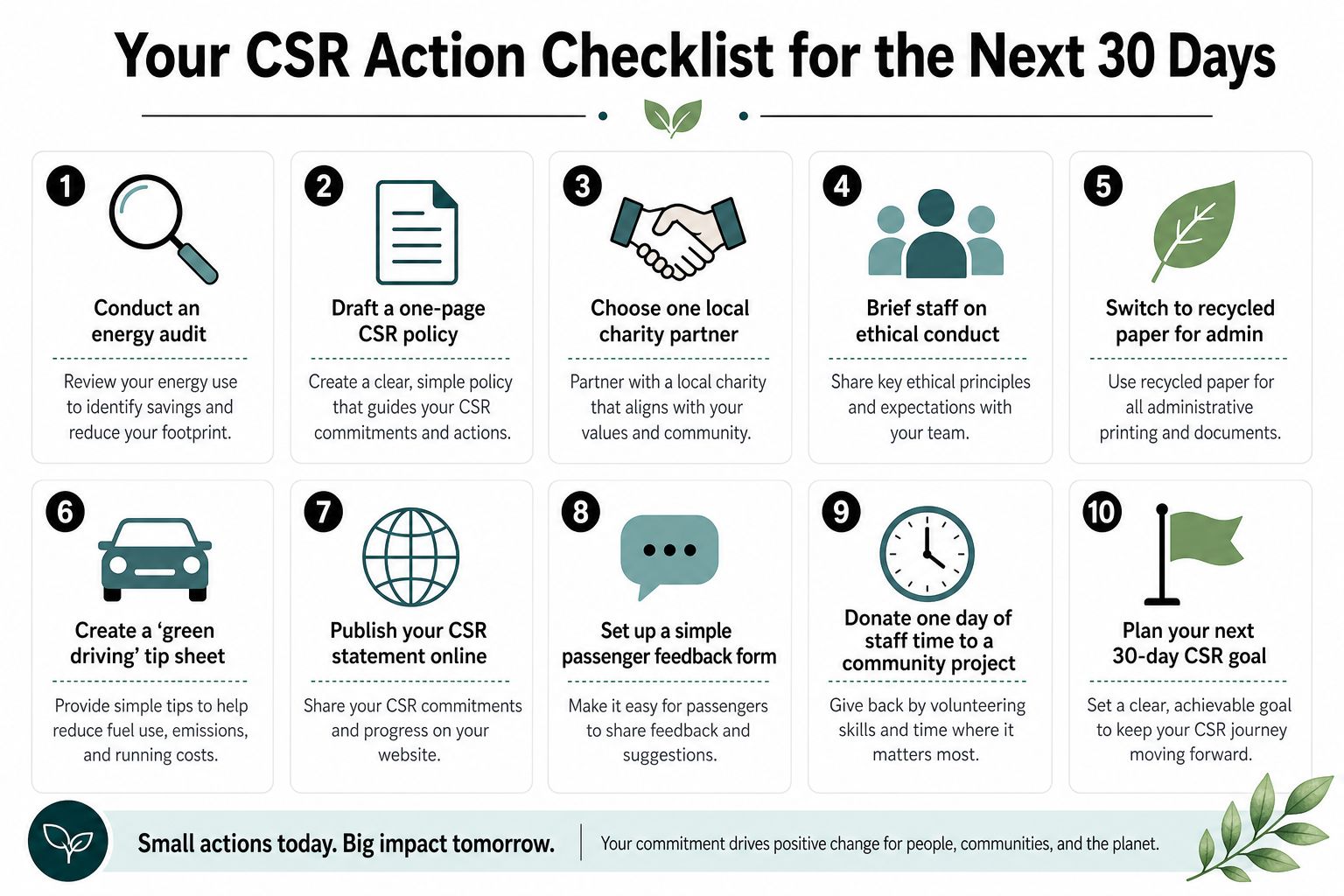
- Name two material focus areas, one operational and one reputational, and write them down.
- Assign one CSR owner, even if that person is also running operations.
- Draft a one-page CSR statement, using only claims you can support.
- Create one KPI for each priority initiative, and keep the list short.
- Set up a simple CSR register, with owner, evidence, and review date.
- Brief drivers on approved wording, especially for sustainability and accessibility questions.
- Review your supplier list, and flag the ones that need an ethics check.
- Decide how offsetting works, if you offer it at all.
- Publish the statement on your website, then link it from your confirmation flow.
- Schedule the first monthly review, so CSR becomes part of management, not a one-off task.
Do those ten things and you'll have a real starting point, not a mood board.
If you want a private transfer partner that understands Heathrow, central London, and the cruise-port routes that matter to your passengers, EC Minibus is set up for the kind of punctual, transparent service this article has been talking about. If you're building a more credible CSR approach around passenger trust, accessibility, and reliable ground transport, visit EC Minibus and see how a practical operator handles the details that reviewers and booking agents notice first.