

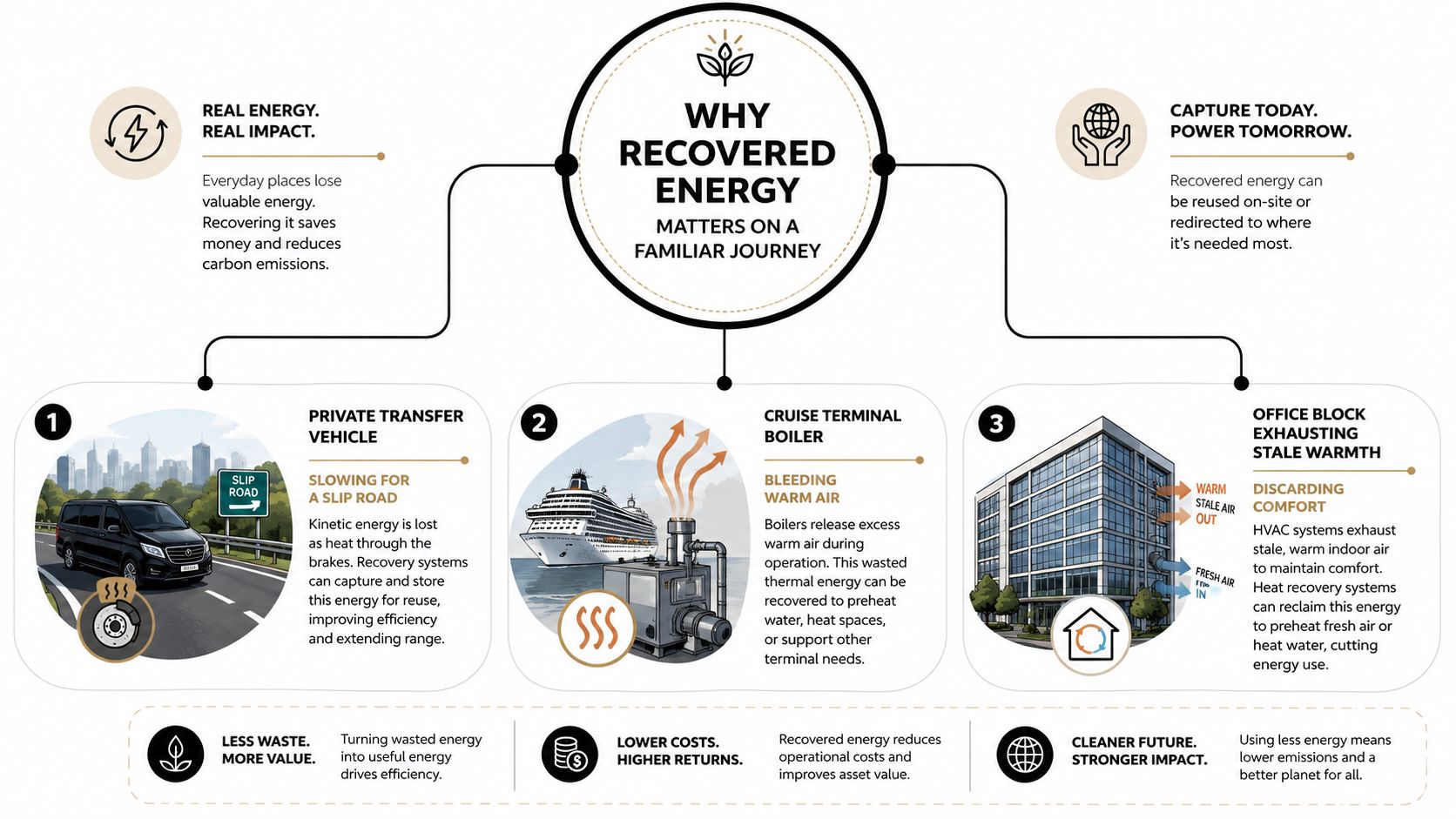
You're slowing for the Heathrow slip road after a long journey, the minibus brakes warm against the wheels, and the vehicle's motion is turning into heat. At the cruise terminal, a boiler sends hot exhaust towards the outside air while a nearby building expels conditioned air that still carries useful warmth. In each case, energy has been paid for or created, but part of it is about to disappear.
Energy recovery systems interrupt that loss. They capture energy that would otherwise be rejected, then convert it into a useful form, such as motion, heat, cooling or electricity. The technology might be small enough to fit inside a vehicle, or large enough to handle waste streams from a national infrastructure network.
The important questions are practical. What energy is available? What device can capture it? Where can the recovered energy go? Recovery only creates value when a suitable “sink”, such as a battery, hot-water circuit, building or electrical network, can use the output.
Table of Contents
- Why Recovered Energy Matters on a Familiar Journey
- The Main Types of Energy Recovery Systems
- Efficiency, Emissions and Cost Savings Explained
- Real World Applications and Case Studies
- Implementation Considerations for Operators
- Performance Metrics and Return on Investment
- Common Misconceptions About Energy Recovery
- Choosing the Right Recovery Approach and What Comes Next
Why Recovered Energy Matters on a Familiar Journey
A private transfer vehicle approaching a Heathrow slip road provides a simple example. The driver presses the brake, and the vehicle's kinetic energy would traditionally become heat in the brake discs. A regenerative braking system changes the route. The motor operates as a generator during deceleration, sending part of that energy to the battery instead of discarding all of it as heat.
At a cruise terminal, the opportunity looks different. A boiler or process system may reject hot gases, while the building next door needs heat for water or space heating. A heat exchanger can transfer energy between the two streams without mixing them. In an office block, outgoing stale air may still be warm in winter, so a ventilation recovery unit can use that heat to pre-warm incoming fresh air.
The two conditions every project needs
Every recovery design begins with two physical facts:
- A wasted energy stream: movement, heat, pressure or chemical energy is leaving a process.
- A useful destination: another part of the system needs energy in a compatible form and at a practical time.
That second condition prevents a common misunderstanding. Capturing energy doesn't automatically make it useful. Warm exhaust is valuable only if a water circuit, air stream or process can accept the heat. Electricity from a generator has greater flexibility, but the generator itself introduces equipment, losses and maintenance.
The designer therefore chooses a recovery route based on temperature, timing, cleanliness, distance and demand. A vehicle needs a compact system that can tolerate repeated acceleration and braking. A building needs reliable comfort and fresh air. A factory may prioritise steam, hot water or electricity.
Practical rule: the best recovery system isn't the one that captures the most energy in theory. It's the one that delivers useful energy to a real user with manageable losses and operating costs.
The Main Types of Energy Recovery Systems
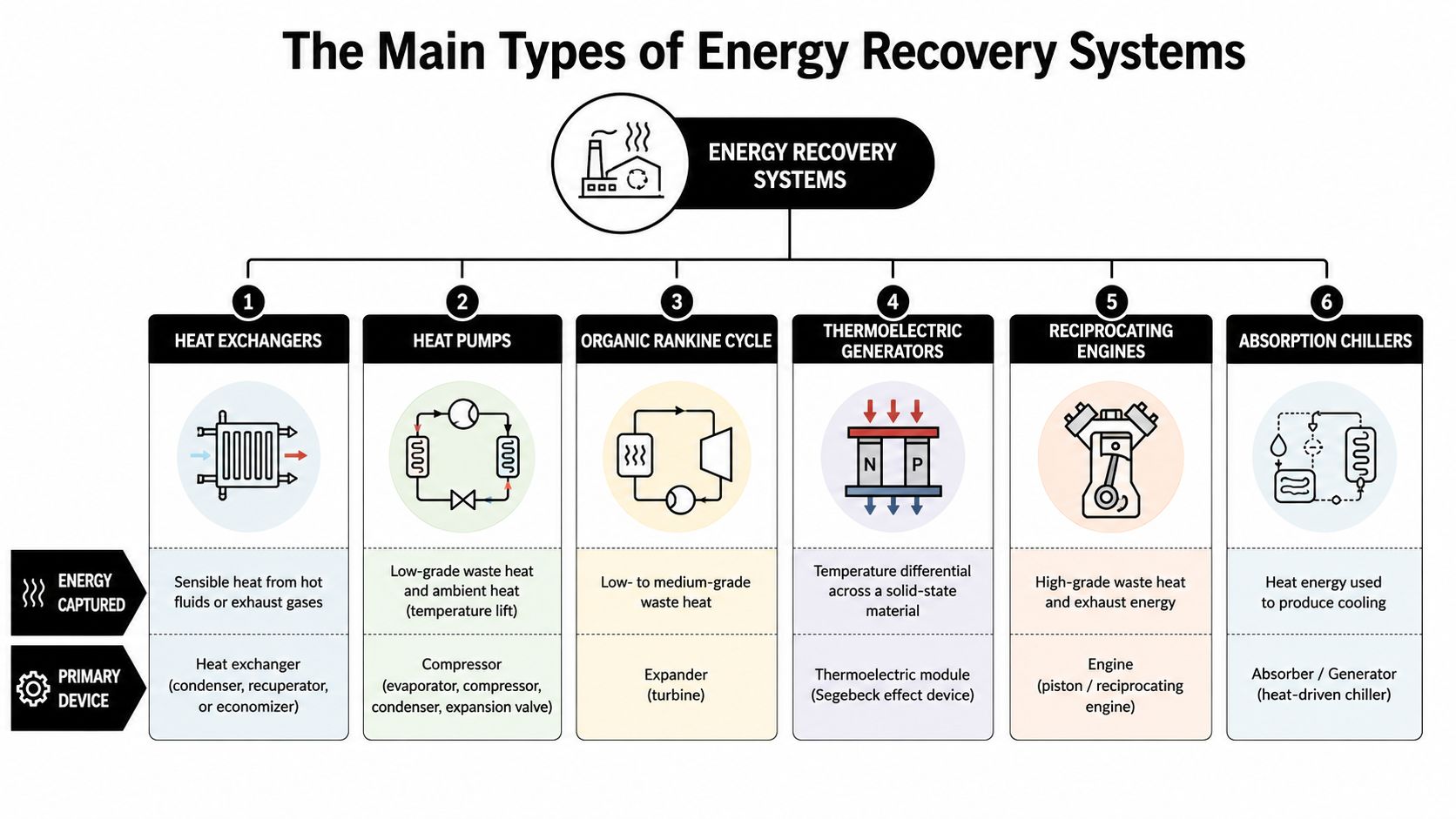
Energy recovery systems are easier to understand when grouped by the form of energy they capture. The six families below cover most examples encountered in transport, buildings, factories and utilities.
Regenerative braking
Regenerative braking captures kinetic energy as a vehicle slows. An electric motor reverses its role and acts as a generator, sending electricity to the battery. The everyday analogy is topping up a small battery every time the vehicle slows, rather than throwing all the vehicle's motion away through friction brakes.
Heat-recovery ventilation
Heat-recovery ventilation transfers energy between outgoing and incoming air streams. The air remains separate, while a core or rotating exchanger passes heat between them. Think of it as letting outgoing warm air pre-warm incoming cold air through a hidden exchanger.
Industrial waste-heat capture
Factories often reject heat through exhaust gases, hot water, steam condensate or process surfaces. A heat exchanger, economiser or similar device captures some of that energy before it leaves the site. The analogy is catching exhaust heat with a heat exchanger before it leaves the stack.
Organic Rankine cycles
An organic Rankine cycle uses a working fluid that vaporises at a lower temperature than water. The vapour expands through an expander or turbine, producing mechanical power that can drive a generator. It's like a steam turbine that runs on lower-temperature vapour than water allows.
Thermal wheels
A thermal wheel slowly rotates through two air streams. Its honeycomb-like material absorbs heat from the warmer stream, then releases it into the cooler stream. The simplest analogy is a slowly turning honeycomb that soaks up heat from one airstream and gives it to another.
Heat pumps
A heat pump moves heat rather than creating it directly. Using a compressor and refrigerant circuit, it extracts low-grade warmth from air, water or the ground and upgrades it to a temperature suitable for heating. It works like a refrigerator running in reverse, upgrading low-grade warmth to useful temperature.
The technologies differ, but the design question stays the same: does the recovered energy arrive at the right temperature, voltage, pressure and time for the intended user?
Efficiency, Emissions and Cost Savings Explained
A recovery system can look efficient on paper yet disappoint in service. The reason is simple: efficiency compares a defined input with a defined output, so the result depends on the technology, operating conditions and chosen baseline.
For a building using a heat pump, the familiar measure is its coefficient of performance, or COP. COP compares useful heat delivered with electricity consumed. A higher COP suggests effective heat upgrading, but it does not show installation cost, peak electrical demand, refrigerant requirements or performance during cold, heavily loaded periods. For a traveller, the same principle applies to regenerative braking. Captured braking energy only has value if the battery, motor and control system can accept it when the vehicle slows.
Energy-from-waste plants use another framework. R1 accreditation identifies facilities that meet an energy-efficiency threshold under the waste hierarchy. That distinction says more than a general statement that a plant “produces energy”, because it relates performance to a recognised regulatory test. The UK sector's published figures show why the baseline matters, with energy recovery and facility capacity both increasing between the comparison years. Detailed figures are available in the official UK energy-from-waste statistics.
Anaerobic digestion measures conversion differently. A UK-focused study examined the share of input energy converted into electricity at a sewage-sludge site. It reported about 15% for conventional AD, 20% with thermal hydrolysis, 23% with second-generation thermal hydrolysis, and 34% gross conversion efficiency when thermal hydrolysis was combined with drying and pyrolysis, according to the University of Surrey research record. These figures describe electricity conversion, not the complete value of recovered heat or useful process outputs.
Emissions and financial value
Emissions reductions depend on the energy source being displaced. Recovered heat can reduce gas combustion in a building, recovered electricity can reduce imported grid power, and regenerative braking can lower the energy later demanded from a vehicle battery or engine. The same recovered output can therefore produce different environmental results at different sites.
Cost savings follow that comparison. A project creates value when capturing, conditioning and delivering energy costs less than buying or generating the equivalent output. A vehicle may save a small amount on each stop, while a continuously operating industrial process can create greater absolute value from a steady waste stream.
Operators should also review an environmental impact assessment before judging the result. The practical questions remain: efficiency of what, measured how, and compared with which baseline?
Real World Applications and Case Studies
A transfer vehicle reveals why repeated small recoveries matter. During an urban route, an airport approach or a cruise-terminal stop, the vehicle slows and accelerates many times. Regenerative braking sends some of that motion back to the battery instead of losing it as heat. The gain remains limited by battery capacity, motor controls, added equipment weight and the need for predictable braking.
UK energy-from-waste shows the same principle at infrastructure scale. A Parliamentary history note recorded that four of the UK's 30 municipal solid waste incinerators could recover energy in 1995. A later government guide recorded energy recovery at 5.5 million tonnes in 2012/13, after rising 13% and more than doubling over the previous decade, according to the UK government energy-from-waste guide.
The capacity recorded at R1-accredited facilities also increased:
| Metric | 2018 | 2020 |
|---|---|---|
| Energy recovery at R1-accredited facilities | 8.5 million tonnes | 9.7 million tonnes |
| R1-accredited facilities | 41 | 43 |
| Annual capacity | 11.6 million tonnes | 12.1 million tonnes |
The same official dataset recorded 59.4 million tonnes of non-hazardous construction and demolition waste in the UK in 2020, of which 55.0 million tonnes was recovered, a recovery rate of 92.6%, as reported in the official dataset. These figures do not by themselves guarantee a successful energy project. Planning consent, emissions controls, grid connection, feedstock quality and nearby heat customers determine whether the recovered energy can be used.
Sewage heat recovery adds a building-scale example. A national analysis for England estimated theoretical annual potential ranging from 18.2 TWh to 30.8 TWh, depending on the discharge-temperature scenario. River-temperature requirements can reduce the usable temperature difference, so theoretical potential is not the same as deployable output. A workable scheme still needs a nearby heat network, suitable pumps, planning approval and an operator who can maintain the equipment.
Implementation Considerations for Operators
A technically impressive recovery system can fail if the site can't use its output. Operators should begin with the waste stream, not the brochure. Measure temperature, flow, operating hours, contamination, pressure and seasonal variation, then compare those conditions with the demand profile of the proposed heat or power sink.
Four decisions shape the project
Size for the dependable stream. Maximum theoretical recovery may occur only during a short operating period. Designing for that peak can leave equipment underused for much of the year. A smaller system matched to the site's normal load may provide better economics and easier control.
Choose retrofit or new build carefully. A new facility can reserve space for heat exchangers, pipework, controls and access routes. A retrofit may need shutdown time, structural work and changes to existing ventilation or process equipment. Congested plant rooms often make installation complexity as important as the recovery device itself.
Budget for maintenance from day one. Heat exchangers need inspection and cleaning when dust, scale or corrosive compounds are present. Pumps, fans, valves, sensors and refrigerant circuits also affect availability. If maintenance access is poor, theoretical efficiency won't survive real operation.
Meet the UK compliance requirements. Waste plants may need R1 accreditation, while ventilation retrofits must satisfy applicable building and safety requirements. Operators should also review pressure systems, electrical protection, fire safety, emissions controls and planning conditions before procurement.
Prices change the answer
The economics of heat recovery also depend on the relative price of electricity and gas. The Climate Change Committee reported that policy-cost changes in November 2025 reduced the electricity-to-gas ratio from 4.7:1 in Q1 2026 to 4.3:1 in Q2 2026, according to UK industrial energy reporting. That shift can change the comparison between an electrically driven heat pump and a gas-side recovery option.
Design warning: contaminated streams, undersized heat sinks and neglected maintenance are common reasons a sound energy balance produces a disappointing project.
For vehicle operators, the human side matters too. Drivers need clear operating guidance, and maintenance teams need training that covers both conventional and recovered-energy components. Practical professional driver training supports safe use, but it doesn't replace engineering verification.
Performance Metrics and Return on Investment
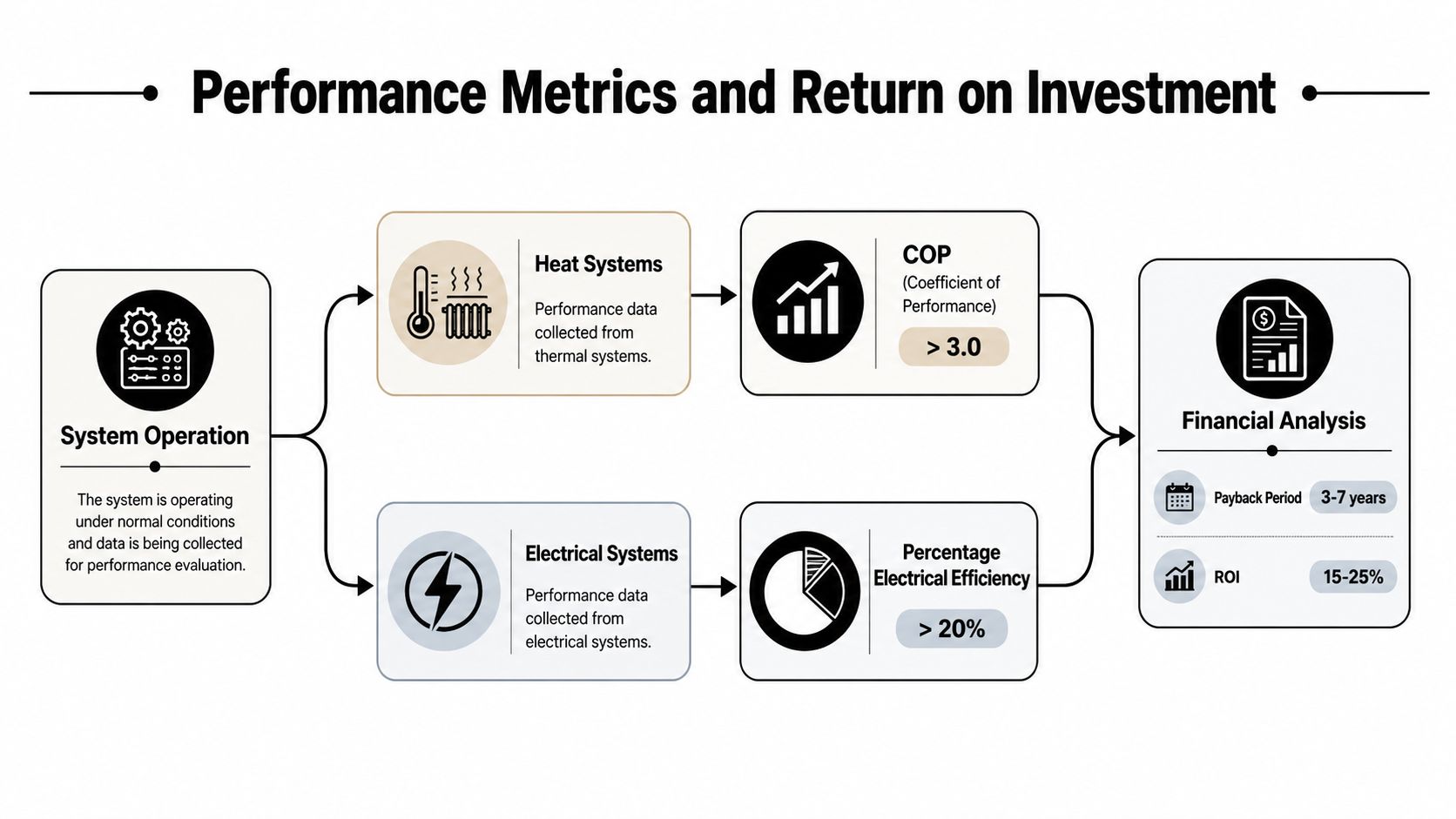
A useful performance measure follows the energy from input to a real service. For a heat pump, COP compares heat delivered with electricity consumed. For anaerobic digestion, electrical conversion efficiency shows how much input energy becomes electricity. For energy-from-waste, R1 indicates whether the facility meets the relevant energy-efficiency threshold. In industrial heat recovery, the practical measure is often the share of available heat that reaches a process user rather than being lost through pipework or unused demand.
A simple payback calculation
Suppose an operator has a recovery project with a stated capital cost, a forecast of annual kilowatt-hours delivered and a current energy unit price. The first screening calculation is:
Annual energy value = annual useful kilowatt-hours × avoided energy price
Simple payback = capital cost ÷ annual energy value
This calculation gives a quick comparison, not a bankable business case. It becomes misleading if the forecast counts heat with no buyer, assumes peak output throughout the year or ignores electricity used by pumps and fans. A full model should test whether the receiving process is operating when recovery is available.
Maintenance, cleaning, controls, financing, downtime, replacement parts and changes in demand charges also affect the result. Test several energy-price scenarios rather than relying on one tariff. A system can look attractive on paper yet deliver little value when a factory, depot or building shuts down.
Storage needs more than arbitrage
Battery-based recovery introduces timing as well as conversion losses. A battery can absorb electricity when it is available and release it later, but market income changes with trading conditions. A June 2026 industry analysis reported average UK battery revenues of £51k/MW/year across November to February, about 35% below the previous winter, with February 2026 at £41k/MW/year and wholesale arbitrage at minus £6k/MW/year, as reported in the Modo Energy market analysis.
These figures support a wider project model. Include balancing, capacity services and resilience alongside trading income. A site may still value storage for backup power or lower peak demand when arbitrage revenue weakens.
Financial assessment should sit beside the operator's environmental objectives. A clear corporate social responsibility approach can explain the project's wider purpose, while measured energy performance establishes whether it delivers the promised result.
Common Misconceptions About Energy Recovery
Myth one, recovered energy is free energy. Every recovery system uses some energy to operate. Fans, pumps, compressors, generators and controls draw power, while fouling in heat exchangers and battery conversion losses reduce the amount delivered. The useful measure is net useful energy, after parasitic loads, downtime and maintenance. A regenerative-braking system in a UK train illustrates the point: braking energy can return to the battery or electrical network, but only after conversion losses and equipment limits.
Myth two, every heat-recovery project pays back quickly. A large theoretical resource does not guarantee a viable installation. England's sewage analysis produced annual potential scenarios ranging from 18.2 TWh to 30.8 TWh, because discharge temperatures affect how much heat can be used. The practical project still needs a nearby heat demand, a connection route and permission to build. A warm wastewater stream beside an occupied building may be useful, while the same stream far from users may not be.
Myth three, batteries make any recovered electricity profitable. Storage improves timing, not certainty. Reported winter battery revenue of £51k/MW/year, February revenue of £41k/MW/year and wholesale arbitrage of minus £6k/MW/year show why a business case needs more than a buy-low, sell-high assumption. The figures were discussed in the UK battery market analysis.
Recovery creates value when net output has a reliable user, equipment stays available and avoided energy costs exceed ownership costs.
Choosing the Right Recovery Approach and What Comes Next
Begin with an audit that traces energy through the site, much like following a journey from a train's brakes to its next stop. Record where motion, heat, pressure or chemical energy leaves the system, when it appears, and whether a nearby process can use it without costly conversion or storage.
Ask suppliers five questions:
- What is the measured baseline? Request current fuel, electricity, heat and operating data.
- What is the net output? Include parasitic loads and conversion losses.
- Who uses the output? Identify the heat sink, electrical connection or storage route.
- What happens during low demand? Check seasonal operation, shutdowns and surplus energy.
- What does maintenance require? Confirm cleaning, access, spare parts and planned downtime.
A recovery system resembles a connecting service. Its value depends on the source and sink meeting at the right time. A factory may have useful waste heat, yet gain little if nearby demand is intermittent. A battery may store recovered electricity, but its economics still depend on cycling, losses and power prices.
The UK power system is changing rapidly. Great Britain recorded strong renewable generation growth in Q1 2026, while many battery, wind and solar projects gained approval in 2025. More renewable electricity can support heat pumps and storage, but changing prices can also alter the value of recovered industrial heat.
Choose the system that matches a dependable source with a dependable user. Test performance under ordinary demand, low demand and maintenance conditions before committing capital.
For reliable journeys between Heathrow, London hotels and Southampton, Dover, Portsmouth or Tilbury, EC Minibus offers private door-to-door transfers with meet and greet, flight and cruise monitoring, and professional drivers. Visit EC Minibus to arrange a fixed-price transfer.