

You're standing in a hotel lobby after a long flight, waiting for a cruise transfer to Southampton or a shuttle back through Heathrow, and the practical questions pile up fast. Will another vehicle add to congestion on the route. Will a depot expansion change drainage or local noise. Who decides whether that project is acceptable before the first spade goes in. The answer, in UK planning language, is usually environmental impact assessment, or EIA, the structured process that helps decision-makers understand likely environmental effects before consent is granted, and what should be done to reduce harm.
Table of Contents
- What an Environmental Impact Assessment Actually Does
- The Legal Roots and UK Regulatory Frame
- How the EIA Process Works Stage by Stage
- Transport Impacts EIA Teams Measure
- Mitigation Measures and Best Practices for Operators
- A Mini Case Study Applying EIA to a Transfer Operator
- Practical Takeaways for Travellers and Travel Agents
What an Environmental Impact Assessment Actually Does
A good EIA starts with the same questions a careful traveller asks before booking a transfer. What changes will this project bring, who feels them, and can the harm be reduced before anyone approves it. The process exists because development choices are easier to shape before contracts are signed and works begin, not after complaints arrive.
An environmental impact assessment is a formal way to identify, predict, evaluate, and mitigate likely effects. The UK government's handbook describes it as a process that looks at emissions, waste, noise, and effects on land, water, air, climate, biodiversity, and cultural heritage, using baseline data and predictive analysis before approval is given. That's why EIA isn't just paperwork, it's a decision-making tool that forces a project team to show its working. The European Commission also treats EIA as a measurable regulatory instrument, because member states must report statistics on how many projects are assessed, how long the process takes, and what it costs under the Directive European Commission EIA overview.
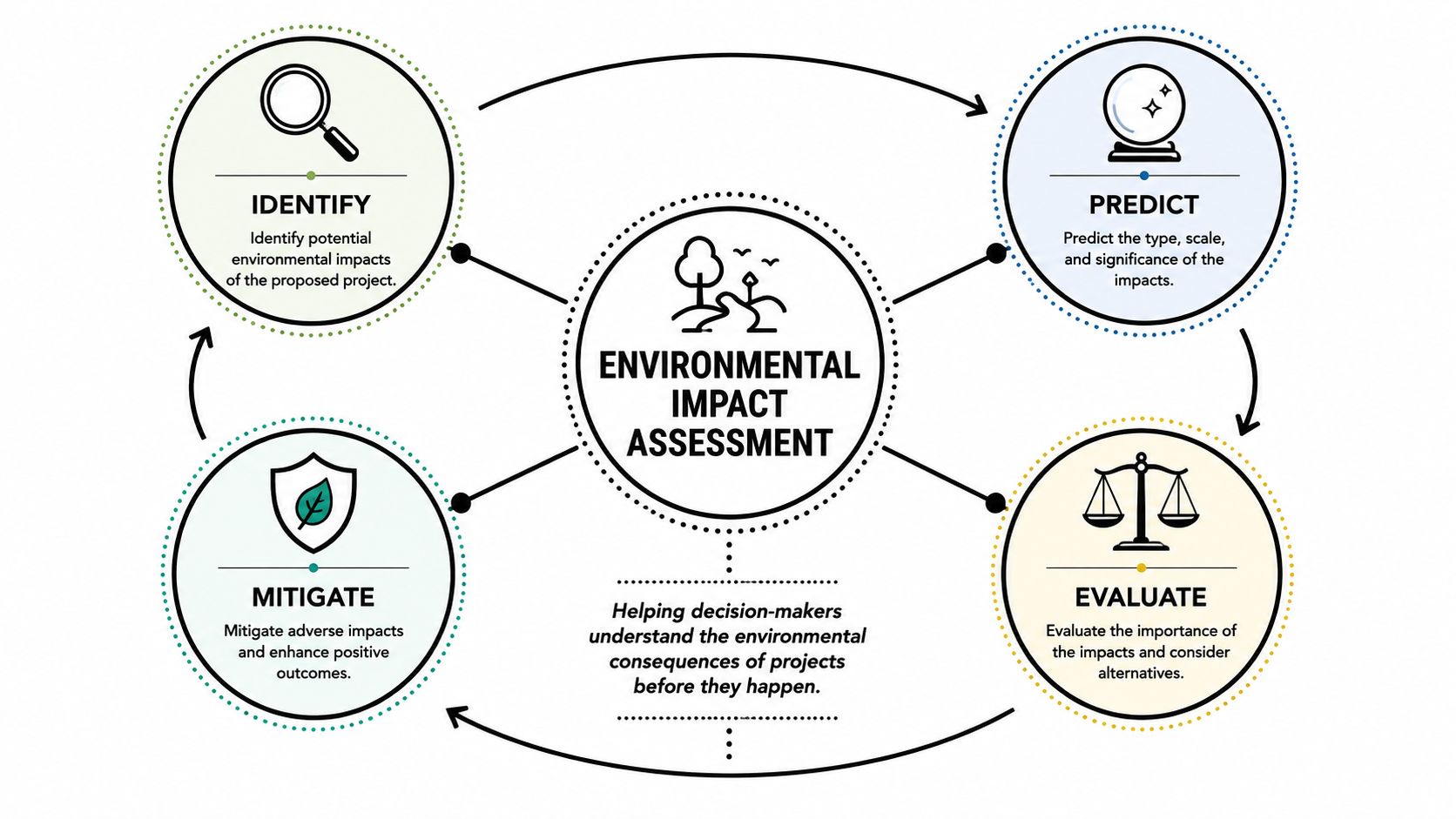
EIA versus a lighter review
Not every project gets the same depth of scrutiny. Some proposals only need screening, which asks whether a likely significant effect is on the table at all. Others need a fuller EIA, with scoping, evidence gathering, impact prediction, mitigation, and a formal statement for decision-makers.
Practical rule: if a project could change traffic patterns, noise exposure, water run-off, or air quality in a noticeable way, EIA logic is already relevant, even if the formal threshold has not yet been decided.
That distinction matters for transport. A small route change, a depot extension, or a new shuttle pattern can look minor from the operator's side, but still raise environmental questions if the corridor passes sensitive receptors such as homes, schools, waterways, or already-stressed road links. EIA is the framework that keeps those questions visible before the project becomes a problem.
The Legal Roots and UK Regulatory Frame
A new airport transfer lane, a cruise port shuttle base, or a depot extension can all trigger the same legal question, does the proposal need environmental assessment before anyone gives consent. The modern legal basis for that answer came from Environmental Impact Assessment Directive 85/337/EEC, adopted in 1985, which set the rule that major projects should be assessed before approval. In UK planning practice, that idea now sits inside the national EIA regime, with screening and scoping used to decide whether a project needs a closer look and what that closer look should cover European Commission EIA overview.
The point is practical, not abstract. EIA is used to decide whether significant environmental effects are likely and what mitigation is needed before development proceeds. That makes it a front-end control, not an after-the-fact review. If likely effects are significant, the authority wants evidence before approving the project, not reassurance after the work is already complete.
Why the UK keeps measuring it
The European Commission says member states must report, every six years, the number of projects assessed, the average time taken, and the costs under the EIA Directive. That reporting duty shows how the system works in practice, as a regulated process with measurable outputs. For operators, that matters because EIA sits alongside planning deadlines, consultation windows, and consent conditions, so the timetable has to be handled with care.
The UK handbook treats EIA as a predictive exercise that identifies and quantifies impacts on land, water, air, climate, biodiversity, and cultural heritage, with baseline data collected before approval UK EIA handbook. That emphasis on prediction is important in transport-heavy places, where roads, ports, airports, drainage, and power connections can all change local environmental conditions. A modest change in vehicle movements, a new pickup pattern, or a yard extension can look routine from the operator's side, while still raising planning questions if it sits near homes, schools, waterways, or busy road links.
For a quick legal refresher, this practical overview of legal requirements for transport-linked projects is a useful companion.
The key question is not “is this paperwork required”. It is “what would the authority need to know to decide responsibly?”
How the EIA Process Works Stage by Stage
A depot expansion or route change usually moves through EIA in a familiar sequence, and it helps to read that sequence like a planning file rather than a mystery novel. Screening comes first, then scoping, baseline work, prediction and evaluation, mitigation, the Environmental Statement, and a decision. If you can follow that chain once, the jargon in most planning updates starts to make sense.
For a small transport operator, the process often feels more practical than people expect. A new airport transfer pickup pattern, a cruise port shuttle change, or a depot extension can all raise the same questions as a larger scheme, just on a smaller footprint. EIA works like a checklist with judgement built in, so the authority can see what might change, how serious that change could be, and what the operator plans to do about it.
Screening and scoping
Screening asks whether a project is likely to have significant environmental effects and therefore needs full assessment. For a transfer operator, that might be the point where a modest yard enlargement is treated differently from a larger scheme with new hardstanding, charging infrastructure, or altered traffic flows. Scoping then narrows the field, so the team focuses on the issues that matter most instead of producing a bloated report that buries the main concerns.
A useful way to understand this is to picture a consultant opening a case file and sorting the evidence into the right folders before the detailed work begins. Screening decides whether the file needs a full assessment. Scoping decides which folders need the most attention, such as traffic, noise, drainage, or nearby sensitive uses.
Baseline data before predictions
Baseline data is the anchor. You need to know what conditions look like now before you can say whether a project will alter them. The UK handbook treats that first step as the foundation of sensible assessment, because change only becomes visible when the starting point is clear.
For water-related effects, the baseline can be very detailed, mapping permanent and intermittent streams, rivers, wetlands, lakes, and reservoirs in the area of influence, alongside station-level water-quality data for parameters that may shift during construction or operation IISD EIA Manual. In a transport setting, that matters even for work that looks fairly modest on paper. A depot yard, a drainage alteration, or a revised parking layout can change how rainwater moves across the site and where it ends up.
Prediction, mitigation, and decision
Once the baseline is set, the team predicts likely effects, evaluates whether they are significant, and designs mitigation. That stage is where the assessment starts to read less like description and more like planning judgment. The Environmental Statement then gathers the evidence for consultation and decision-making, so the authority can see the logic behind the proposal rather than just the final recommendation.
In plain terms, the document says, “here is what we expect to happen, here is why it matters, and here is how we will avoid or reduce it.” That is also why operators who already think about corporate social responsibility often find the process easier to understand. Both frameworks ask the same basic question, how does a business make practical choices that reduce harm and show its working clearly?
Useful shortcut: if a story mentions “the application is stuck at scoping” or “the Environmental Statement has gone out for consultation”, that tells you exactly where the project sits in the decision chain.
The final stage is post-consent follow-up, where monitoring checks whether the predicted effects and the promised mitigation match real-world conditions. That is the point where EIA stops being a paper exercise and becomes part of day-to-day site management.
Transport Impacts EIA Teams Measure
A transport project often makes environmental assessment feel less abstract because the effects show up in everyday life. A shuttle corridor can change the air people breathe near junctions. A depot can add local noise or alter surface-water run-off. A route change can shift congestion around ports, stations, and airport access roads. The same EIA logic applies whether the proposal is a motorway scheme or a small operator's yard extension.
Air quality, noise, and traffic
For air quality, the team looks at vehicle emissions, idling, and any change in traffic volume or flow. In airport and port corridors, that matters because vehicles often queue, stop-start, or cluster around tight access points, which raises exposure for nearby residents and workers. Noise follows a similar pattern, but the focus shifts to disturbance from engines, braking, manoeuvring, loading, and early-morning or late-night activity. Traffic and congestion focus on whether the proposal changes journey patterns, delays, junction pressure, or safety risks on already busy roads.
A practical example helps. A short transfer route can still create new pressure if it sends more vehicles through a residential street or concentrates pick-ups at one gate rather than several smaller points.
Carbon and water effects
For carbon and greenhouse gas emissions, the key question is how the project changes fuel use and operating intensity, not just whether the fleet is new or old. Route length, vehicle occupancy, and the type of power source all affect that picture. Water and surface-water run-off matter more than many operators expect. Even a small depot can alter drainage patterns, bring polluted run-off into view, or interact with local water bodies if the site sits near sensitive hydrology.
Water assessment becomes harder when the site has a real footprint on the ground, because the team has to separate short construction effects from longer operational change. That usually means looking at the area of influence, the sensitivity of nearby receptors, and how conditions may shift over time. The same basic question sits underneath the technical detail, which streams, wetlands, or reservoirs could be affected if the depot goes ahead.
| Common Transport Impacts Assessed in EIA | What EIA Measures | Why It Matters for Transfers |
|---|---|---|
| Air quality | Vehicle emissions, idling, and corridor exposure | Busy airport and port routes can already be sensitive |
| Noise | Manoeuvring, braking, loading, and timing of operations | Night-time and early-morning runs can affect neighbours |
| Traffic | Congestion, junction pressure, and route change | A small service change can still add local friction |
| Carbon | Fuel use, fleet efficiency, and operating pattern | Travel providers are increasingly judged on emissions |
| Water run-off | Drainage, contamination risk, and site discharge paths | Depot works can affect nearby water receptors |
There is another layer, and it is easy to miss if a guide stays focused only on emissions and drainage. EIA also asks who benefits from a proposal and who carries the burden. Guidance used in impact assessment practice expects social, health, gender, and special-group effects to be considered, and rights-based commentary warns that low-income, disabled, older, or otherwise vulnerable residents can be overlooked when assessments stay too biophysical. For transfer operators, that means route choices do not affect everyone in the same way.
A practical transport example is a school run, an airport transfer, or a cruise port shuttle that changes its pick-up point. One group may gain a shorter journey, while another group faces more noise, more crossing risk, or less reliable access.
For more on the people side of operational decisions, see this note on professional driver training and service standards.
Mitigation Measures and Best Practices for Operators
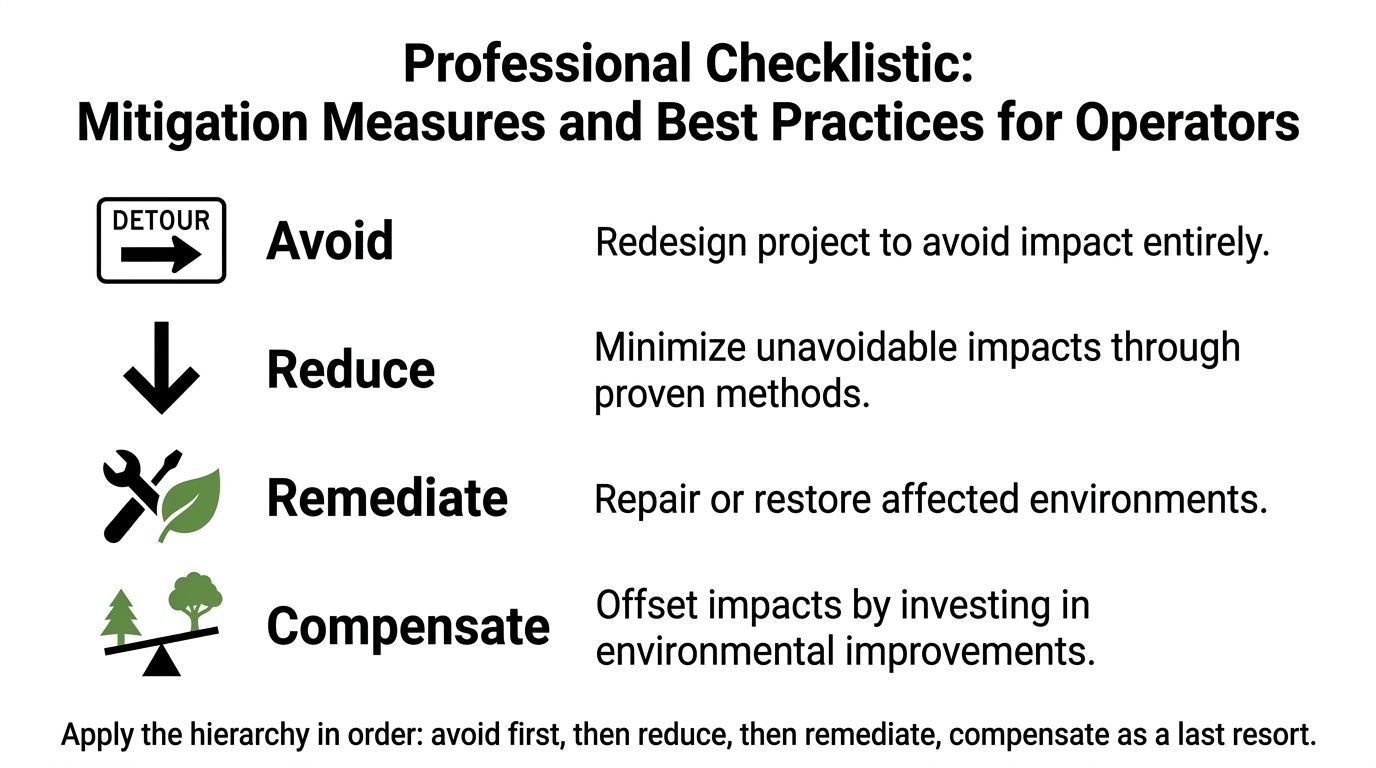
Mitigation in EIA follows a clear sequence, even when the paperwork makes it look technical. Avoid, then reduce, then remediate, and only at the end compensate. For private transfer operators, that order is useful because it turns environmental care into ordinary business choices, such as where a depot sits, how vehicles are routed, and how drivers are briefed.
What the hierarchy looks like in practice
Avoidance usually begins with route design and site choice. If a depot can be placed away from flood-prone ground, sensitive neighbours, or awkward access roads, the risk is removed before operations even begin. Reduction comes next, through cleaner vehicles, better routing, and less idling at pick-up points. Remediation covers repair or restoration after an effect has happened, while compensation is the fallback when some impact cannot be removed.
Practical rule: the cheapest mitigation is usually the one built into the project design before permissions, leases, or procurement are locked in.
The water aspect needs careful handling. Streams, wetlands, and reservoirs are not treated as background features in EIA, and depot works should never be seen as “just paving”. If the area of influence includes vulnerable surface-water features, the operator needs drainage design, spill control, and runoff management built into the scheme from the start, as noted earlier.
Operator habits that mirror EIA thinking
A private transfer business does not need a formal EIA to think in the same way. It can build a small assessment habit into day-to-day decisions by asking a few disciplined questions before changes are made.
- Route planning: Can the journey avoid the most congested or sensitive roads without adding avoidable mileage?
- Fleet choice: Does the vehicle mix cut emissions and noise in the corridors where passengers are travelling?
- Driver practice: Are staff trained to reduce idle time, harsh braking, and unnecessary manoeuvring?
- Depot siting: Is the site suitable for drainage, access, and local environmental conditions before lease commitments are signed?
- Reporting: Can the company show what it changed, what it monitored, and what it learned?
Those questions also fit with wider business responsibilities. A transfer operator that wants to connect environmental decisions with governance, staff conduct, and customer expectations can use this corporate social responsibility resource as a useful starting point.
The strongest mitigation is visible in the operating model, not only in the report. When a provider can explain why a route was chosen, how the depot was designed, and how issues are monitored, it is already doing much of the work an assessor would expect.
A Mini Case Study Applying EIA to a Transfer Operator
A London-based transfer company has run Heathrow, Central London, and Southampton Cruise Terminal trips since the mid-2000s. Demand grows, and the owner proposes four electric minibuses, a small depot near the M25, and a new direct Tilbury route. No one has called it an EIA project yet, but the planning questions appear immediately.
Screening and scoping in plain terms
The first question is whether the package of changes crosses the line into a formal assessment. The depot work is the most obvious trigger point, because new operational land use can carry noise, traffic, drainage, and local receptor effects. The route change and extra vehicles may not sound dramatic on their own, but the combined scheme changes the project footprint enough that a screening conversation is sensible.
Scoping follows fast. The team doesn't need to chase every possible environmental issue, it needs to focus on the ones most likely to matter. For this operator, that means traffic around the M25 link, noise at the depot boundary, charging infrastructure, and water run-off from the hardstanding.
What the operator would actually do
Before buying vehicles or signing the lease, the company collects baseline information on present traffic conditions, nearby receptors, and local water features. It then compares alternative layouts for the depot, checks whether the charging setup adds any electrical or visual constraints, and designs routing to avoid the worst congestion where possible. That is classic EIA thinking, even if the project is still small by infrastructure standards.
Mitigation becomes part of the business plan rather than a late add-on. Electric minibuses reduce tailpipe emissions, but the company still needs driver training, sensible scheduling, and a practical reporting method for complaints, delays, and maintenance issues. If passengers flag noise, queuing, or late arrivals, the operator has a record that shows whether those effects are isolated, repetitive, or a sign that the route plan needs adjustment.
The useful lesson is simple. EIA is not only for airports, ports, and motorways. A smaller operator can borrow the same discipline by asking what changes, what's sensitive, and what evidence proves the project is under control.
Practical Takeaways for Travellers and Travel Agents
Travellers rarely need to read an Environmental Statement, but they can still ask EIA-style questions. A transparent provider is usually a better one, because good environmental management tends to go hand in hand with better route planning, clearer operations, and fewer surprises on the day.
Questions worth asking before you book
- Fleet standards: What vehicle types does the company use, and how does it handle emissions and noise on busy corridors?
- Routing: Does it plan around sensitive roads, or does it take the shortest path every time?
- Monitoring: Does it track complaints, delays, or operational issues in a way that could inform environmental improvements?
- Local impacts: How does it deal with neighbours, depots, and access points that may be affected by the service?
- Equity and access: Does the provider show awareness of vulnerable road users and nearby communities, not just passenger convenience?
That last point matters more than people realise. EIA is increasingly expected to consider who carries the burden of a project, especially in dense transport corridors where residents, workers, older people, and disabled people may experience the effects differently. For travel agents, that makes environmental due diligence part of client care, not just a compliance extra.
If you're arranging transfers for airport, cruise, or hotel journeys, choose providers that can explain how they handle routing, vehicle choice, and local impacts in plain English. That's the kind of operator that usually takes environmental responsibility seriously.
If you want a transfer partner that values punctuality, comfort, and clean, well-managed journeys across Heathrow, London, and the cruise ports, take a look at EC Minibus. Their door-to-door service is built around the same practical discipline that good EIA relies on, clear planning, transparent decisions, and sensible care for the people and places along the route.