

You've just landed at Heathrow with a wheelchair, scooter, walker or transfer aid beside your luggage. The flight may have gone smoothly, yet the next questions arrive quickly. Will the vehicle have enough room? Can the aid be loaded without damage? Will the ramp, lift, storage area and staff support work together when you reach the cruise terminal?
Those questions reveal an important truth about mobility assistance equipment. Travel success depends on more than choosing a device from a catalogue. Your specific aid must fit, be carried and be supported through every stage, from home to airport, transfer vehicle, hotel and ship.
Table of Contents
- Introduction to Stress Free Travel with Mobility Support
- Understanding Mobility Assistance Equipment and How It Helps
- Key Specifications That Affect Travel Decisions
- How to Choose the Right Equipment for Your Trip
- Preparing Documentation and Airport and Cruise Port Procedures
- Storing Transporting and Booking Transfers with EC Minibus
- Safety Insurance and Your Pre Travel Checklist for Peace of Mind
Introduction to Stress Free Travel with Mobility Support
A traveller arriving at Heathrow might need assistance from the aircraft door to baggage reclaim, then from the terminal to a private vehicle and onwards to Southampton, Dover, Portsmouth or another port. A folded wheelchair could fit in one boot but not another. A powered scooter might be suitable for a long terminal journey but difficult to store during a transfer. A walker may be easy to lift, yet still need protection from being crushed under luggage.
Planning each link turns a stressful chain into a manageable journey. Start by writing down the aid's measurements, weight, folding method, battery details and the type of help you need. Then share that information with the airline, cruise operator and transfer provider rather than relying on the word “accessible”.
The scale of mobility need across England helps explain why these practical details matter. The Department for Transport reported that 2.84 million Blue Badges were held in England on 31 March 2024, an increase of 10% from March 2023. The same release recorded 12 mobility centres and 52 outreach centres across England, while 24% of people in England reported a disability in the year ending March 2023, around one in four residents. These figures are available in the Department for Transport's Blue Badge and disability statistics.
The useful question isn't only “Which aid should I take?” It's “Will this aid work from my front door to my final destination?”
This guide follows that journey. It begins with the main types of equipment, translates specifications into travel consequences, then moves through airline and cruise procedures, vehicle transfers, safe handling and final checks. You don't need to become an engineer or transport specialist. You need clear information about your own equipment and written confirmation from the people responsible for carrying and supporting it.
Understanding Mobility Assistance Equipment and How It Helps
Think of mobility aids as different types of footwear. Walking shoes may work on a smooth pavement, but they aren't the right choice for a steep trail or a wet beach. In the same way, a cane, rollator, wheelchair and powered scooter each solve a different mobility problem.
Match the aid to the support you need
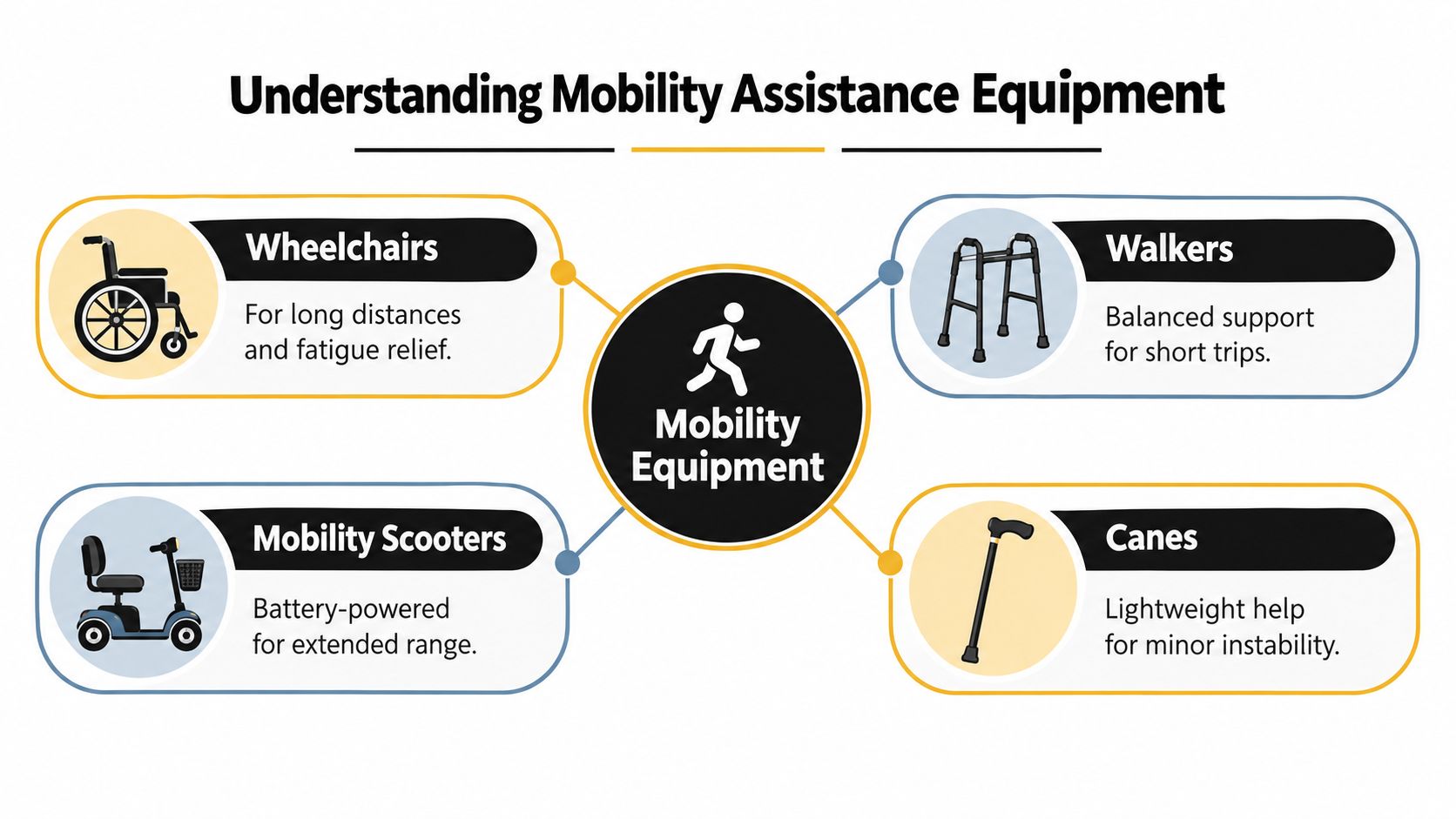
A cane offers a light point of contact for someone who needs modest balance support. It doesn't replace the strength needed to walk long distances, but it can make short movements feel more controlled.
A walker or rollator provides a broader support frame. A standard walker needs to be lifted or moved in stages, while a rollator has wheels and may include a seat. These aids can help with balance and pacing, although their width and turning space matter in aircraft aisles, hotel rooms and narrow transfer areas.
A manual wheelchair reduces walking demand and can be pushed by a companion or operated by the user. It often suits airport transfers, sightseeing and cruise terminals when fatigue or distance is the main difficulty. Folding models can simplify transport, but the folded dimensions still need checking.
A powered wheelchair or mobility scooter supports people who can't rely on walking for extended periods. It can provide greater independence across large terminals and outdoor routes, yet it introduces additional questions about battery handling, charging, weight, turning space and vehicle storage.
Consider the environment, not only the device
The same equipment can feel easy to use in a hotel lobby and difficult on a sloped pavement. Ask where you'll use it, how far you'll travel between stops, whether a companion can push or lift it, and whether you need to remain seated during boarding.
NHS England has maintained a formal national wheelchair data collection since 2015/16, with quarterly official statistics published from Q1 2019/20 onward. Government-commissioned research estimates around 1.2 million wheelchair users in the UK, with two-thirds described as regular users. An England-focused study estimated 688,000 to 860,000 wheelchair users in 2018/19, rising as high as 1.37 million when powered mobility scooter users are included. The NHS England national wheelchair statistics show how closely wheelchair use, delivery times and service expenditure are tracked.
The important distinction is functional. Some equipment supports balance, some conserves energy, some enables movement without walking and some helps with transfers. Travel exposes the differences, so choose according to your real route rather than a general label.
Key Specifications That Affect Travel Decisions
A product specification becomes useful only when you connect it to a travel task. Weight affects lifting and loading. Folded dimensions determine whether equipment fits through a vehicle door or inside a luggage compartment. Turning radius influences whether you can manoeuvre in a cabin, corridor or terminal queue.
Battery information deserves careful attention. Ask the manufacturer for the battery chemistry, whether it can be removed, how it must be protected and what approval the airline requires. Never assume that a device described as “portable” automatically meets an airline's carriage rules.
Read the specification sheet like a traveller
| Equipment Type | Typical Weight and Size | Battery and Power Notes | Travel Fit Consideration |
|---|---|---|---|
| Manual wheelchair | Often folds, though frame width and folded length vary | No drive battery, unless fitted with power assistance | Check lifting arrangements, boot opening and protection from damage |
| Powered wheelchair | Usually heavier and less compact than a manual model | Battery type, removal and terminal protection need confirmation | Verify airline acceptance, ramp capacity and secure storage |
| Mobility scooter | Folding and dismantling options vary significantly | Battery and charging requirements affect carriage and destination use | Confirm separated-part handling, vehicle space and turning room |
| Walker or rollator | Generally narrower than a wheelchair, but wheels and seat add bulk | Usually no battery | Measure the folded aid and check whether luggage can be kept separate |
| Cane or transfer aid | Compact and comparatively easy to store | Usually no drive battery | Confirm cabin storage and whether assistance is needed during transfers |
For electrically powered devices, BS EN 12184:2002 is a key engineering benchmark used to test most powered wheelchairs, mobility scooters, power-assist systems and add-on systems for product safety. The standard separates equipment into Classes A, B and C, which helps indicate the intended performance envelope and terrain. The mobility-device regulatory guidance from Wheels for Wellbeing explains why a device should be matched to its intended setting rather than treated as one generic category.
Ramp design can be decisive in a transfer vehicle. Buckinghamshire Council's wheelchair-accessible vehicle specification requires a one-piece ramp with at least 70 centimetres of clear width between the rails, a safe working load of at least 250 kilograms, certification to BS 6109, and enough length to accommodate all four wheelchair wheels while the passenger remains seated. The Buckinghamshire Council vehicle specification also addresses slipping and tilting. These requirements show why ramp width, surface friction and load capacity must be confirmed against your actual aid.
How to Choose the Right Equipment for Your Trip
Begin with the itinerary, not the shop window. Write down each movement in order: home departure, airport check-in, aircraft boarding, baggage reclaim, transfer loading, hotel arrival, port check-in, ship boarding and daily shore activities. Mark where you'll walk, where you'll sit, where equipment must be folded and where someone else must handle it.
Let the route decide
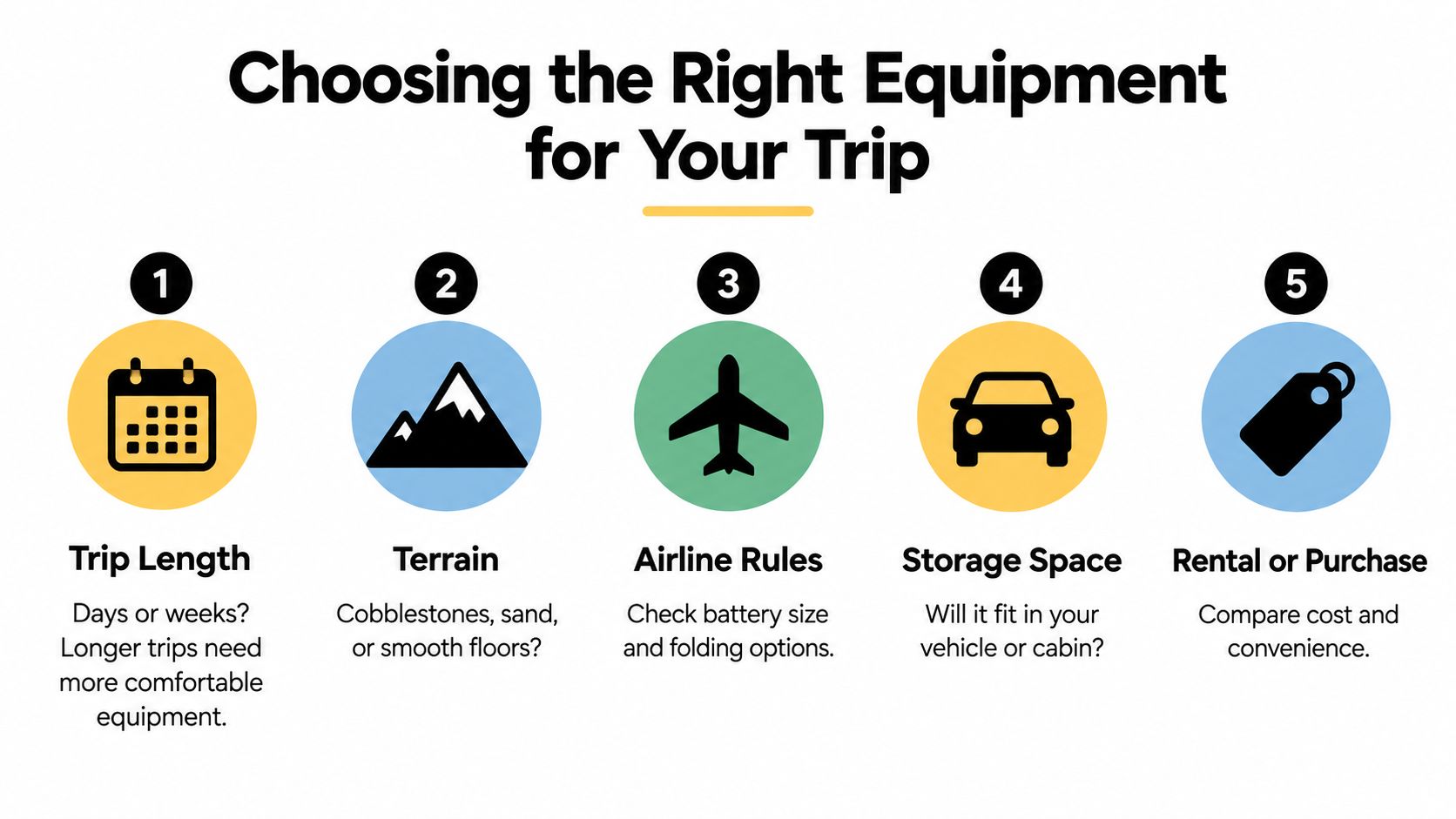
A lightweight manual wheelchair may be the practical choice for a short airport-to-hotel transfer when a companion can push and the main challenge is terminal distance. A powered wheelchair or scooter may be more appropriate when you need to cover long routes independently or can't safely rely on walking between stages.
Terrain changes the answer. Smooth airport floors and ship corridors place different demands on equipment than uneven pavements, cobbles, slopes or outdoor sightseeing routes. Check the device's intended class, ground clearance, stability and braking performance against the places you plan to visit.
Trip duration matters too. Equipment that feels acceptable for a brief transfer may become uncomfortable over a longer holiday. Look at seating support, pressure management, battery range as described by the manufacturer, charging access and the availability of repairs or replacement parts at your destination.
Ask five practical questions
- How much walking will I do? If the answer is uncertain, plan around the longest likely terminal or port movement rather than the shortest route.
- Who will handle the aid? Identify whether you, a companion, airline staff, port staff or a driver will fold, push, lift or secure it.
- Where will it be stored? Measure the vehicle opening and storage area, not only the interior volume.
- Can I use it indoors and outdoors? A larger device may perform well outside but be awkward in a cabin or hotel room.
- What happens if the plan changes? Consider a delayed flight, a vehicle substitution, a damaged component or a missed connection.
The best choice is often the least complicated aid that safely supports the whole itinerary. More features can mean more weight, more rules and more opportunities for a handover to fail. A device that fits every stage may serve you better than one that performs brilliantly in only one location.
Preparing Documentation and Airport and Cruise Port Procedures
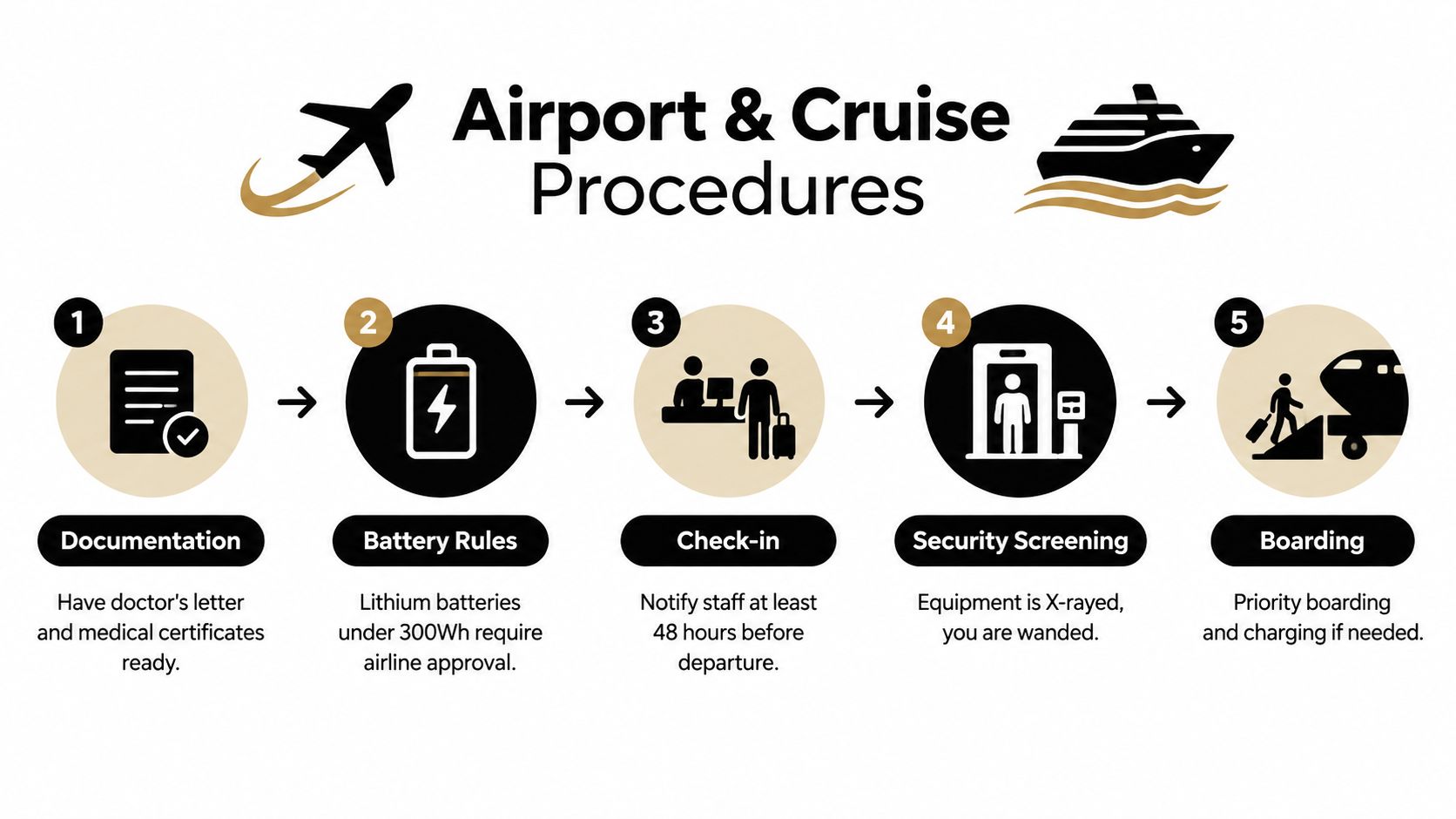
Airlines and cruise operators need precise information before travel. Send the equipment's make and model, measurements, weight, battery details, folding instructions and your assistance requirements. Explain whether you'll remain seated during boarding, whether the aid must be returned at the aircraft door and whether you can transfer independently.
Build a document pack
Keep essential paperwork in your hand luggage, not inside equipment that may be checked separately.
- Equipment details: Carry a printed specification sheet showing dimensions, weight and battery information.
- Battery instructions: Include the manufacturer's removal, isolation and protection guidance.
- Medical information: Take any medical certificates or letters requested by the airline, insurer or cruise operator.
- Contact details: Store airline assistance, cruise accessibility and transfer-provider numbers offline.
- Photographs: Photograph the aid from several angles before departure, including serial numbers and removable parts.
The exact airline process varies, so confirm requirements directly with the carrier. The visual process below is useful as a prompt, but it shouldn't replace the airline's written instructions.
Confirm the space, not just accessibility
A service may advertise accessible travel while leaving unanswered whether your particular scooter, chair or walker will fit. ncat's 2025 transport accessibility research found that 24% of respondents needed real-time information about mobility-aid space availability, while the reviewed data sources didn't provide that information. The ncat transport accessibility highlights report describes the gap clearly.
Ask the airline, cruise operator and transfer provider specific questions. Will your aid be carried on the intended vehicle? Where will it be stored? Can the ramp accommodate its width and weight? Who will help at each handover? Request written confirmation, especially for the airport-to-port leg.
For broader planning around accessibility expectations and operator responsibilities, review this accessibility compliance guidance. Keep copies of confirmations with your travel documents and show them at check-in if staff need to verify the agreed arrangements.
Storing Transporting and Booking Transfers with EC Minibus
A transfer vehicle is part of the equipment plan, not an afterthought. A wheelchair or walker may fit inside one vehicle only when folded, while a powered scooter could require more careful allocation. The booking team needs the aid's folded dimensions, total weight, number of passengers, luggage quantity and whether you can transfer into a standard seat.
Describe the aid accurately
Use plain, measurable information:
- Width and length: Give both unfolded and folded measurements.
- Weight: Include batteries, baskets, cushions and detachable components.
- Folding method: State whether the aid folds as one piece or must be dismantled.
- Loading needs: Explain whether you need a ramp, a second person or extra time.
- Passenger position: Clarify whether you can sit in a vehicle seat or must remain in the wheelchair.
EC Minibus states that its vehicles aren't wheelchair accessible, but foldable wheelchairs and walkers can be transported when disclosed at booking so an appropriate vehicle can be allocated. That distinction matters. A vehicle carrying a folded aid isn't the same as a vehicle where a passenger remains seated in the chair throughout the journey.
Routes can connect Heathrow with Central London hotels and cruise terminals including Southampton, Dover, Portsmouth and Tilbury, as well as St Pancras International. Booking information should cover meet and greet, luggage assistance, flight or cruise monitoring, pickup timing and the fixed price. You can compare those details with the provider's wheelchair-accessible minibus information, while confirming the actual vehicle arrangement for your equipment before payment.
Make boarding repeatable
Safe boarding depends on more than a friendly driver. The ramp must be positioned securely, the equipment must be stable while moving, and loose parts must be protected during transport. If you transfer into a seat, ask where the folded aid will be placed so it won't be crushed by suitcases.
A coordinated door-to-terminal plan also reduces handover uncertainty. Confirm where the driver will meet you, who will identify the equipment, how delays will be handled and what happens if the flight or ship arrival changes. Those details are especially important on a multi-leg journey, where a missing piece of information can affect the next provider.
Safety Insurance and Your Pre Travel Checklist for Peace of Mind
Responsibility can become unclear when several organisations handle the same mobility aid. The airline may manage aircraft loading, the port may manage terminal movement, a transfer company may manage vehicle storage and the passenger may manage detachable parts. The UK Transport Committee's 2025 report called for a unified complaints service and clearer, updated accessibility standards, while the Disabled Persons Transport Advisory Committee's 2024 to 2025 report records ongoing work on mobility-aid regulations and the existing “invalid carriage” framework. Read the Disabled Persons Transport Advisory Committee annual report for the current policy context.
Insurance should match the equipment and journey. Ask whether your travel policy covers loss, theft, accidental damage, delayed return and repair costs. Keep purchase records, photographs, serial numbers and written valuations where available, and check exclusions before departure. This guide to comprehensive insurance coverage can help you identify the questions to ask your insurer.
Complete the final review
Use this checklist shortly before leaving home:
- Measure again: Confirm the aid's folded and unfolded dimensions.
- Record the weight: Include batteries and detachable accessories.
- Check the battery: Follow the manufacturer's isolation and packing instructions.
- Confirm every handover: Contact the airline, cruise operator and transfer provider.
- Request space confirmation: Ask whether the specific aid will fit and be carried.
- Label the equipment: Add your name, mobile number and destination details.
- Protect vulnerable parts: Remove or secure baskets, controls, footrests and cushions.
- Photograph its condition: Save images before check-in and after collection.
- Carry documents: Keep medical, equipment, booking and insurance information with you.
- Pack a contingency plan: Take essential medication, chargers and support contacts in hand luggage where appropriate.
Written confirmation is your travel safety net. It gives each organisation a clear responsibility before the journey begins.
You don't need to predict every possible problem. You do need to replace assumptions with measurements, battery information, named contacts and confirmed storage. When your specific mobility assistance equipment fits the vehicle, the terminal process and the cruise transfer, accessible travel becomes much more predictable.
EC Minibus can arrange private transfers between Heathrow, London hotels, St Pancras International and cruise ports including Southampton, Dover, Portsmouth and Tilbury, with meet and greet, flight and cruise monitoring, fixed pricing and support for disclosed foldable wheelchairs and walkers. Visit EC Minibus to share your equipment details and request a transfer plan that fits your journey from arrival to terminal.