

Insurance that covers damage to your own vehicle as well as third-party losses is the broadest tier of motor insurance. Unlike the UK legal minimum, which only covers other people, it can also protect the vehicle carrying you, your family, or your luggage.
You may be checking this before booking an airport pickup, arranging a ride from Heathrow to Southampton, or comparing cover for a family car. The important question isn't whether a vehicle is insured. It's what the policy pays for when something goes wrong, who is allowed to drive, and whether the vehicle is insured for carrying passengers for payment.
Table of Contents
- What This Level of Cover Actually Means
- What a Comprehensive Policy Typically Includes
- Comprehensive vs Third-Party Cover at a Glance
- Common Exclusions and Add-Ons to Watch For
- Factors That Move a Comprehensive Premium
- Questions to Ask Before You Book a Private Transfer
- What to Do Right After an Incident or Claim
- Key Takeaways and Quick Answers
What This Level of Cover Actually Means
A traveller leaves Heathrow Terminal 5, collects a suitcase, and finds a minibus waiting at the pickup point. The driver loads the luggage, then another vehicle clips the minibus's rear bumper while leaving a crowded car park. Nobody is hurt, but the minibus needs repairs and the transfer schedule is suddenly under pressure.
This type of motor insurance can protect the insured vehicle as well as other people and their property. It commonly responds to accidental damage, fire, theft, and other insured events. It also includes third-party liability for injury or property damage caused by the driver. The policy wording decides the final result, so the broad label is only the starting point.
The difference between protecting others and protecting the vehicle
The legal minimum in the UK is third-party insurance. It covers the driver's liability for injury or damage caused to other people, their vehicles, or their property. It does not usually pay to repair the policyholder's own car after a collision that driver caused.
For example, a private car scrapes a concrete pillar while collecting relatives from an airport. Third-party-only cover may deal with damage to the pillar or another vehicle, while the driver's own repair bill remains theirs. With cover that also protects the insured vehicle, that damage may be considered under the own-vehicle section, subject to the policy terms and excess.
UK guidance describes this as the highest standard motor insurance tier, while explaining that inclusions differ between insurers and that an excess can still apply. MoneyHelper's car insurance guidance helps separate the broad cover label from the conditions that determine whether a claim is paid.
Why transfer journeys make the distinction practical
Airport and cruise-port journeys bring luggage, tight pickup windows, unfamiliar roads, busy drop-off areas, and repeated mileage. A damaged vehicle can disrupt a passenger's journey even when the incident appears minor. Checking that a provider has suitable insurance forms part of checking that the transfer has been planned responsibly.
Cover is a foundation, not a promise that every loss will be paid. The policy schedule, permitted use, driver conditions, limits, and exclusions determine the protection available for an airport pickup, cruise transfer, or family ride. A vehicle insured for ordinary private use may not have the right permission for carrying passengers in exchange for payment, so that detail deserves attention before booking.
What a Comprehensive Policy Typically Includes
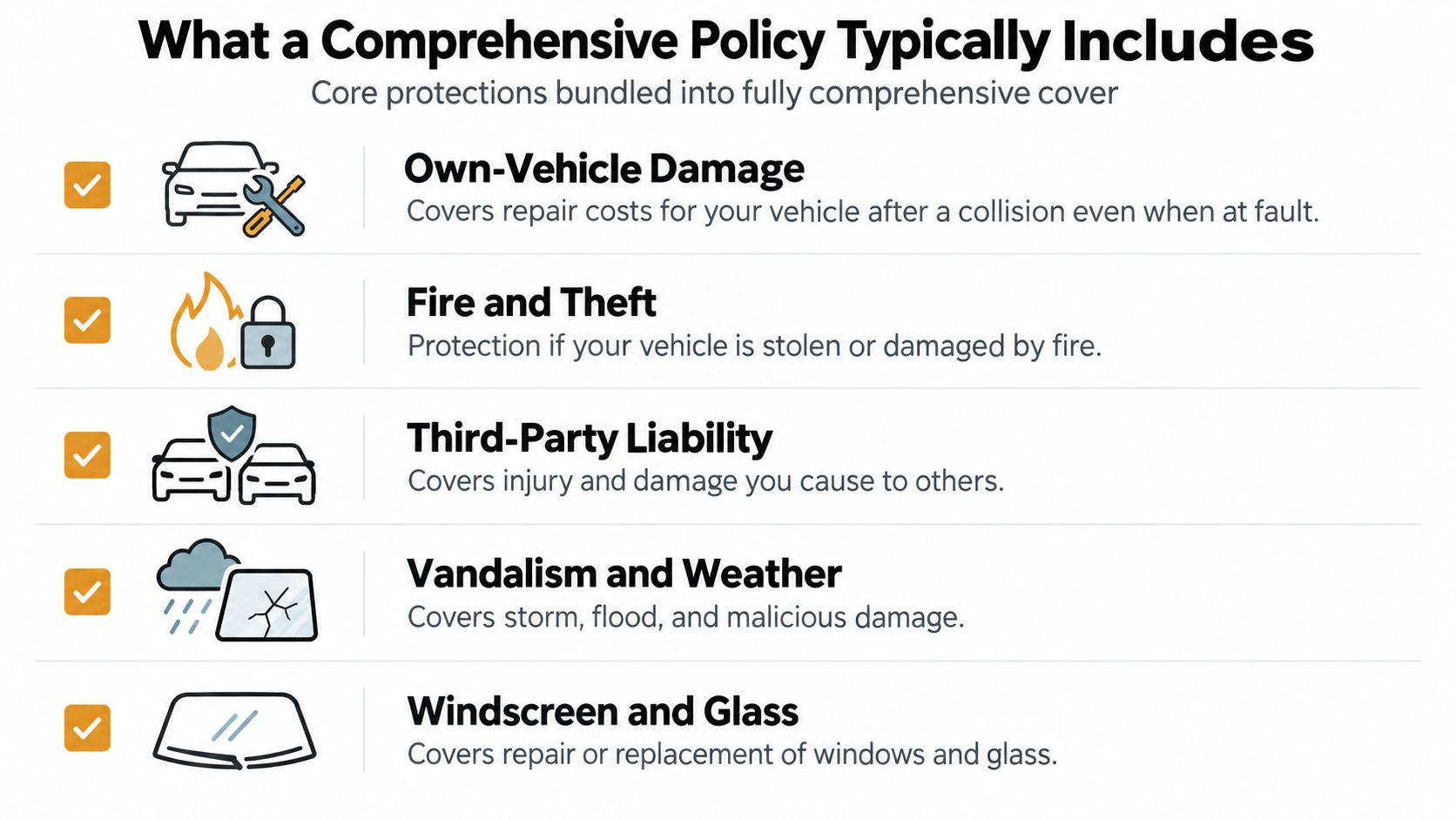
For a family collected from the airport, a cruise transfer, or a day trip on UK roads, the cover needs to address more than damage to another vehicle. This top-tier policy usually combines protection for the insured vehicle, other people, and several non-collision risks. Treat it like a travel bag with different compartments. The main label says one thing, but each compartment, own-damage, fire and theft, and liability, has its own limits and excess.
The core protections
- Own-vehicle damage: If the insured driver hits another car, a wall, or a barrier, this section can pay for repairs to the insured vehicle, even when the driver caused the collision, subject to the policy terms and excess. A minor supermarket car park collision before an airport pickup is a straightforward example.
- Fire and theft: The policy may cover a stolen vehicle, fire damage, or damage after an attempted break-in. If someone forces open a door to steal equipment from a working vehicle, damage to the vehicle may be treated differently from the missing contents. The wording decides which part, if any, applies.
- Third-party liability: If the driver injures someone or damages another vehicle, building, gate, or item of street furniture, this section can meet covered legal claims. It supports the protection required for road use, while the policy sets its own conditions.
- Vandalism and weather: Keyed paintwork, broken mirrors, storm damage, and flooding may be insured risks. A vehicle parked overnight near a cruise terminal could be damaged while nobody is driving it, but the policy must include the relevant event.
- Windscreen and glass: A stone chip on the M25 may fall under a separate glass provision, with its own excess and approved-repairer conditions. Window damage after an attempted theft can also follow special claims rules.
Optional benefits may include personal accident benefits, medical expense benefits, replacement-key cover, or a courtesy vehicle. The policy name does not guarantee them. A courtesy car may depend on its type, availability, duration, or the cause of the damage.
The excess is the amount the insured pays towards an accepted claim. Named-driver rules, business-use restrictions, passenger-use conditions, and luggage or personal-belongings limits can affect a transfer just as much as the headline cover.
Vehicle safety equipment and sensible journey preparation can reduce the chance of a minor incident disrupting passengers. EC Minibus's vehicle safety features guide provides related information about features passengers may encounter during a transfer.
The following video provides another general introduction to the subject:
Comprehensive vs Third-Party Cover at a Glance
A family is travelling to the airport when the transfer vehicle is damaged in a collision. The cover needed depends on whether the claim concerns other people, the vehicle itself, or a theft or fire event. Use this shortcut first: if repairing or replacing the vehicle would interrupt household finances or a passenger service, price the highest tier of cover before considering a lower one.
| Coverage Feature | Third-Party Only | Third-Party, Fire & Theft | Highest tier of cover |
|---|---|---|---|
| Injury or damage caused to other people | Covered | Covered | Covered |
| Damage to another person's vehicle or property | Covered | Covered | Covered |
| Vehicle stolen | Not covered | Covered, subject to terms | Covered, subject to terms |
| Vehicle damaged by fire | Not covered | Covered, subject to terms | Covered, subject to terms |
| Accidental damage to your own vehicle | Not covered | Usually not covered | Usually covered, subject to terms |
| Windscreen or glass | Usually not covered | Policy dependent | Often included, with conditions |
| Vandalism or storm damage | Usually not covered | Policy dependent | Often included, with conditions |
| Excess payable | May apply to accepted claims | May apply to accepted claims | May apply to accepted claims |
For a vehicle that is newer, financed, leased, or costly to replace, damage cover may prevent one incident from becoming a large personal bill. A transfer operator should also consider lost availability while the vehicle is being repaired. A damaged minibus can affect an airport pickup or cruise transfer even when passengers are not injured.
A lower tier may be suitable for an older vehicle with modest value, secure parking, and an owner who can meet repair costs. Compare the premium with the excess, the vehicle's value, likely journey risks, and any finance or lease conditions. A cheaper quote is not automatically better value if permitted use is narrow or the excess is high.
Third-party only covers liability to other people. Third-party, fire and theft adds specific protection for events such as theft or fire, while damage to the insured vehicle after an ordinary collision is usually outside that tier. The broadest standard tier generally includes that own-vehicle protection, subject to the wording.
For an airport or cruise journey, check the policy before relying on the label. Confirm that the vehicle may be used for the trip and that the listed drivers and passenger arrangements fit the policy terms. A vehicle can appear well protected at first glance yet leave a gap when it is needed for a booked transfer.
Common Exclusions and Add-Ons to Watch For
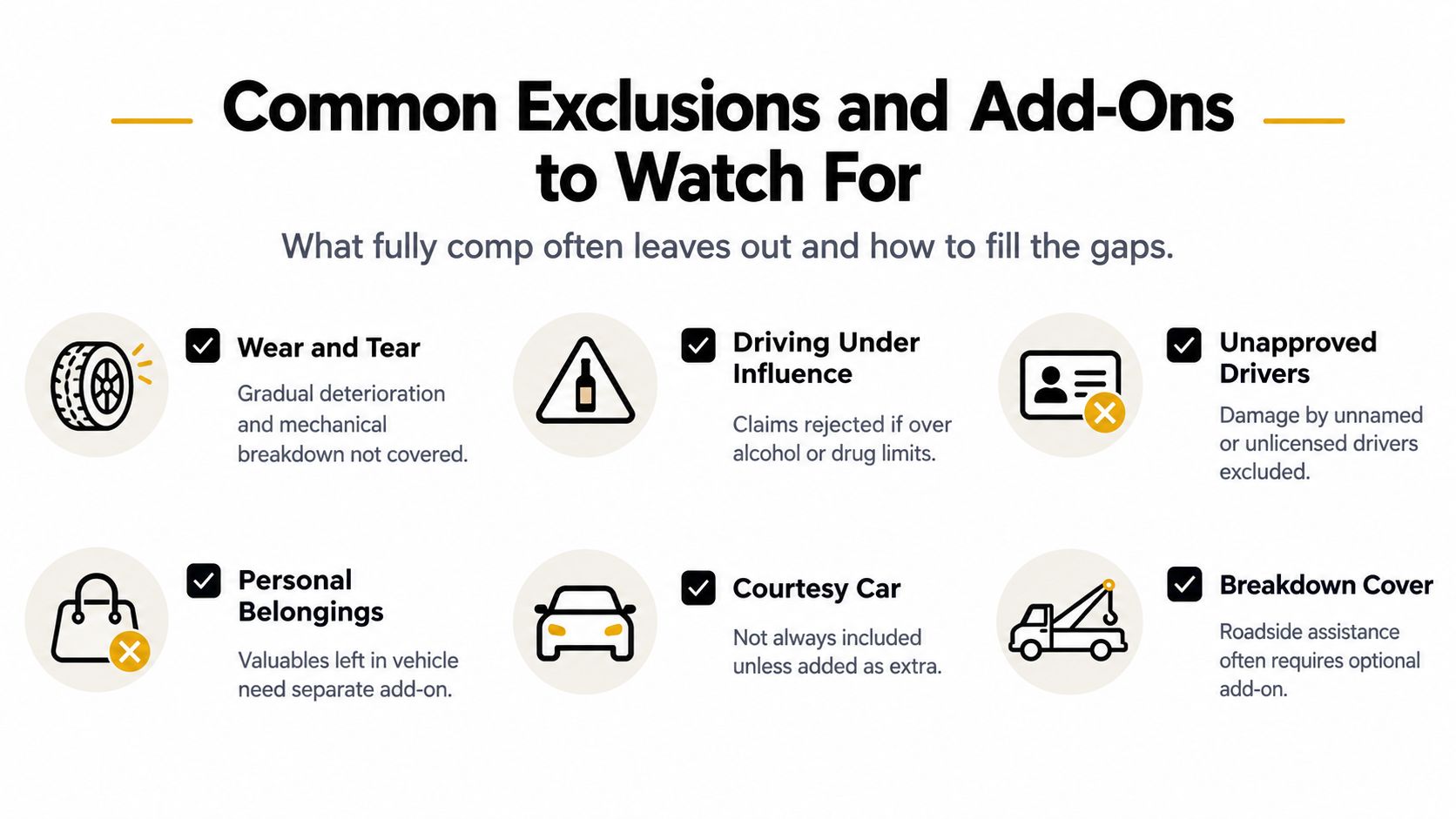
“Fully comprehensive” doesn't mean “every possible loss”. It means the policy offers the broadest standard tier, while still applying exclusions, conditions, limits, and excesses. A claim can fail because of what happened, who was driving, how the vehicle was being used, or what the policyholder failed to disclose.
Common gaps
Normal deterioration isn't usually an insured accident. Worn tyres, ageing brakes, corrosion, and mechanical breakdown generally need maintenance or a separate breakdown arrangement. Insurance coverage also won't normally protect a driver who was intoxicated, unlicensed, or driving outside the agreed terms.
A policy may exclude damage caused by an undeclared or unapproved driver. It may also reject a claim if a vehicle was used to carry passengers for payment without the correct hire or reward permission. This point is especially important for private transfers. A personal motor policy may not be suitable for a paid airport journey.
Geographical restrictions matter too. Cover may change outside the UK, and some destinations require an extension or separate documentation. Personal belongings, such as a passenger's camera or suitcase contents, may have low limits or no cover under the motor policy at all.
Excesses and optional protection
An excess combines the part of a claim the policyholder must pay. For example, with a £400 voluntary excess, a small repair costing less than that amount may produce no payment from the insurer. A larger repair may still be covered, but the excess reduces the settlement.
Common add-ons include:
- Courtesy car: Provides temporary replacement transport, although the vehicle size and availability may be restricted.
- Protected no-claims bonus: Can preserve a discount after certain claims, but it won't necessarily prevent every premium increase.
- Legal expenses cover: May help with specified legal costs after an insured incident.
- Key replacement: Can assist with replacement keys or related security work.
- Breakdown assistance: Provides roadside help, but it often sits outside the core motor policy.
Check the policy schedule and exclusions page before booking a journey involving paying passengers. Apex Insurance Brokers' explanation of comprehensive motor insurance also stresses that exact benefits vary and that the legal minimum doesn't protect the policyholder's own vehicle.
Factors That Move a Comprehensive Premium
Two drivers can insure similar vehicles and receive very different quotes because insurers assess risk through several inputs. A postcode, a driver's history, the vehicle's repair cost, and the intended use can all change the price.
London pricing shows why location deserves attention for a transfer operator. Market data recorded an average fully annual premium of £795.45 in London, compared with £483.54 in the South East and £546.76 in the North West in September 2026, when paid annually. The same source recorded £522.50 as the UK average when paid annually, compared with £549.53 when paid monthly. MoneySuperMarket's car insurance statistics provides that regional and payment comparison.
| Factor | Effect on Premium |
|---|---|
| Driver age and experience | Less experience can increase the assessed risk |
| Postcode | Traffic density, theft exposure, parking conditions, and claims patterns can affect pricing |
| Vehicle value and repair profile | More expensive or complex repairs can increase the insurer's exposure |
| Annual mileage | More time on the road can mean more opportunities for incidents |
| Claims and convictions | A history of claims or driving offences can affect the quote |
| Vehicle use | Business use, hire, reward, or passenger transport may require specialist cover |
| No-claims history | A qualifying record can influence the offered price |
| Excess | A higher voluntary excess can reduce the quoted premium, while increasing the policyholder's contribution after a claim |
The wider market has moved sharply rather than following a straight line. The Confused.com Price Index, produced with WTW, reported premiums down 16% year on year to an average of £757 by June 2025, then down a further 9% year on year to £711 by March 2026. It also reported an average of £726 by January 2026, a fall of £111 over 12 months. These are quoted-market measures, not a guarantee for an individual driver. WTW's summary of the Confused.com Price Index explains the historical movement.
For a London fleet, driver rotation, vehicle mix, mileage, passenger use, and vehicle downtime all need accurate disclosure. The practical levers a driver can control include choosing a sensible voluntary excess, considering telematics where suitable, and giving an honest annual mileage estimate. Reducing a quote by understating use can create a much larger problem at claim time.
Questions to Ask Before You Book a Private Transfer
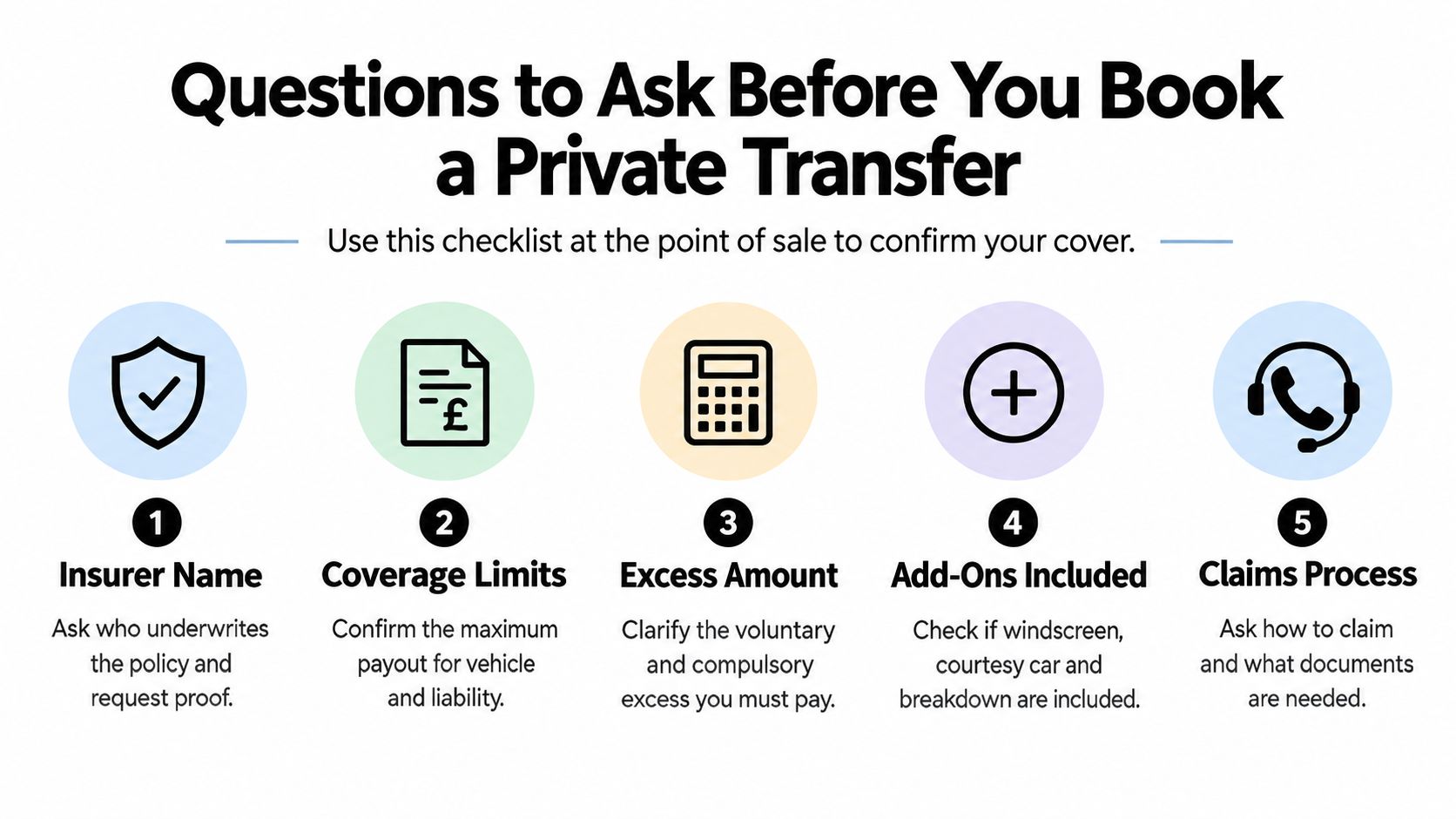
A low fare tells you little about the protection behind a journey. Before confirming an airport pickup or cruise-port transfer, ask questions that identify the insurer, the permitted use, and the claims route.
Use this booking checklist
- Who underwrites the vehicle? Ask for the insurer's name, the policy number, and a copy or confirmation of the certificate of motor insurance. A legitimate provider should be able to explain who insures the journey.
- What cover level applies? Confirm whether the vehicle has full or third-party, fire and theft cover. Then ask whether the policy permits private hire or carrying passengers for reward. A standard personal policy may not cover a paid transfer.
- What liability applies to passengers? Ask whether passenger injury is covered, what liability limits apply, and whether the operator has any separate commercial liability arrangements. Don't assume that a vehicle's insurance label answers every passenger question.
- What happens to luggage? Motor insurance may not cover personal belongings inside the vehicle. Ask about luggage responsibility, exclusions, and whether passengers need their own travel insurance.
- What evidence supports safe operation? Check the operator's licence through the DVSA public register and licensing information, and ask whether the vehicle has a current MOT where one is required, working seatbelts, and suitable maintenance.
A provider that refuses to share basic insurance information, gives vague answers about who covers the journey, insists on cash without clear booking records, or avoids questions about hire and reward should make you pause. You don't need to become an insurance specialist, but you do need enough information to know who carries the risk.
For wider context on the rules that can affect passenger transport, read EC Minibus's legal requirements guide. Keep the provider's booking confirmation and emergency contact details with your travel documents, especially when several family members are travelling together.
What to Do Right After an Incident or Claim
A collision during a transfer can feel chaotic, particularly when passengers are tired, unfamiliar with the road, or trying to catch a flight or ship. Deal with safety first, evidence second, and notifications third.
At the scene
Stop in a safe place if possible, switch on the hazard lights, and check the driver, passengers, and other road users for injuries. Call emergency services when someone needs urgent help or when the scene creates a danger to traffic.
Don't argue about fault at the roadside. Exchange names, contact details, registration numbers, vehicle details, and insurance information with the other driver. If witnesses are present, ask for their names and phone numbers.
Take photographs when it's safe to do so. Capture the position and condition of every vehicle, registration plates, road markings, traffic signs, weather or surface conditions, and the surrounding area. Note the time, location, and a clear description of what happened while the details are fresh.
Call the police where there are injuries, suspected drink-driving, a hit-and-run, threats, or another circumstance that requires official attendance. Follow the instructions you receive and keep any reference number.
Notify the right people
The transfer provider should be told promptly so its fleet insurer or claims team can be notified. If you're travelling under your own motor or travel policy, contact the relevant claims line as soon as possible and follow the reporting deadline in the documents. Don't authorise expensive repairs or dispose of damaged items before the insurer or assessor explains what to do.
The process commonly follows this sequence:
- Notification: The insurer records the incident, checks the policy, and asks for the initial facts.
- Assessment: An assessor or approved repairer examines the damage and considers whether it falls within cover.
- Authorisation: The insurer confirms whether repairs can proceed and which repair route applies.
- Repair or settlement: The vehicle is repaired, or the insurer considers another settlement under the policy terms.
- Excess and closure: The applicable excess is accounted for and the claim is closed once the insurer has the required documents.
Keep photographs, witness details, receipts, correspondence, and medical information together. If communication breaks down, the provider's customer complaint resolution process may explain how to escalate a service issue separately from the insurance claim itself.
Key Takeaways and Quick Answers
This insurance coverage is the broadest standard motor insurance tier. It can protect the insured vehicle after accidental damage, fire, theft, vandalism, and certain weather events, while also covering third-party liability. It still isn't unlimited. Excesses, exclusions, driver rules, vehicle use, geographical limits, and optional add-ons shape the actual value of the policy.
For travellers, the practical lesson is simple. Before booking a private transfer, ask who insures the vehicle, whether the policy permits paid passenger journeys, what liability applies to passengers, and how luggage is treated. Keep the booking confirmation, operator contact details, and emergency information accessible during the journey.
Short answers to common questions
Does broad cover apply abroad?
It may, but the territorial limits and level of protection can change outside the UK. Check the policy wording and obtain any required extension or documentation before driving or arranging a journey overseas.
Is a private hire driver covered under a personal motor policy?
Not necessarily. Carrying passengers for payment may require specific hire or reward cover. The operator should confirm that the vehicle and driver are insured for the service being provided.
Will a non-fault claim affect a no-claims bonus?
It depends on the policy, the claims circumstances, and whether the insurer recovers its costs from the responsible party. A protected no-claims add-on may preserve the bonus under specified conditions, but it doesn't guarantee that the overall premium won't change.
Is comprehensive always the best-value option?
No. Compare the premium, excess, vehicle value, financial resilience, parking environment, and intended use. For a passenger vehicle or transfer service, the correct commercial permission and liability arrangements matter as much as the cover tier.
EC Minibus provides licensed, insured private transfers between Heathrow, London hotels, and UK cruise ports including Southampton, Dover, Portsmouth, and Tilbury. For a door-to-door journey with meet and greet, flight or cruise monitoring, luggage assistance, and fixed pricing, visit EC Minibus and check the booking details before your next trip.