

In 2024, Great Britain recorded 1,538 road fatalities, 29,918 killed or seriously injured casualties, and 127,883 casualties of all severities, even though total casualties fell 4% year on year. The same government consultation warns that progress in reducing deaths and serious injuries has slowed since 2010, so vehicle safety features remain a practical passenger concern, not a showroom extra. UK government road-safety and type-approval consultation
For international travellers, the issue is especially straightforward. You may be tired after a flight, unfamiliar with left-side driving, or travelling through narrow lanes, busy roundabouts, and dense city traffic. A safe transfer depends on more than a modern-looking vehicle. The belts must be usable, the driver must understand assistance systems, and the provider should be willing to answer sensible questions about maintenance and passenger protection.
Table of Contents
- Why Vehicle Safety Features Matter More Than Ever
- Core Safety Systems Every Passenger Should Recognise
- Advanced Driver Assistance Systems and the Confusion Gap
- The 2026 UK Safety Mandate and What It Means for Passengers
- Your Passenger Safety Checklist for Evaluating Transfer Providers
- What Safety Standards You Can Expect from EC Minibus
- Travelling with Confidence on UK Roads
Why Vehicle Safety Features Matter More Than Ever
Britain's safety standards developed over time rather than arriving as one complete package. Braking requirements appeared in 1903–1904, flashing indicators were legalised in 1954, seat belts became compulsory for new cars in 1967, front-seat belt wearing became compulsory in 1983, and rear-seat adult belt wearing followed in 1991. These milestones show how the UK moved from basic roadworthiness rules towards occupant protection as a normal expectation. The UK government's vehicle safety consultation outlines this legislative timeline.
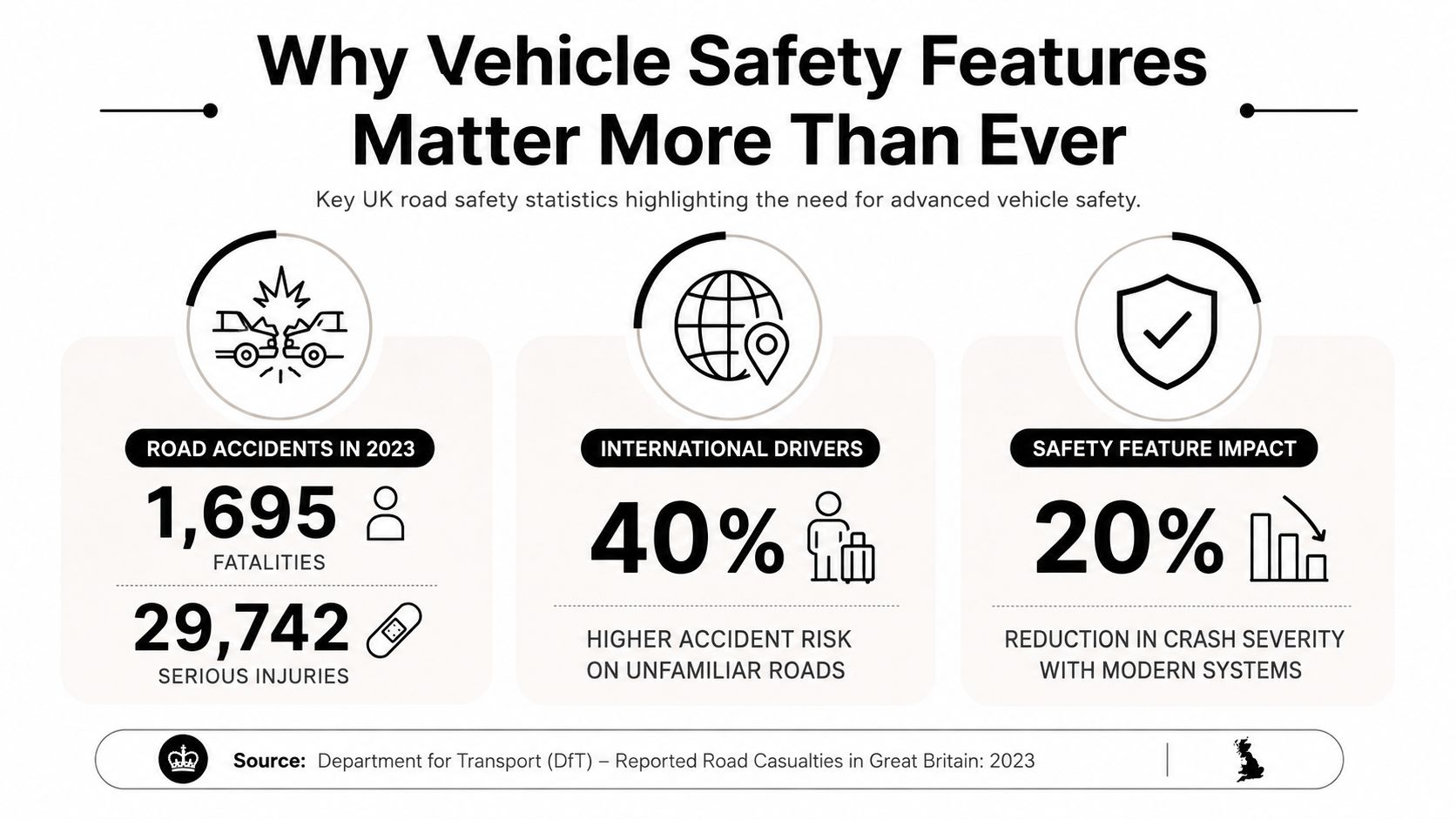
That history matters because passengers often judge safety by comfort, cleanliness, and the vehicle's age. Those things matter, but they don't tell the whole story. A well-maintained vehicle with functioning restraints, stable handling, clear warning displays, and a driver who uses assistance technology properly offers more meaningful reassurance than a polished exterior alone.
Safety is a system, not a single feature
A seat belt only protects you if it's fastened and positioned correctly. Electronic stability control can help during a sudden manoeuvre, but it can't overcome unsafe speed or poor judgement. Emergency braking may support a driver's response, yet it doesn't turn a vehicle into an autonomous taxi.
The professional standard is therefore layered. Passive safety systems help protect occupants when a collision occurs. Active safety systems help the driver avoid or reduce a collision. Human performance, including attention, speed choice, observation, and correct restraint use, connects both layers.
Passenger principle: Treat vehicle safety features as assistance and protection, not as a replacement for a responsible driver.
For a transfer booking, ask practical questions rather than requesting a technical sales pitch. Does the vehicle have usable seat belts for every passenger? Are child seats available when needed? Does the provider maintain its fleet and train drivers to respond appropriately to warning alerts? A reputable operator should answer clearly, without making you feel difficult for asking.
Core Safety Systems Every Passenger Should Recognise
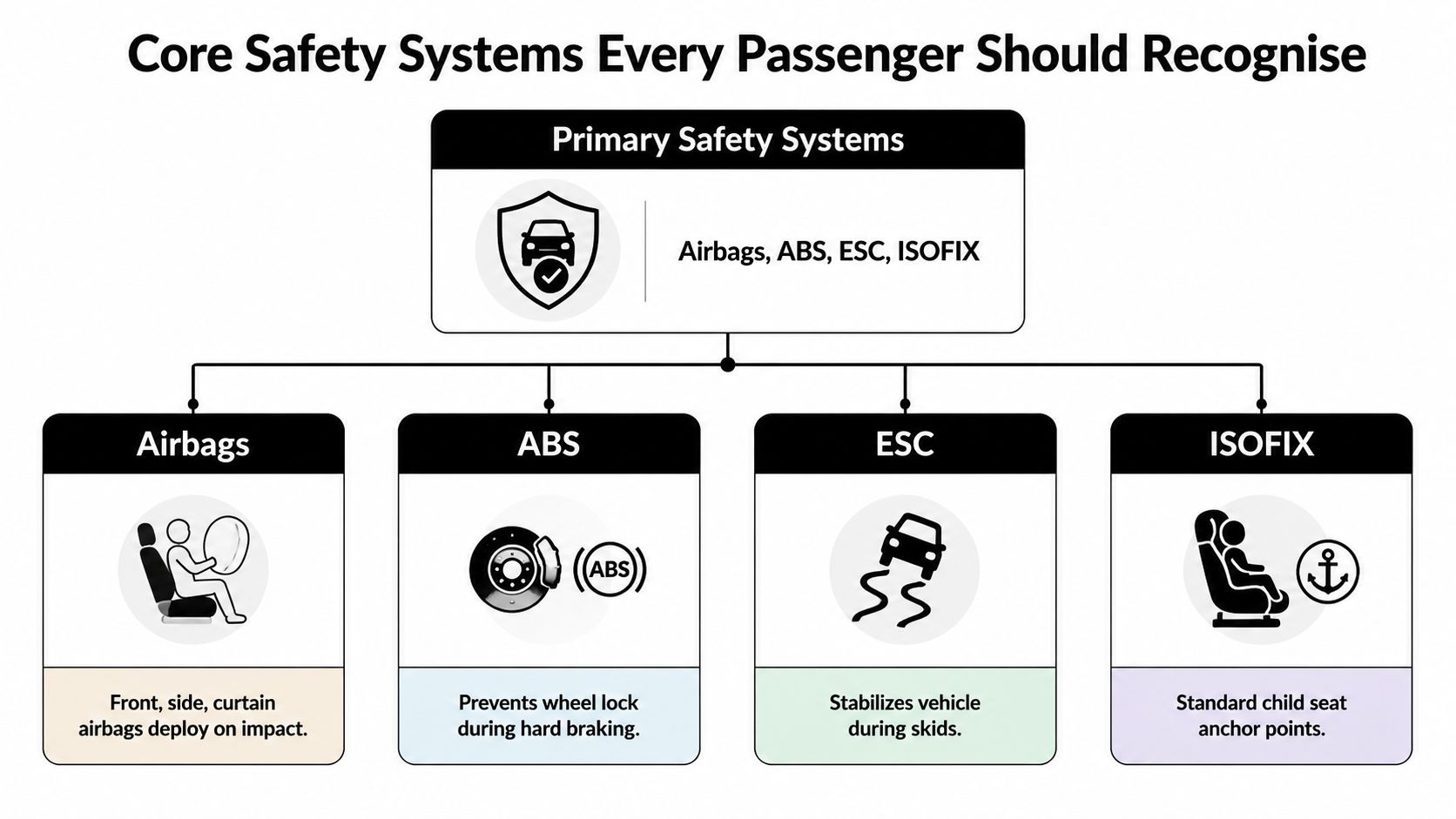
The most important vehicle safety features aren't always the most complicated. Some have protected occupants for decades, while newer systems build on the same basic idea: keep people restrained, keep the vehicle controllable, and manage crash forces.
Seat belts and airbags work together
A seat belt holds your body in the safest available position during sudden braking or impact. It also helps place you where the airbag can provide protection as designed. Keep the lap section low across your pelvis, position the shoulder section across your chest, and don't place the belt behind your back or under your arm.
Airbags provide a cushioning layer during a collision. They may be located at the front, sides, or roof area, depending on the vehicle. Passengers shouldn't lean against doors or rest close to airbag locations, particularly when travelling in a minibus where seating positions can vary.
ABS preserves steering control
Anti-lock braking system, or ABS, prevents wheels from locking during hard braking. Think of it as allowing the tyres to continue gripping and responding while the driver brakes firmly. On a wet motorway or approaching a congested roundabout, that can help the driver steer around a developing hazard instead of sliding straight ahead.
ABS doesn't shorten every stopping distance, and it doesn't remove the need for a safe following distance. Passengers may feel a pulsing sensation through the vehicle during heavy braking. That sensation can be normal system operation rather than a fault.
ESC helps the vehicle stay stable
Electronic stability control, or ESC, monitors the vehicle's direction and can intervene when the vehicle begins to skid or depart from its intended path. A useful analogy is an invisible hand applying small corrections when a vehicle starts to rotate on a slippery bend or wet roundabout.
The system is particularly relevant on rural roads, steep approaches, and tight urban turns. It supports control, but it can't defeat physics. The driver still needs to reduce speed for weather, visibility, road layout, and traffic.
ISOFIX and structure add another layer
ISOFIX anchor points provide standard attachment points for compatible child seats. Families should confirm that the requested child seat is suitable for the child and compatible with the vehicle before travel. This guide to child safety seats can help families prepare more specific questions.
Finally, the vehicle's structure matters. Crumple zones are designed to absorb some crash energy, while the passenger cell helps preserve space around occupants. Passengers won't see these structures working, but they form an important part of protection when preventative systems can't avoid an incident.
Advanced Driver Assistance Systems and the Confusion Gap
Advanced driver assistance systems, or ADAS, can feel reassuring in one journey and irritating in another. That doesn't necessarily mean the technology is unreliable. It often reflects a mismatch between how a system is designed to work and the road environment in front of it.
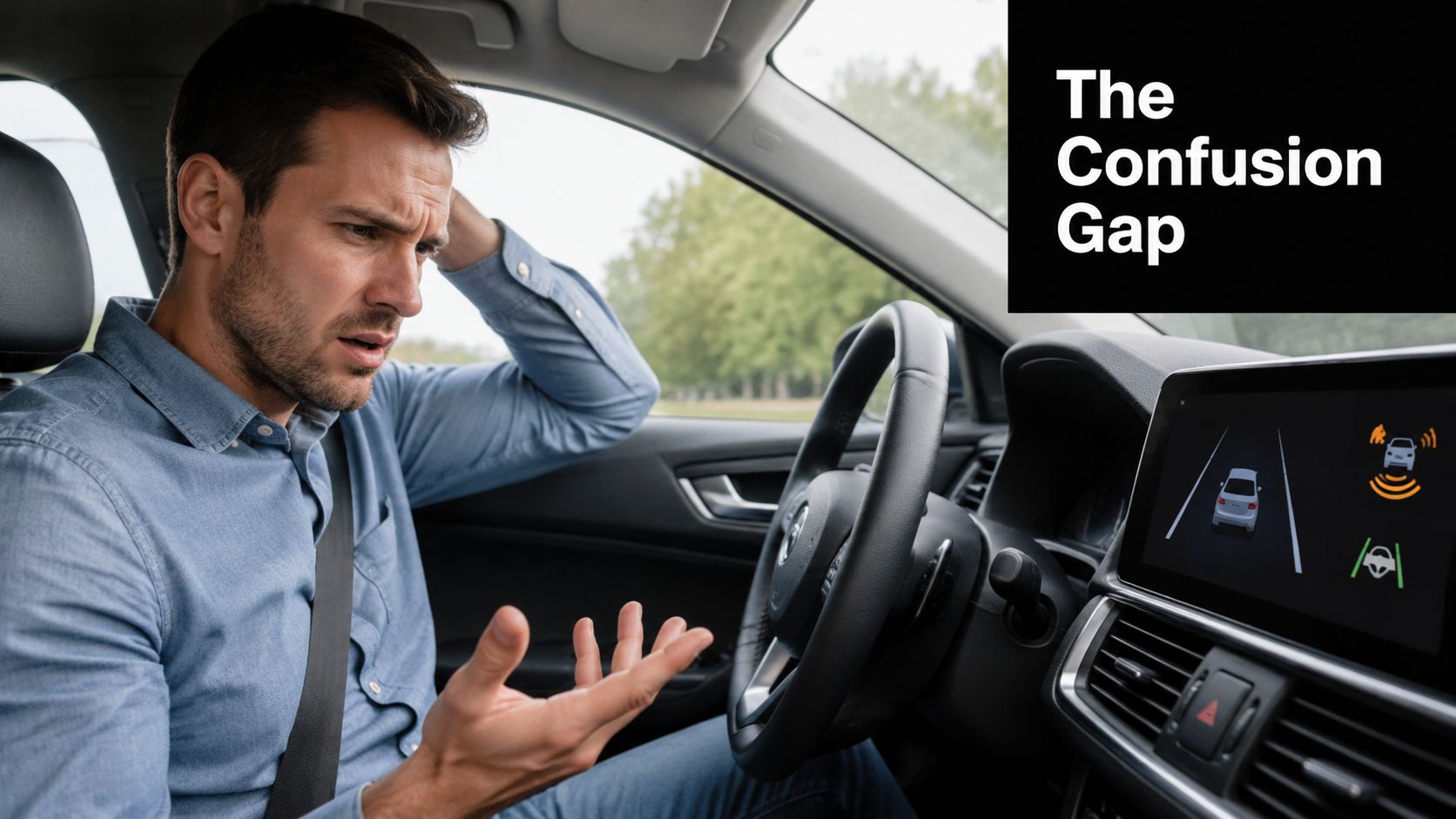
A 2025 UK survey found that 40% of car buyers weren't given enough information about the safety and assistance systems fitted before purchase. The same reporting linked confusion with dissatisfaction around lane-keep assist and emergency braking. Carbuyer's report on driver confusion and dissatisfaction illustrates why a feature list isn't enough.
Why UK roads can make assistance feel intrusive
Lane-keep assist relies on visible road markings. A narrow country lane, temporary roadworks, faded lines, or an unusual urban layout can produce alerts that feel unnecessary to someone who doesn't understand the system's boundaries. Roundabouts also demand decisions that don't always resemble a simple motorway lane pattern.
Automatic emergency braking can warn or intervene when the vehicle detects a potential forward collision. Blind-spot information can alert the driver to traffic beside the vehicle. These functions may reduce risk, but they don't replace mirror checks, observation, or careful positioning.
A professional driver should know what each warning means, recognise when a sensor may have limited visibility, and respond without treating the system as either infallible or useless. Passengers can ask whether the driver understands the vehicle's assistance functions and whether warning messages are addressed before departure.
Ask this before boarding: “Are the vehicle's assistance systems active, and what do you do if one reports a sensor or camera problem?”
There's evidence that drivers generally see value in ADAS rather than rejecting it. 82% of UK drivers say ADAS makes them feel safer, and over half say it has actively prevented collisions, according to the same UK reporting. Yet frustration can lead people to switch features off, which makes explanation and responsible use commercially important for transfer providers.
Passengers don't need to memorise every dashboard icon. They do need confidence that the driver remains attentive and treats technology as a support tool. That distinction is especially important when travelling in unfamiliar traffic conditions.
The 2026 UK Safety Mandate and What It Means for Passengers
In July 2026, the UK government confirmed that 18 safety technologies will be required for GB type approval, with compliance phased in over 12 to 48 months, depending on vehicle type. The measures include intelligent speed assistance, blind-spot information, reversing motion awareness, emergency braking, driver drowsiness warnings, tyre pressure monitoring, and event data recorders. The government response explains the confirmed requirements and implementation approach.
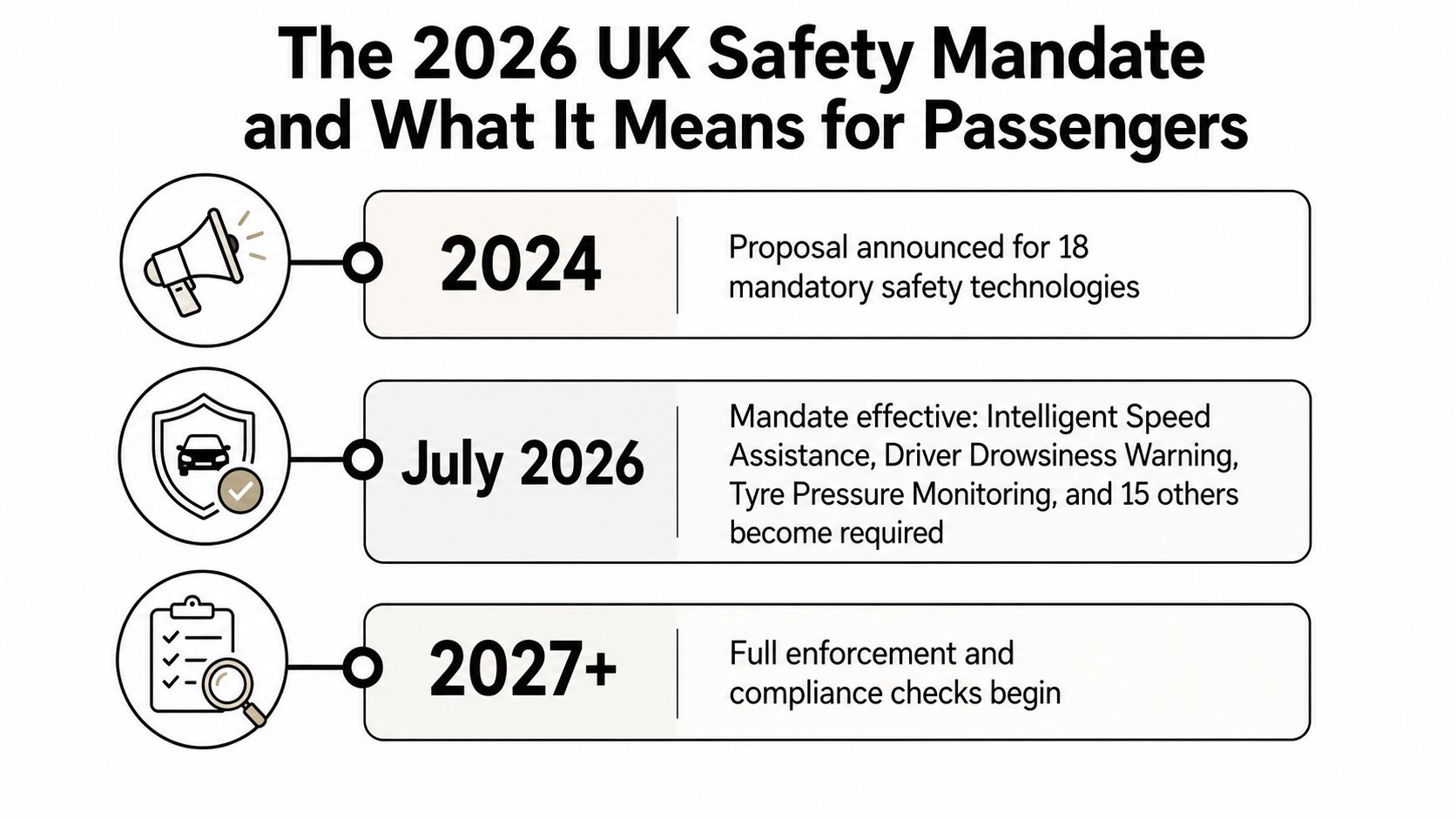
The mandate establishes a safety baseline, not a promise that every vehicle will prevent every incident. Emergency braking and blind-spot information can support collision avoidance. Other systems monitor vehicle condition, driver state, or events after a collision, so their benefits are less visible to passengers.
Regulation doesn't mean every vehicle changes overnight
The phase-in period matters on real UK roads. Vehicles already in service will not receive identical equipment at once, and the model, approval date, and specification can affect what is fitted. A newer registration alone does not confirm every mandated feature.
Ask the provider which vehicle is assigned and what equipment it has. You can also review the legal requirements for private hire vehicles when comparing a transfer service's stated obligations with its practical arrangements.
Maintenance remains part of the safety picture. A fault warning needs attention, a tyre-pressure alert points to a problem that still requires correction, and an event data recorder helps explain an incident after it occurs rather than preventing it.
Why active use deserves attention
UK reporting indicates that some drivers switch safety features off, including speed assistance and lane-keep assist. The same government reporting places this behaviour in a wider public-awareness and usage context.
Passengers do not need to control every setting or memorise dashboard symbols. They can expect the driver to understand the vehicle's systems, make informed choices, explain important limitations, and respond to fault warnings. This is the practical gap between equipment being installed and passengers receiving its intended protection.
A useful question before boarding is: “Are the vehicle's safety systems operating, and would you act on a warning before departure?” Compliance sets the floor. Responsible operation turns that baseline into meaningful protection.
Your Passenger Safety Checklist for Evaluating Transfer Providers
A transfer provider should make safety questions easy to ask. You can use the following checklist before booking, at pickup, and once seated. It's designed for practical verification, not technical inspection.
Before you book
- Ask about the assigned vehicle. Request the vehicle type or class and ask whether it provides seat belts for every passenger. If the provider can't explain what will arrive, ask how substitutions are handled.
- Discuss passenger needs early. Tell the provider about children, mobility requirements, luggage, and the number of travellers. Child restraint arrangements should be confirmed before the journey, not improvised at the airport.
- Ask about maintenance. You don't need a workshop report, but the provider should be able to explain that safety systems, tyres, lights, brakes, and restraints are inspected as part of normal fleet maintenance.
- Check the driver standard. Ask whether drivers are licensed, insured, and trained for passenger transport. A professional driver should understand UK road conditions and know that ADAS supports, rather than replaces, active driving.
When the vehicle arrives
Look first at the things you can verify without tools. Check that the seat belt webbing isn't twisted, frayed, or trapped in the seat, and confirm that the buckle clicks securely. Each passenger should have enough space to sit upright with the belt positioned across the body.
Then observe the driver's preparation. A calm pre-departure check, safe luggage handling, and attention to pickup surroundings indicate an organised operation. Dashboard warnings shouldn't be ignored, especially alerts involving brakes, tyres, airbags, or sensor faults.
A useful boundary: You're entitled to ask for a vehicle or arrangement that allows every passenger to travel restrained and comfortably. Raising that issue isn't confrontational.
During the journey
Keep your belt fastened, including on short urban sections. Don't assume a low speed makes restraint unnecessary, and don't treat a quiet dashboard as proof that every system is functioning perfectly.
Red flags include a driver who dismisses safety questions, encourages passengers to travel without belts, drives aggressively around roundabouts, or appears confused by repeated vehicle warnings. If something feels unsafe, ask the driver to stop in a suitable safe location and contact the provider.
What Safety Standards You Can Expect from EC Minibus
For travellers comparing transfer providers, EC Minibus presents its service around licensed and insured drivers, modern vehicles, and door-to-door transport between Heathrow, London hotels, and UK cruise ports. Its published service information also describes meet and greet at Heathrow, flight and cruise monitoring, fixed pricing, luggage assistance, and support for routes including Southampton, Dover, Portsmouth, Tilbury, and St Pancras International.
Those service details matter to safety because a well-organised transfer reduces avoidable pressure. Flight monitoring can help coordinate a changed arrival, while meet and greet assistance can make it easier for tired passengers to locate the correct driver and vehicle. Clear booking information also gives families and groups an opportunity to raise seating, child-restraint, and luggage questions before travelling.
Questions to put to the provider
Ask which vehicle will be used, whether every passenger position has a seat belt, and how the company handles a vehicle substitution. You can also ask how drivers are trained to use ADAS, what happens when a dashboard warning appears, and whether the vehicle undergoes regular maintenance.
EC Minibus requires passengers to use seat belts at all times under its terms and conditions. That policy gives passengers a clear expectation from the outset. It should still be paired with sensible checks at pickup, because the passenger needs to see that the belt is accessible and usable.
Driver competence is part of the safety picture. EC Minibus's professional driver training information offers a relevant point of comparison when evaluating how a transfer company describes its people and operating standards. Look for specific information rather than broad promises about friendliness or punctuality.
A provider that welcomes questions is easier to assess. Before booking, use the online process or support channel to confirm your passenger requirements, then keep the confirmation available on your travel day. The aim isn't to create anxiety. It's to make sure comfort, timing, and protection are considered together.
Travelling with Confidence on UK Roads
An international cruise passenger arriving at Heathrow may have spent hours in the air before starting the journey to Southampton. They may not know the difference between a lane warning and a system fault, but they can still ask whether every traveller has a working seat belt, whether child seating has been arranged, and whether the driver is prepared for UK roads.
That short conversation changes the passenger's role. Instead of judging safety only by appearance, the traveller checks the essentials and chooses a provider that gives clear answers. Understanding vehicle safety features isn't about expecting technology to eliminate risk. It's about recognising the layers of protection and knowing when human attention remains decisive.
Quick passenger summary
- Confirm seat belts for every traveller.
- Arrange child restraints before pickup.
- Ask about maintenance and driver training.
- Treat ADAS as assistance, not autonomous driving.
- Report inaccessible belts, serious warnings, or unsafe driving promptly.
Book your Heathrow, London, or UK cruise-port transfer with a provider that makes passenger protection part of the conversation. EC Minibus offers private door-to-door transfers with meet and greet, monitored travel arrangements, licensed and insured drivers, and modern comfortable vehicles, so contact the team before travel to confirm the safety requirements for your group.